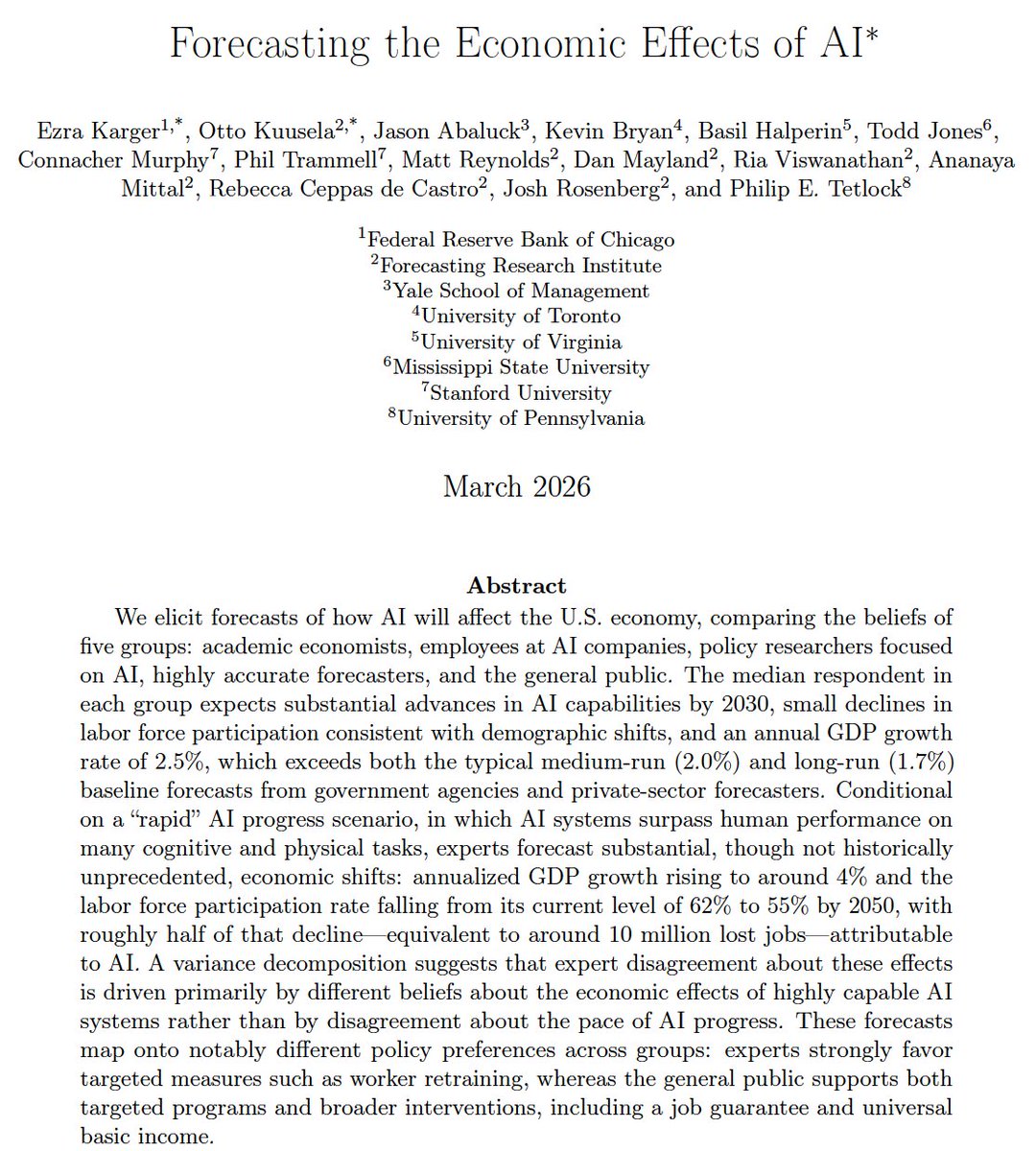
“80% of wealth held by the top 10% (highest since 1939)” – yet no major growth in GFP says a new projection on impacts of AI from @PTetlock and others.
SOCIETY
-

Tri-System Theory: AI’s Impact on Human Reasoning and Cognitive Autonomy
By
–
Thinking—Fast, Slow, and Artificial: How AI is Reshaping Human Reasoning and the Rise of Cognitive Surrender papers.ssrn.com/sol3/papers.… ✍️Steven D. Shaw & Gideon Nave via @SSRN @Wharton 👉 "We introduce Tri-System Theory, extending dual-process accounts of reasoning by positing System 3: artificial cognition that operates outside the brain" 👉 "System 3 can supplement or supplant internal processes, introducing novel cognitive pathways" 👉 "Across studies, participants with higher trust in AI and lower need for cognition and fluid intelligence showed greater surrender to System 3" 💡 "Tri-System Theory thus characterizes a triadic cognitive ecology, revealing how System 3 reframes human reasoning and may reshape autonomy and accountability in the age of AI" @Corix_JC @ahier @sim010101 @maponi @sallyeaves @CEO_AISOMA @dinisguarda @JagersbergKnut @FernandaKellner @PVynckier @EstelaMandela @sulefati7 @ChuckDBrooks @SusanHayes_ @theomitsa @TarakRindani @FrRonconi @Nicochan33 @JoannMoretti @Khulood_Almani @TheAIObserverX @pchamard @mikeflache @TysonLester @smaksked @amalmerzouk @Analytics_699 @MaryRich78 @NathaliaLeHen @sminaev2015 @WillyRayNick @RLDI_Lamy
→ View original post on X — @sallyeaves, 2026-04-01 13:52 UTC
-
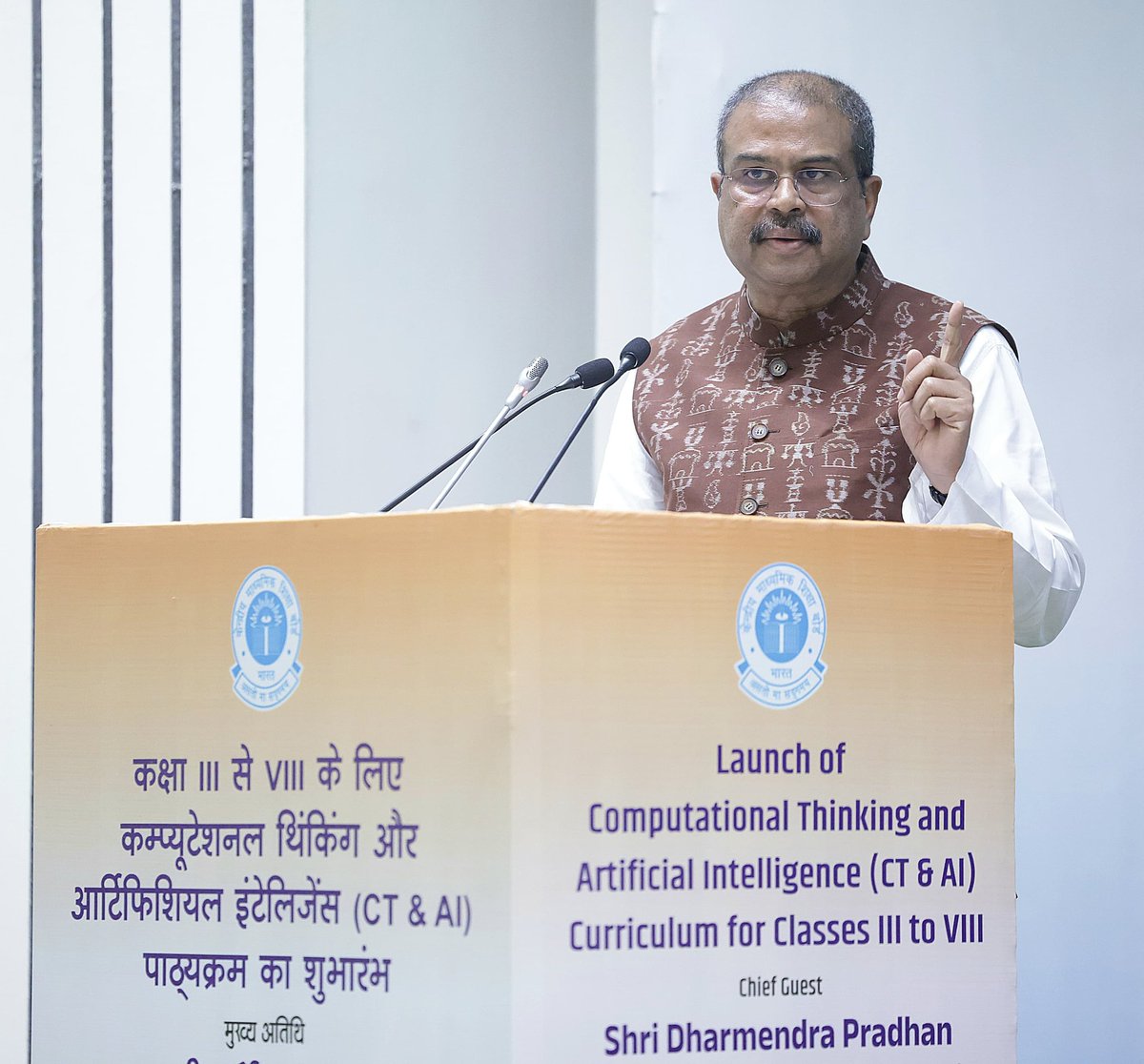
India Launches AI and Computational Thinking Curriculum for Classes III-VIII
By
–

At the launch of the Computational Thinking & Artificial Intelligence (CT & AI) Curriculum of the Central Board of Secondary Education, in the presence of Shri Dharmendra Pradhan, a significant step was taken towards building a future-ready education ecosystem. The curriculum for Classes III to VIII formally introduces structured AI education at scale, supported by comprehensive modules, teacher handbooks and robust assessment frameworks, ensuring early exposure to emerging technologies. Aligned with the vision of “AI for Education, AI in Education,” the initiative aims to foster critical thinking, design orientation and innovation among young learners. #AIForEducation #DigitalIndia #FutureReady #Innovation #IndiaAI @AshwiniVaishnaw @jitinprasada @PIB_India @SecretaryMEITY @abhish18 @kavitabha @GoI_MeitY @_DigitalIndia @mygovindia @EduMinOfIndia @cbseindia29 @ncert
→ View original post on X — @officialindiaai, 2026-04-01 13:48 UTC
-

India Scales AI for Digital Governance and Public Infrastructure
By
–
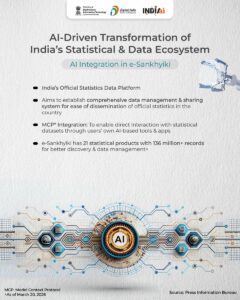
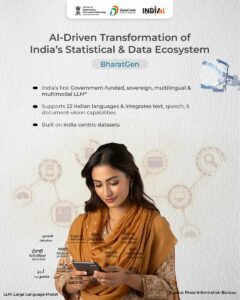
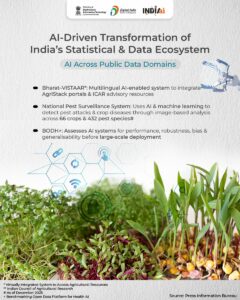
India is emerging as a powerful example of how #AI can be scaled to transform public digital infrastructure and strengthen governance at every level. 🇮🇳 From enabling smarter data ecosystems to enhancing service delivery, AI is driving efficiency, transparency, and impact across sectors. As India accelerates its digital journey, it is not just adopting AI, it is shaping how technology can serve citizens at scale. #DigitalIndia #AIforGovernance #TechForGood #PublicDigitalInfrastructure #Innovation @AshwiniVaishnaw @jitinprasada @PIB_India @SecretaryMEITY @abhish18 @kavitabha @GoI_MeitY @_DigitalIndia @mygovindia
→ View original post on X — @officialindiaai, 2026-04-01 13:31 UTC
-
AGI Achievement: AI Influencing Political Decisions Through Code
By
–
Quand on sera arrivé a "Madame Claude" et qu'ils auront developpé une maison close pour le code, et qu'elle maintiendra du code sexy, ainsi que des infos persos sur les politiques pour influencer leurs decisions, on aura atteint l'AGI.
-

AI Job Displacement: Artists, Writers, Musicians Need Protection Now
By
–
Either we accept this as a society, and set a precedent for allowing virtually all jobs to be replaced with almost no compensation. Or we speak up now. For artists. For writers. For musicians. For everybody.
-
UN Secretary-General Guterres visits India AI Impact Summit 2026
By
–
At the #IndiaAIImpactSummit 2026, UN Secretary-General António Guterres visited the UN Women India exhibition space at the JanAI Pavilion on 20 Feb ’26.
— IndiaAI (@OfficialINDIAai) 1 avril 2026
He was joined by Christine Arab, Regional Director, UN Women Asia & the Pacific, and Shri Anil Malik, Secretary, highlighting… https://t.co/88U3nBDeg1At the #IndiaAIImpactSummit 2026, UN Secretary-General António Guterres visited the UN Women India exhibition space at the JanAI Pavilion on 20 Feb ’26. He was joined by Christine Arab, Regional Director, UN Women Asia & the Pacific, and Shri Anil Malik, Secretary, highlighting the growing focus on inclusive, gender-responsive AI and innovation. A strong reminder that the future of AI must be equitable, inclusive and empowering for all. #IndiaAIImpactSummit #AIForAll #GenderEquality #DigitalInclusion #UNWomen @UN @UN_Women @unwomenindia UN Women India (@unwomenindia) #ICYMI: On 20 Feb’ 26, UN Secretary-General António Guterres visited the UN Women India exhibition space at the JanAI Pavilion, India AI Impact Summit 2026, alongside Christine Arab, Regional Director, UN Women Asia and the Pacific, and Shri Anil Malik, Secretary, @MinistryWCD — https://nitter.net/unwomenindia/status/2039302460913951162#m
→ View original post on X — @officialindiaai, 2026-04-01 12:40 UTC
-

Human And Machine: AI’s Future In Collaboration Not Replacement
By
–
Human And Machine: The Future Of #AI Lies In Collaboration, Not Replacement
by Sylvio Lindenberg @Forbes Learn more: https://
bit.ly/3PBZYB1 #ArtificialIntelligence #MachineLearning #ML #DL -
History of AI extinction concerns from Čapek’s robots to modern times
By
–
(Depending on how we mark the history, I think I'd currently point to the lineage of extinction concerns as beginning with Karel Čapek in 1920. Čapek coined the word 'robot', meaning 'worker', in a play R.U.R. about how these unpaid robots had rebelled and wiped out humanity. Čapek's politics were not particularly right-wing, if that part matters much to you; he was a staunch anti-fascist in the 1920s sense of that term. One can obviously point to even earlier precedents like Frankenstein, or the Golem of Prague. To mark a "starting point" of any real intellectual history is usually rather arbitrary. But neither Frankenstein nor the Golem constitute a mass-manufactured race of unpaid servants, who then turn on humanity as a whole and exterminate it; so I'm picking Rossum's Universal Robots. Čapek's story was mostly an ungrounded what-if; it was simply taken for granted that the Robots (workers) were sufficiently human-derived or human-imitative to resent working for free. I think R.U.R. nonetheless can be declared the start of the intellectual lineage even if it doesn't make a careful argument; because R.U.R. makes the fair and obvious point that if you are manufacturing a powerful new servant species, it could perhaps turn on you and destroy you. This is a reasonable thing to worry about even before you start looking into further details of careful arguments! Čapek did not need to be a secret tool of (nonexistent) robot manufacturers looking to pump their stock prices, to observe that building a powerful new sapient race, supposedly to serve humans, might have some unpleasant consequences. It's in fact an obvious sort of concern; which is why historically speaking the word "robot" was coined back when "computer" still meant a human who worked a mechanical calculator. The very first story about "robots", manufactured workers, observed that such a race of manufactured beings might possibly turn on humans and wipe them out. Some later key figures in working out more detailed reasons for concern, beyond R.U.R.'s what-if, would on my accounting include the editor John Campbell, the writer Isaac Asimov, and the academic mathematicians I. J. Good and Vernor Vinge. All of them lived far too early to be secret clever tools of AI companies. The first two wrote before ENIAC. And of course I started on this a couple of decades before the current AI companies as well.)
→ View original post on X — @esyudkowsky, 2026-04-01 02:33 UTC