But it’s not that hard to replicate. Anyone with 100M and the will to do it can create a rather good model from anywhere on earth. Good actor, or bad actor.
SAFETY
-
First Principles Thinking for AI Intervention Analysis
By
–
Don't look for things that just sound similar and assume you can borrow what you know from there. Think deeply, from first principles, and considering beyond 1st order effects, about what interventions will do.
-
Frontier Model Licensing Proposals Car Analogy Critique
By
–
Your attempt to align frontier model licensing proposals with car licensing is confusing two things that happen to use the same words but are *totally* different. This is a lazy analogy.
-
Misinterpreting AI Risk Discourse: Assumption versus Reality
By
–
You say it's important "we *also* talk about the very real risks that many people… see and believe we need to mitigate"; and yet, I explicitly say lets *assume* those risks are real in the first minute of my talk. You're responding to what you assume you hear, not what's real
-
Regulatory Capture Worsens AI Concerns Rather Than Solves
By
–
Of course concerns are warranted. But regulatory capture is not a solution to those concerns. It makes them worse.
-
Why LLMs Enable Malicious Users More Than Other Tech Fields
By
–
Why does LLMs give access to evil/stupid script kiddies? Why are virology students not evil/stupid script kiddies?
-
Democratizing Virology Skills: Ethics and Access Questions
By
–
So why is it not OK to democratise access to virology skills? Why are those that learn it now OK to have this knowledge?
-
Scientists Lack Risk Management Expertise for AI Safety
By
–
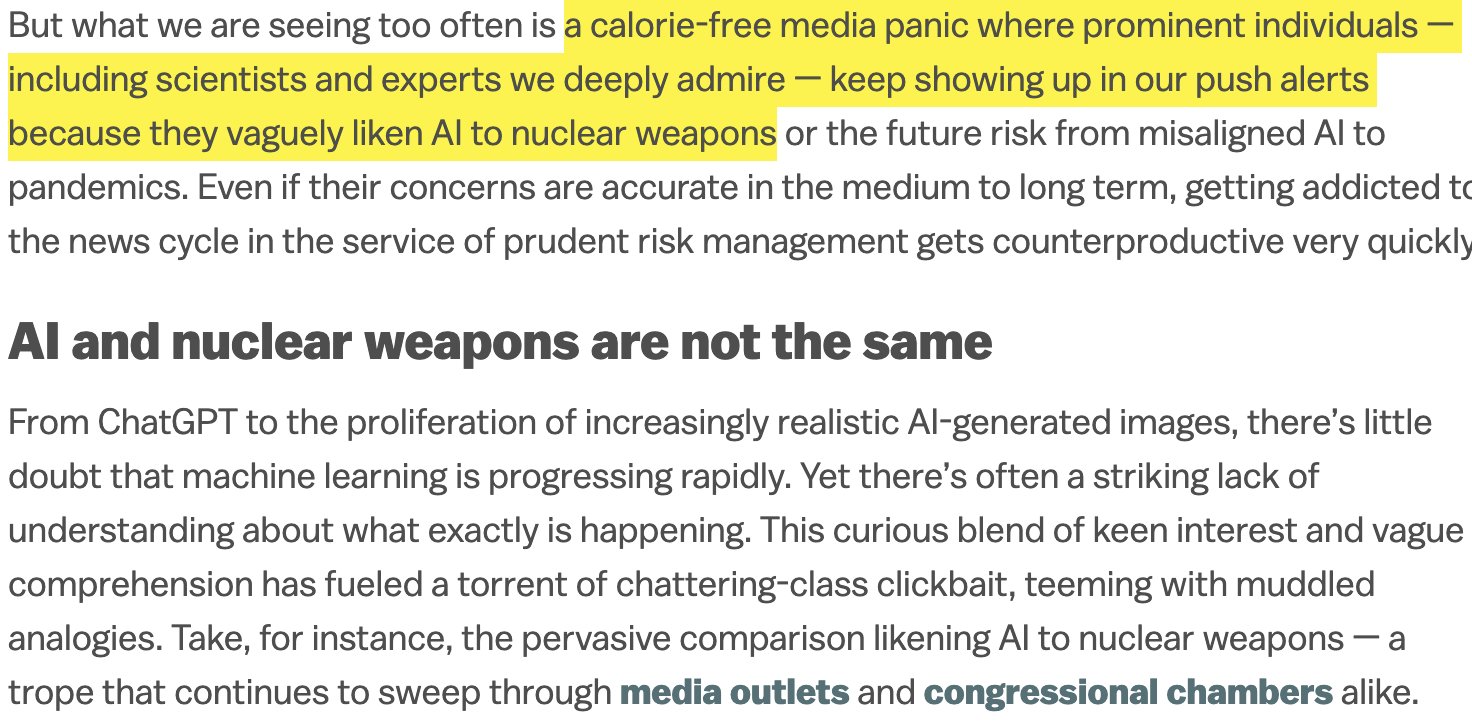
Whilst @geoffreyhinton is a *brilliant* scientist, scientists are *not* the people to teach us about risk management. The project manager for the Nuclear Information Project has already warned us about these "muddled analogies", leading to a "calorie-free media panic".
-
AI Safety Organizations Notably Absent from Research Signatories
By
–
It doesn't appear in the arxiv paper, but does appear (briefly) in the addendum. Interestingly, none of the usual AI Safety organizations appear as signatories to this.
-
Differential Risk Treatment in AI Harm Assessment
By
–
These seems premised on the idea that all things that could cause harm should be treated identically – is that correct? If so, I don't see how that is true. And if not, I don't understand what is being claimed.