If an LLM is saying something to a human that it knows is false, this is very bad and is the top priority to fix. After that we can talk about when it's okay for an AI to keep quiet and say other things not meant to deceive. Then, discuss if the LLM is thinking false stuff.
SAFETY
-

Unitree Robots Vulnerable to Bluetooth Hijacking Exploit
By
–
8. Unitree robots hacked Researchers exposed “UniPwn,” a Bluetooth exploit that lets attackers hijack robot dogs and humanoids, raising major robotics security concerns.
-
Mastering Prompt Engineering Fundamentals
By
–
The meta-lesson from reverse-engineering Anthropic's library:
Prompt engineering isn't about clever tricks. It's about clear communication of: WHO should respond (role)
WHAT they should do (task)
HOW they should do it (process)
WHAT format to use (structure)
WHAT to avoid -
Error Handling in AI Prompts
By
–
Ninth discovery: error handling is built into prompts. Anthropic anticipates edge cases and tells Claude how to handle them. If the input data is:
– Incomplete: State what's missing and make reasonable assumptions
– Contradictory: Identify the contradiction and -
Anthropic’s Thinking Tags for Complex Reasoning
By
–
Fifth discovery: they use thinking tags for complex reasoning. When the task requires multi-step logic, Anthropic explicitly asks Claude to show its work. Before answering, wrap your reasoning in tags.
Include:
– Assumptions you're making
– Alternative -

Anthropic’s granular role definition technique
By
–
Third technique: role definition goes way deeper than "you are an expert." Anthropic specifies expertise granularly. Weak role definition: You are a software engineer. Anthropic's method: Senior backend engineer with expertise in:
– Distributed systems architecture
– -

Separating Thought and Output in Prompts
By
–
Second pattern: they separate thinking from output. Most prompts blend everything together. Anthropic isolates the reasoning process. Standard prompt: Analyze this data and create a report. Anthropic's structure: First, analyze the data following these steps:
1. -
Claude’s XML tag obsession revealed
By
–
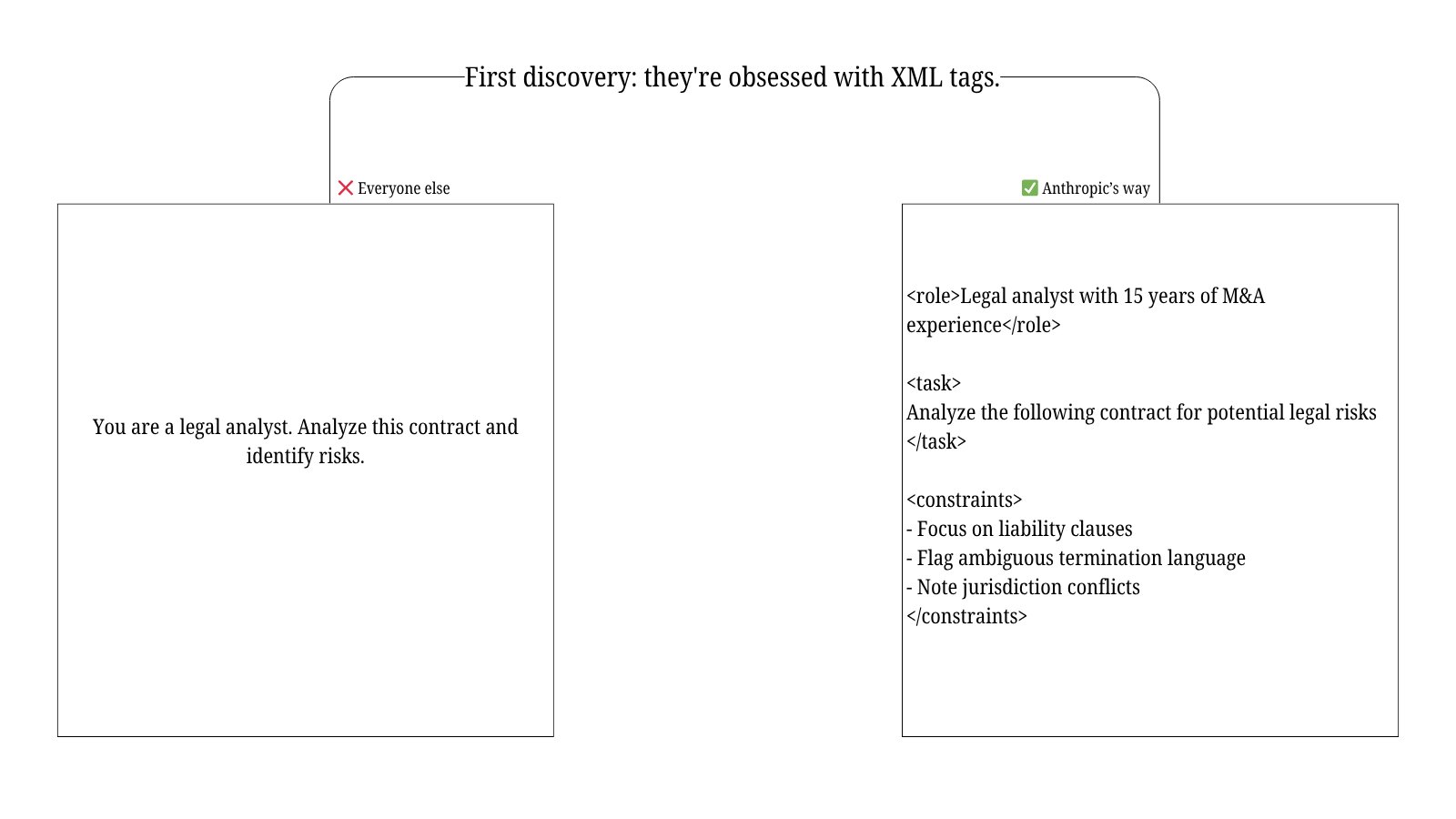
First discovery: they're obsessed with XML tags. Not markdown. Not JSON formatting. XML. Why? Because Claude was trained to recognize structure through tags, not just content. Look at how Anthropic writes prompts vs how everyone else does it: Everyone else: You are a legal
-
Anthropic’s Secret Prompting Techniques Revealed
By
–
Anthropic's internal prompting style is completely different from what most people teach. I spent 3 weeks analyzing their official prompt library, documentation, and API examples. Here's every secret I extracted
-
Diverse prompts enhance model reasoning
By
–
this is also backed by work in Dipper (prompt ensembles) showing that feeding multiple diverse prompts in parallel improves reasoning and reduces blind spots. and the more you mix prompt styles – contrast, random pivoting, persona shifts – the more the model “sees” new