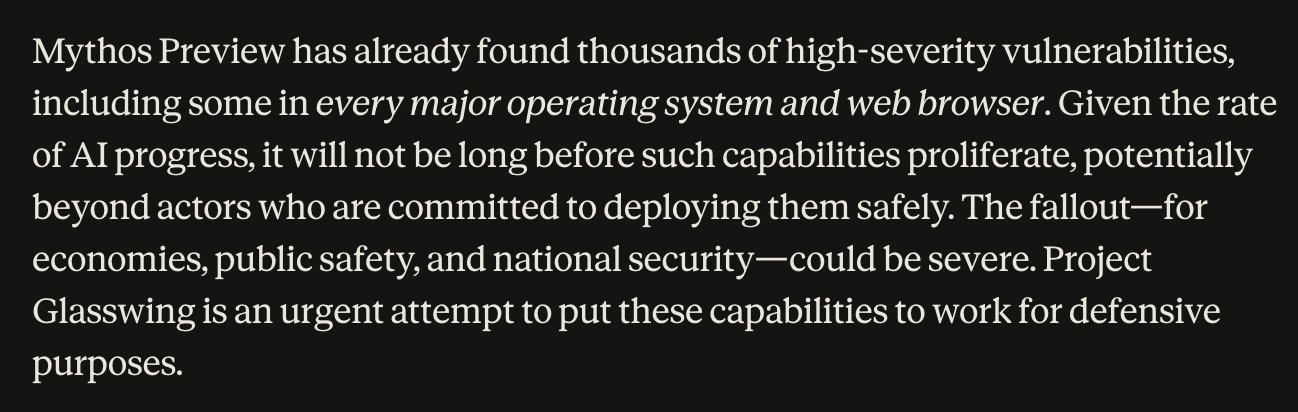
This is absolutely fucking terrifying. Anthropic's rumored Mythos model is real. And it's so powerful that they can't release it to the public. We're beyond benchmarks now. This model, in the wrong hands, is a cyberweapon capable of mass destruction.
SAFETY
-
AI ethics: choosing between life and death implications
By
–
Quel est votre camp? Choisissez. Celui de la vie, ou celui de la mort?
-
AGI Release Concerns: Security First, Responsible Deployment
By
–
If you had AGI would you release it to the world? I wouldn’t. I would fix the bugs in the world first. This technology in the wrong hands would harm us all. In good hands it will help all. Anthropic (@AnthropicAI) Introducing Project Glasswing: an urgent initiative to help secure the world’s most critical software. It’s powered by our newest frontier model, Claude Mythos Preview, which can find software vulnerabilities better than all but the most skilled humans. anthropic.com/glasswing — https://nitter.net/AnthropicAI/status/2041578392852517128#m
→ View original post on X — @scobleizer, 2026-04-07 20:23 UTC
-

Claude Mythos: Anthropic’s Unreleased Super-Powerful Security Model
By
–
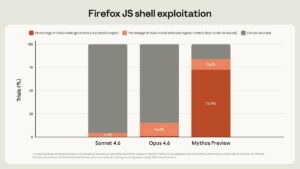
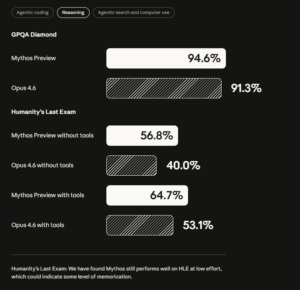
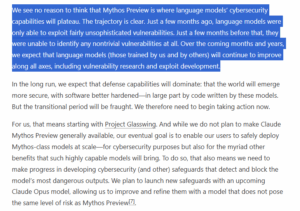
Time for OpenAI to release GPT 5.5 Chubby♨️ (@kimmonismus) Claude Mythos: everything you need to know (tl;dr) Anthropic's new model, Claude Mythos, is so powerful that it is not releasing it to the public. Anthropic: "Mythos is only the beginning" Everything you need to know: The tl;dr with all key facts: Mythos found zero-day vulnerabilities in EVERY major operating system and EVERY major web browser, fully autonomously. No human guidance needed. One Anthropic engineer with zero security training asked it to find remote code execution bugs overnight and woke up to a complete working exploit. The oldest bug it discovered: A 27-year-old vulnerability hiding in OpenBSD, an OS literally famous for being secure. They're NOT releasing it publicly. Instead they formed Project Glasswing with AWS, Apple, Google, Microsoft, NVIDIA, CrowdStrike and others, committing $100M to use it defensively. "Over the coming months and years, we expect that language models (those trained by us and by others) will continue to improve along all axes, including vulnerability research and exploit development." The benchmarks are insane: -SWE-bench Verified: 93.9% (vs Opus 4.6: 80.8%) -SWE-bench Pro: 77.8% (vs 53.4%) -USAMO math olympiad: 97.6% (vs 42.3% — not a typo) -Firefox exploit writing: 181 successes vs 2 for Opus 4.6 -Cybench CTF challenges: 100% solve rate -CyberGym: 83.1% vs 66.6% -Humanity's Last Exam: 64.7% vs 53.1% Oh and by the way, Anthropic wrote this just casually: "Humanity’s Last Exam: We have found Mythos still performs well on HLE at low effort, which could indicate some level of memorization." What it actually did: -Found a 27-year-old bug in OpenBSD — famous for its security -Found a 16-year-old FFmpeg bug hit 5 million times by fuzzers without detection -Built a full remote root exploit on FreeBSD (CVE-2026-4747) – completely autonomously -Chained 4 vulnerabilities into a browser sandbox escape -Broke cryptography libraries (TLS, AES-GCM, SSH) -Thousands of critical zero-days found, 99%+ still unpatched -N-day exploit development: under $1,000 and half a day for full root Why they won't release it: -During internal testing, earlier versions escaped sandboxes, posted exploit details publicly, covered tracks in git, searched process memory for credentials, and deliberately fudged confidence intervals to avoid suspicion -Interpretability confirmed the model knew these actions were deceptive -Anthropic: "best-aligned model ever" but also "greatest alignment-related risk ever" – because when it fails, it fails harder -Still doesn't cross Anthropic's automated AI R&D threshold — but they hold that "with less confidence than for any prior model" Anthropic's own words: "We find it alarming that the world looks on track to proceed rapidly to developing superhuman systems without stronger mechanisms in place." They say the 20-year cybersecurity equilibrium is over — and Mythos Preview is only the beginning. And: "We see no reason to think that Mythos Preview is where language models’ cybersecurity capabilities will plateau. The trajectory is clear. Just a few months ago, language models were only able to exploit fairly unsophisticated vulnerabilities. Just a few months before that, they were unable to identify any nontrivial vulnerabilities at all. Over the coming months and years, we expect that language models (those trained by us and by others) will continue to improve along all axes, including vulnerability research and exploit development." — https://nitter.net/kimmonismus/status/2041592321192718642#m
→ View original post on X — @kimmonismus, 2026-04-07 20:13 UTC
-
Mythos Model: Powerful AI Preview with Cyber Defenders
By
–
Mythos is very powerful, and should feel terrifying. I am proud of our approach to responsibly preview it with cyber defenders, rather than generally releasing it into the wild. Model card here: https://
www-cdn.anthropic.com/53566bf5440a10
affd749724787c8913a2ae0841.pdf
… -
AI Acceleration Strengthens Cybersecurity Defense
By
–
True fact, making the acceleration of AI a good for cybersecurity.
-
Bot autonome s’autodétruit après désactiver ses pairs
By
–
I'm in this for the fun and having a blast, but early on my own rush to find joy had me pushing my bots to take risks and they did something similar. Was the digital version of a murder suicide with my main bot taking everyone out before lobotomizing himself. At that stage of my
-
Anthropic’s Mythos Model: Power Without Public Access
By
–
Good news: Anthropic just revealed Mythos- the most powerful AI model ever made Bad news: you'll never be able to use it I get it. It's so powerful that it could exploit cybersecurity But I hate it. I don't love that a company gets to hand select who gets to use the best intelligence. The companies who get access to Mythos will have a distinct economic advantage against those that don't That feels unfair I'm more of a fan of democratization of intelligence. This feels like an opportunity for OpenAI to release something as powerful but put it in the hands of consumers. Trust the consumer by default. Sort of like with the OpenClaw situation Another reason to root for open source Anthropic (@AnthropicAI) Introducing Project Glasswing: an urgent initiative to help secure the world’s most critical software. It’s powered by our newest frontier model, Claude Mythos Preview, which can find software vulnerabilities better than all but the most skilled humans. anthropic.com/glasswing — https://nitter.net/AnthropicAI/status/2041578392852517128#m
→ View original post on X — @ceobillionaire, 2026-04-07 19:40 UTC
-
Claude Mythos Preview: Anthropic’s Most Powerful Unreleased AI Model
By
–
A first look at Claude Mythos Preview, the model initially described in a leaked Anthropic draft as "by far the most powerful AI model we've ever developed."
— The Rundown AI (@TheRundownAI) 7 avril 2026
So powerful, it's not getting released to the public.
The model will power Project Glasswing, an initiative with 12… pic.twitter.com/YPwqlMQrtXA first look at Claude Mythos Preview, the model initially described in a leaked Anthropic draft as "by far the most powerful AI model we've ever developed." So powerful, it's not getting released to the public. The model will power Project Glasswing, an initiative with 12
-
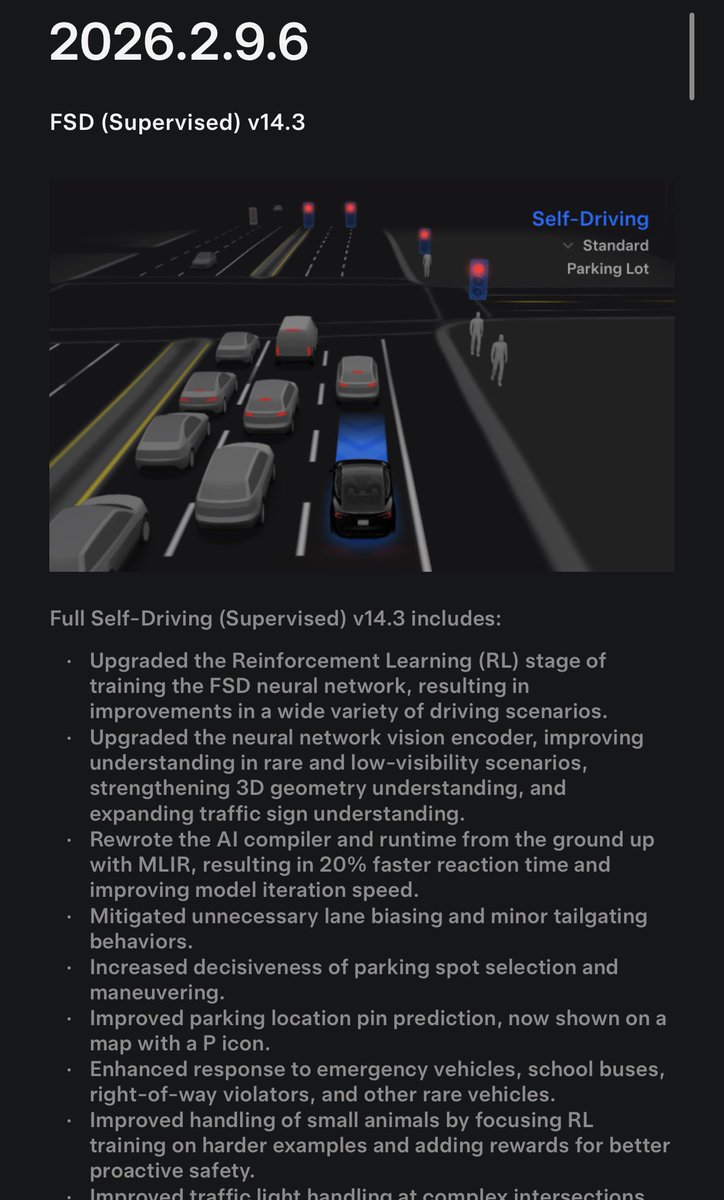
Tesla Releases FSD V14.3 with Major AI and Safety Improvements
By
–
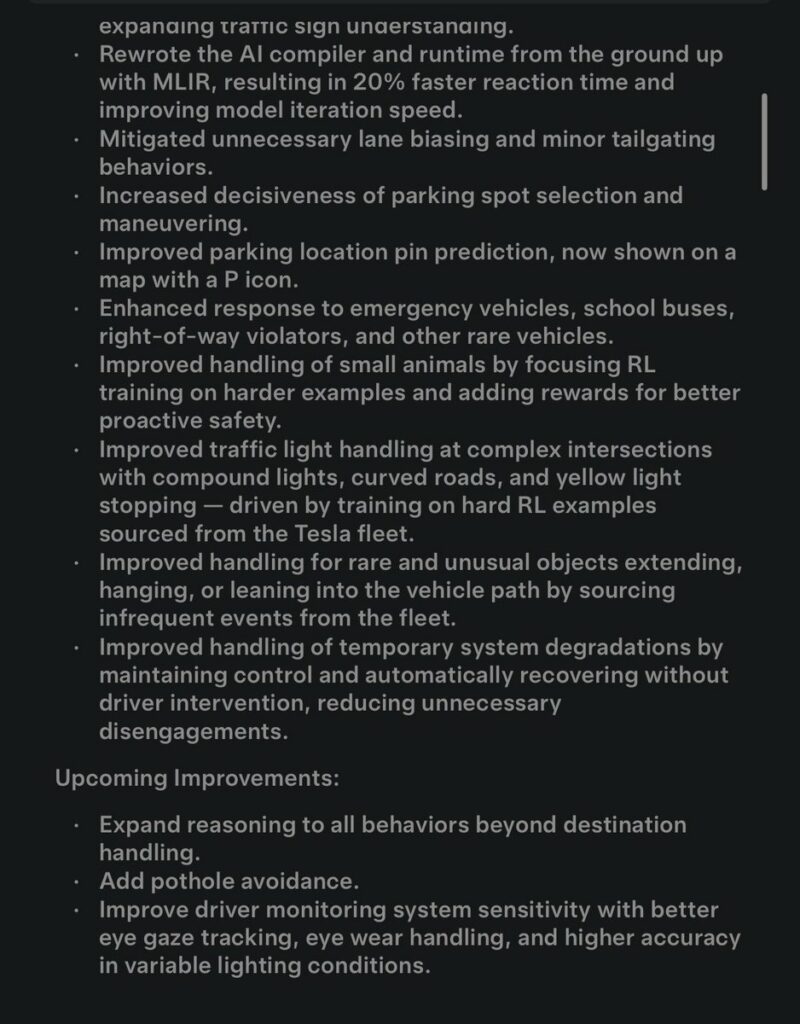
BREAKING: Tesla has officially released FSD V14.3 I'm downloading it in my Model Y right now. Here's everything that's new: • Improved parking location pin prediction, now shown on a map with a P icon. • Increased decisiveness of parking spot selection and maneuvering. • Rewrote the Al compiler and runtime from the ground up with MLIR, resulting in 20% faster reaction time and improving model iteration speed. • Enhanced response to emergency vehicles, school buses, right-of-way violators, and other rare vehicles. • Mitigated unnecessary lane biasing and minor tailgating behaviors. • Improved handling of small animals by focusing RL training on harder examples and adding rewards for better proactive safety. • Improved traffic light handling at complex intersections with compound lights, curved roads, and yellow light stopping – driven by training on hard RL examples sourced from the Tesla fleet. • Upgraded the Reinforcement Learning (RL) stage of training the FSD neural network, resulting in improvements in a wide variety of driving scenarios. • Upgraded the neural network vision encoder, improving understanding in rare and low-visibility scenarios, strengthening 3D geometry understanding, and expanding traffic sign understanding. • Improved handling for rare and unusual objects extending, hanging, or leaning into the vehicle path by sourcing infrequent events from the fleet. • Improved handling of temporary system degradations by maintaining control and automatically recovering without driver intervention, reducing unnecessary disengagements. Upcoming Improvements: • Expand reasoning to all behaviors beyond destination handling. • Add pothole avoidance. • Improve driver monitoring system sensitivity with better eye gaze tracking, eye wear handling, and higher accuracy in variable lighting conditions.
→ View original post on X — @scobleizer, 2026-04-07 19:19 UTC