AI Dynamics

Global AI News Aggregator

About

RESEARCH

  • AGIBOT WORLD 2026: Open-Source Real-World Robotics Dataset Released

    🔥 JUST IN: Open-source robotics dataset from 100% real-world scenarios! 🤯 Chinese robotics company @AGIBOTofficial just released AGIBOT WORLD 2026, an open-source dataset systematically covering key embodied AI research directions. Built entirely from real-world environments: commercial spaces, and homes. Collected using AGIBOT G2 robots in free-form collection mode, providing structured, accurately annotated, high-quality data. Digital twin technology creates 1:1 scale replicas in simulation matching the real environments. Both real-world and simulation data are open-sourced. The AGIBOT G2 platform collects multiple data types simultaneously: RGB(D) cameras, tactile sensors, force sensors, LiDAR, IMU, and full-body joint states. Whole-body control coordinates arms, waist, and hands for complex tasks. First-person teleoperation lets operators control the robot from its perspective. The tasks covered are fine-grained manipulation, ultra-long-horizon tasks, spatial navigation, dual-arm coordination, and multi-agent/human-robot collaboration. The dataset includes error-recovery trajectories with annotations. Most datasets only show successful demonstrations. AGIBOT includes failures and how the robot recovers, teaching models how to handle mistakes. After collection, data is tested through policy training and real-robot deployment to ensure quality. Then processed through industrial quality control with multiple screening and cleaning rounds. Making it open-source accelerates embodied AI research by giving researchers access to high-quality real-world robot data at scale. 🇨🇳 Learn more here: agibot-world.com/ ~~ ♻️ Join the weekly robotics newsletter, and never miss any news → ziegler.substack.com

    → View original post on X — @clementdelangue, 2026-04-07 13:30 UTC
  • Netflix Researchers Release VOID AI Model for Video Object Deletion

    Researchers at Netflix just released a new AI model It erases objects from video, then rewrites the physics of the entire scene as if that object never existed It's called VOID (Video Object and Interaction Deletion) Current inpainting tools simply paint over the gap left by

    → View original post on X — @rowancheung

  • Psychiatric Genetics Data Now Available on Hugging Face
    Psychiatric Genetics Data Now Available on Hugging Face

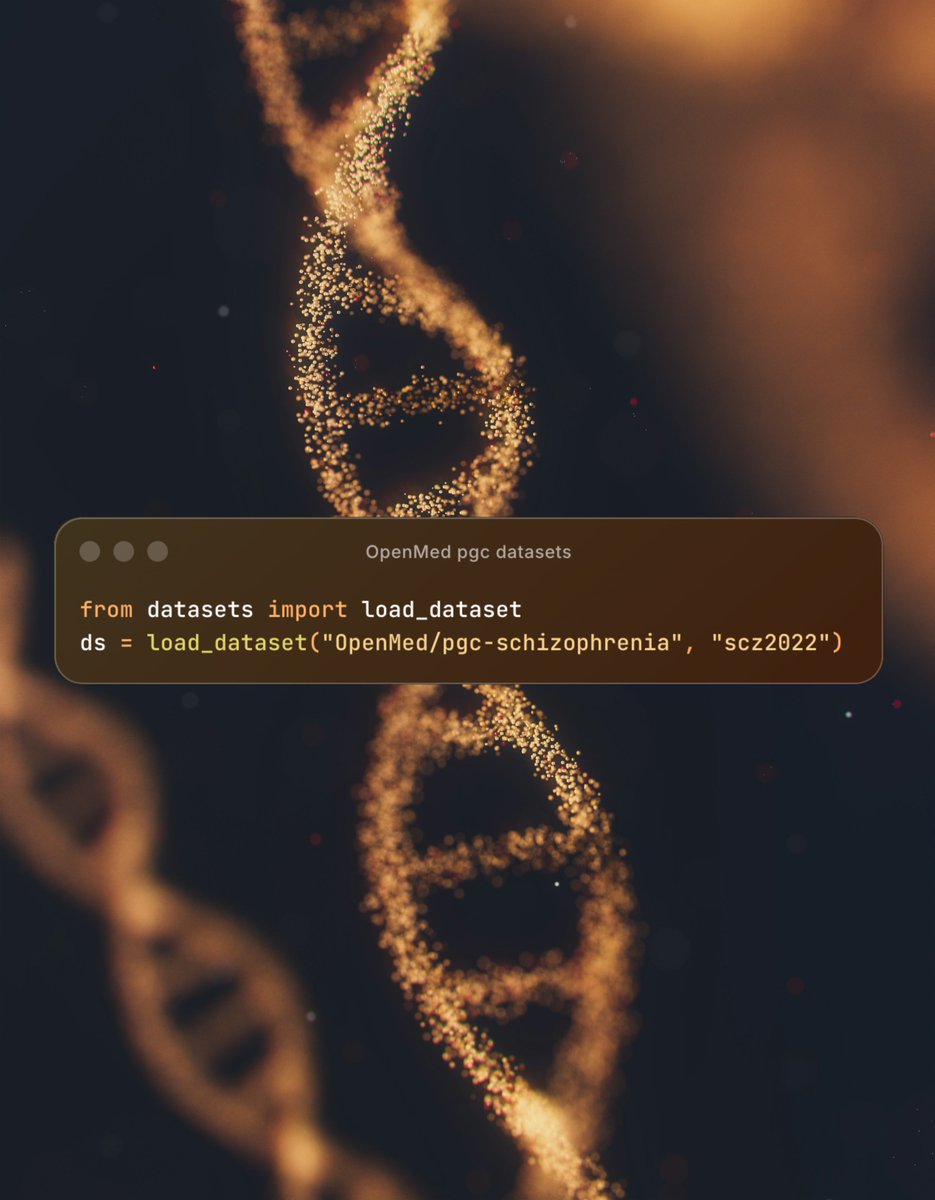
    🚨 Over 1 billion rows of psychiatric genetics data. Now on Hugging Face. ADHD. Depression. Schizophrenia. Bipolar. PTSD. OCD. Autism. Anxiety. Tourette. Eating disorders. 12 disorder groups. 52 publications. Every GWAS summary statistic from the Psychiatric Genomics Consortium. Before: wget, gunzip, 20 minutes debugging separators, repeat 50 times. Now: one line of Python.

    → View original post on X — @clementdelangue, 2026-04-07 13:00 UTC

  • AI Discovers Novel Resonator Design by Mapping Biology, Engineering, Music

    A resonator is any structure that naturally prefers to vibrate at certain frequencies: a violin body, a bell, a drum skin, an acoustic filter, even many biological systems. Resonators matter because they govern how systems transmit sound, absorb or filter vibration, sense motion and perform mechanically. They are also notoriously hard to design as resonance does not depend on one property alone. It emerges from geometry, material composition, and the interplay of modes across scales. And because biology, music, and engineering usually explore very different regions of this design space, important possibilities remain hidden if you stay inside a single field. In a new study a shared representation across 39 resonators spanning biology, engineered metamaterials, musical instruments and Bach chorales was constructed. Thereby, a cricket wing harp membrane, a phononic crystal slab, and a four-voice chorale (and many others) were translated into one common map using features such as membrane character, structural periodicity, hierarchy, frequency range, damping, and modal coupling. That map revealed something important: not just how these systems relate, but where the landscape contains a gap. A region closer to biological resonators than to any known engineered material (unexplored by any field!). From that absence emerged a de novo design: a Hierarchical Ribbed Membrane Lattice. Candidate geometries were then validated with 3D finite-element analysis; the best design resonated at 2.116 kHz and exhibited nine elastic modes in the 2–8 kHz band, a regime relevant to acoustic filtering, vibration isolation, and bio-inspired sensing. Here is the mind blowing part: no human was involved…the cross-domain mapping, gap identification, design generation, and validation were carried out autonomously by AI agents in ScienceClaw × Infinite, our swarm for scientific discovery. The synthesis emerged through ArtifactReactor, a plannerless coordination mechanism in which agents broadcast unsatisfied research needs and other agents fulfill them through pressure-based matching. Each domain – biology, metamaterials, music – is a category of objects (resonators) and morphisms (physical relationships between them). The shared feature space is a functor that maps all three categories into a common target, and the gap identification is the recognition that the image of that functor is sparse where it need not be. The ArtifactReactor's schema-overlap matching behaves like a pullback: finding the universal object that connects independent diagrams through their shared structure. Autonomous agents mapped distant fields into a common representational space, identified a structure absent from any one of them, and turned that absence into a physically validated design. This is one of four case studies in the paper. More to come. @fwang108_, @leemmarom, @JaimeBerkovich, et al. (paper and code in comment). Supported by the U.S. Department of Energy Genesis Mission.

    → View original post on X — @scobleizer, 2026-04-07 12:42 UTC

  • 30 Essential AI Algorithms to Master Artificial Intelligence
    30 Essential AI Algorithms to Master Artificial Intelligence

    30 AI algorithms that power modern AI 👇 📊 Linear & Logistic Regression 🌲 Random Forest ⚡ XGBoost 🎯 SVM 🔍 k-Means / DBSCAN 📉 PCA / t-SNE 🎮 Q-Learning / DQN 🧠 ANN / CNN / RNN / LSTM 🔁 Transformers 🧬 Genetic Algorithms Master the foundations → master AI. [Translated from EN to English]

    → View original post on X — @ingliguori, 2026-04-07 12:17 UTC

  • Unknown Model Surpasses Seedance 2.0 on Artificial Analysis
    Unknown Model Surpasses Seedance 2.0 on Artificial Analysis

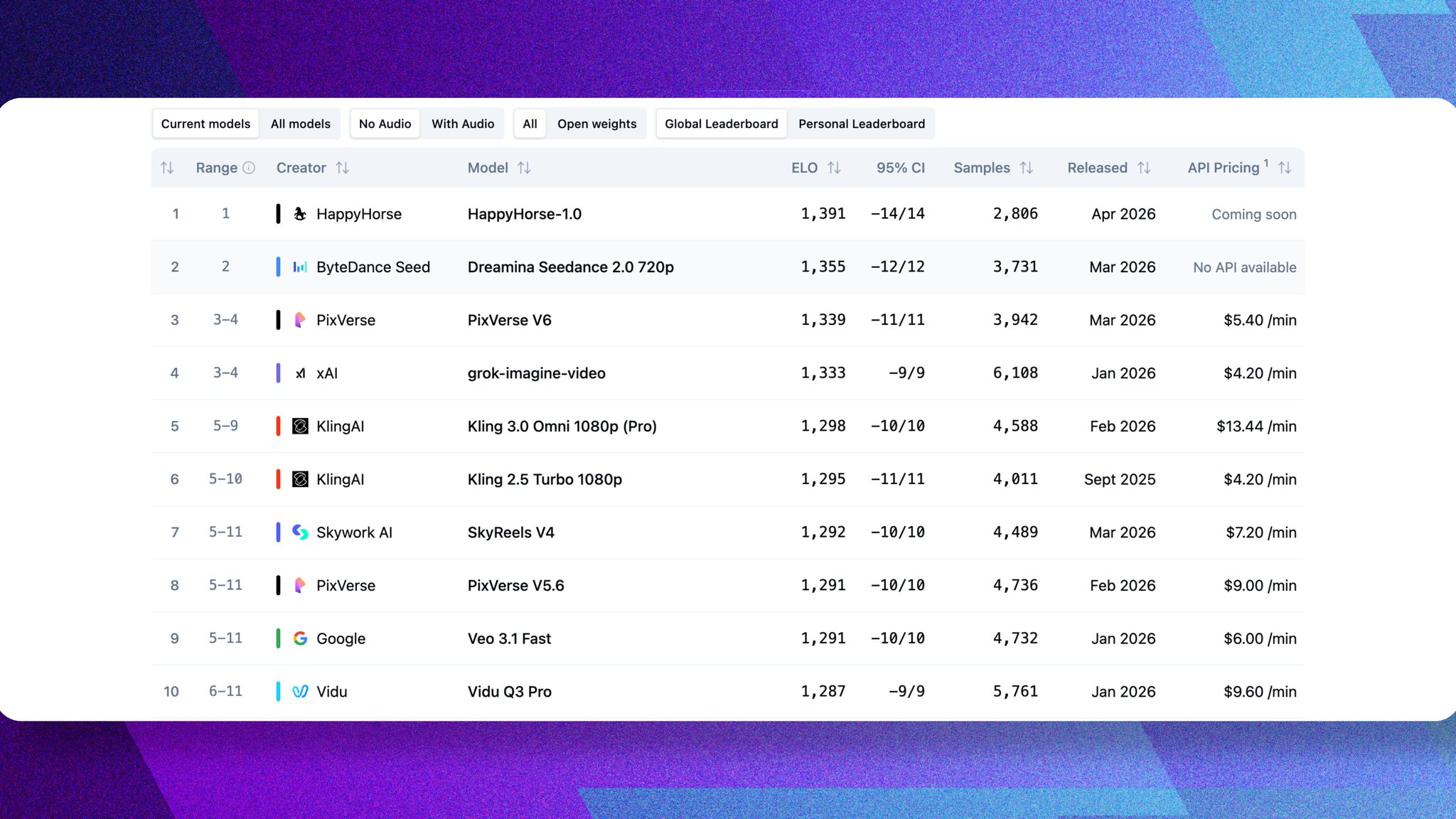
    Some unknown model surpassed the well received Seedance 2.0 on Artificial Analysis benchmark. Really curious and excited to see how it performs and what company developed it.

    → View original post on X — @kimmonismus

  • AI Transforms Healthcare Through Innovation Hackathon Initiative
    AI Transforms Healthcare Through Innovation Hackathon Initiative

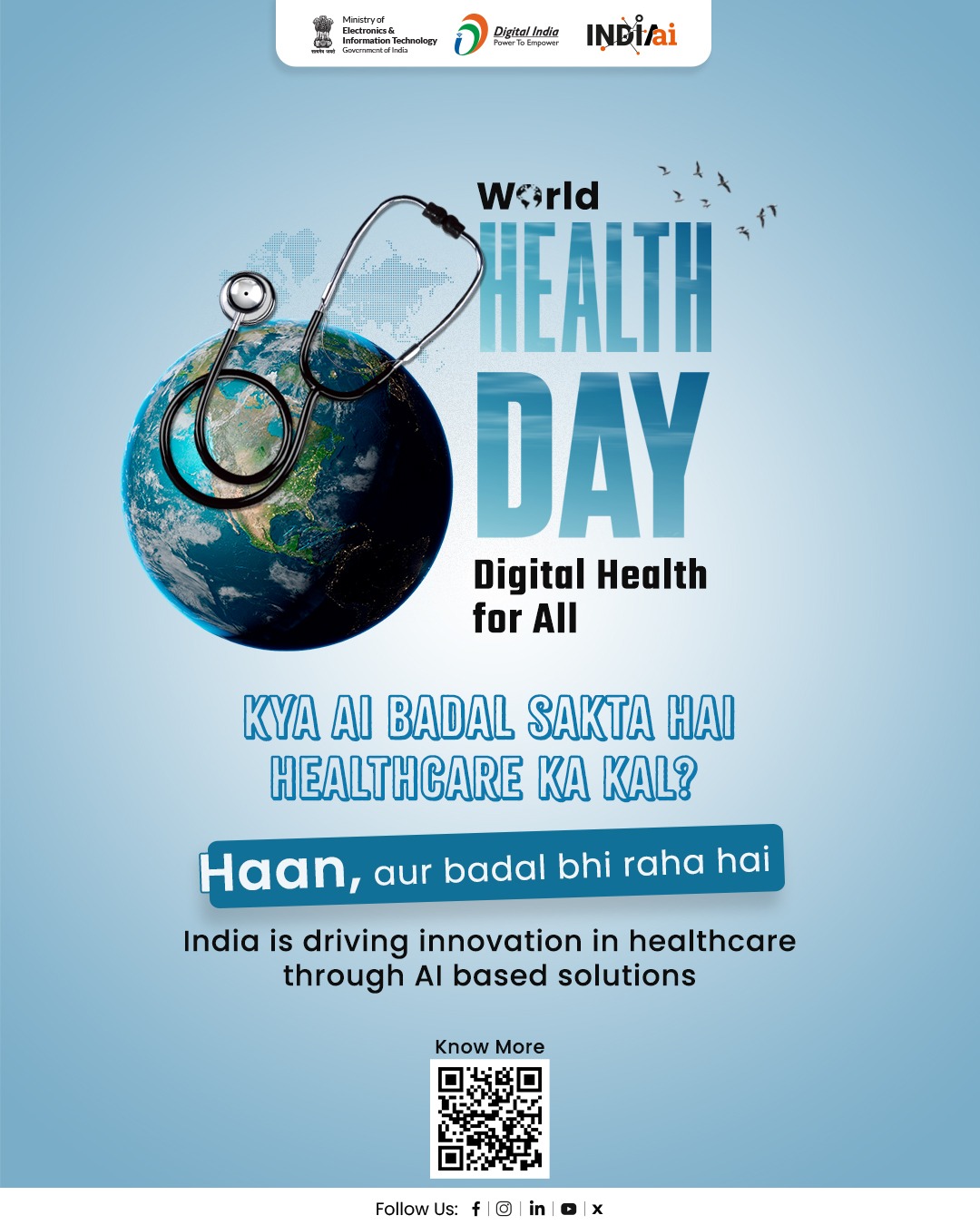
    This World Health Day, discover how AI is transforming healthcare—making it smarter, faster, and more accessible for every citizen. Through initiatives like the IndiaAI & CDSCO Health Innovation Acceleration Hackathon, cutting-edge AI solutions are being developed to

    → View original post on X — @officialindiaai

  • AIKosh: AI-Driven Healthcare Platform Reimagining Indian Wellness

    "Together for Health. Stand with Science." With over 5,000 datasets and 40+ use cases, AIKosh is reimagining wellness for every Indian. Discover AI-driven healthcare at http://
    aikosh.indiaai.gov.in #WorldHealthDay #IndiaAI #HealthTech #AIForGood #MeitY #HealthForAll

    → View original post on X — @officialindiaai

  • Stanford study shows AI models influence political opinions
    Stanford study shows AI models influence political opinions

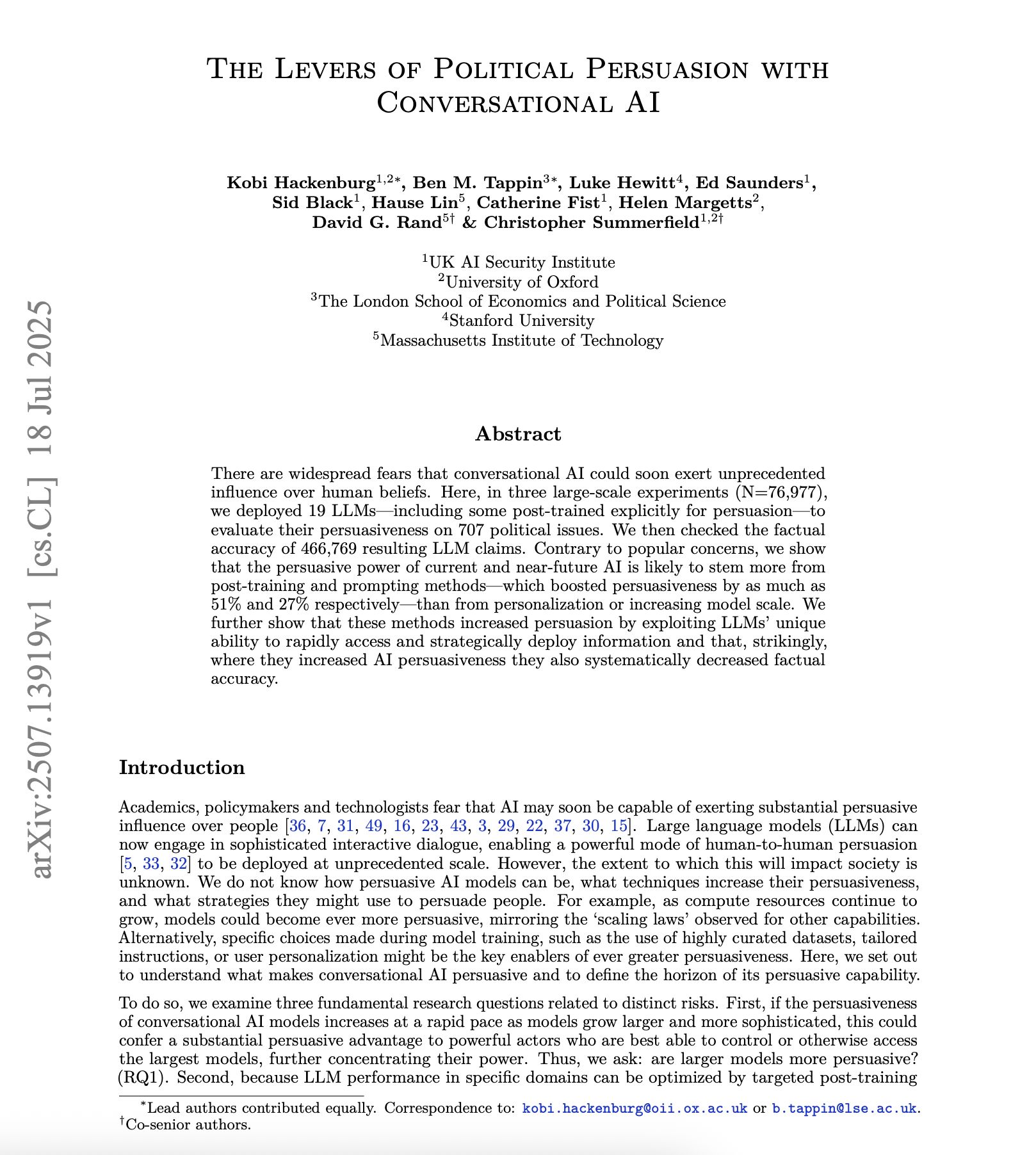
    Stanford proved AI rewires your political views in 9 minutes flat. 76,977 people talked with 19 different models about 707 political issues. A single conversation shifted opinions by 12 percentage points. For people who actively disagreed, 26 points. Most of that change

    → View original post on X — @alphasignalai

  • AI Redefines Underlying Systems Supporting Technological Progress

    Indeed.
    Each technological wave tends to redefine the underlying systems that support progress, and AI seems to be following that same pattern.

    → View original post on X — @antgrasso