Por ejemplo, me estáis compartiendo un vídeo donde se propone marcar los textos de ChatGPT de forma invisible para poder detectar que es artificial. El problema, como comenta aquí Jeremy, es que estos sistemas una vez creados, son muy fáciles de superar.
RESEARCH
-
Can AI-Generated Content Be Reliably Detected?
By
–
¿Cómo podemos detectar si una imagen o un texto ha sido creado por una IA? ¿Se puede usar otra IA? Esto es algo que muchos me preguntáis y malas noticias: NO SE PUEDE Al menos por ahora no hay método satisfactorio que te permita identificar si algo es artificial… [1/n]
-

Dutch Tech Leaders Showcase Responsible AI at CES 2023
By
–
The Dutch are ready for #CES2023. Proud to be part of the #NLatCES. Technology has the potential to tackle some of society’s biggest challenges. Meet us at Hall A-C 55332 and see how we use #responsibletech to #acceleratethechange. #AI #ML #computervision
-
Anthropic Hiring Research Engineers and Scientists for Interpretability
By
–
We’re also actively hiring research engineers/scientists to work with us on interpretability. If you’re interested, we’d encourage you to apply!
Research engineer: https://
jobs.lever.co/Anthropic/436c
a148-6440-460f-b2a2-3334d9b142a5
…
Research scientist: https://
jobs.lever.co/Anthropic/eb9e
6d83-626c-4f59-8a0e-fa7c413b2014
… -
Thanks to Adam S Jermyn for reproducing and extending results
By
–
Thanks to @AdamSJermyn for his comments reproducing and extending these results! https://
transformer-circuits.pub/2023/toy-doubl
e-descent/index.html#comment-jermyn-1
… -
Mechanistic Theory of Memorization: Open Questions and Research Directions
By
–
We hope these results are a step towards a mechanistic theory of memorization. There are many open questions, such as understanding the loss spike, or what happens when only a subset of the data is repeated.
-
Model Capacity and Double-Descent: Strategy Transitions in ML
By
–
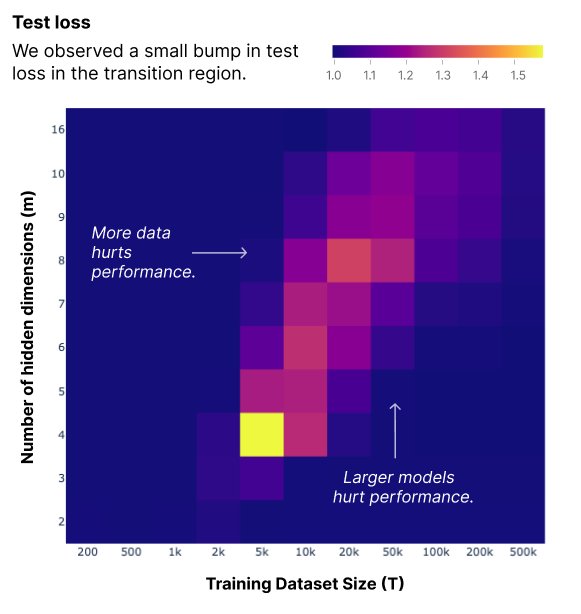
Models struggle to transition between these strategies, as exhibited by a spike in test loss. This spike moves to larger datasets as one increases model capacity. This is a clear signature of double-descent, a phenomenon that is now well-known in the ML literature.
-

Superposition in Neural Networks: Memorization vs Feature Learning
By
–
For small training sets, models use superposition to memorize more data points than the two available neurons. For large training sets, models learn features in superposition, as observed in our previous work, allowing the model to generalize. https://
transformer-circuits.pub/2022/toy_model
/index.html
… -
Superposition Strategy: How Neural Networks Embed Features in Hidden Space
By
–
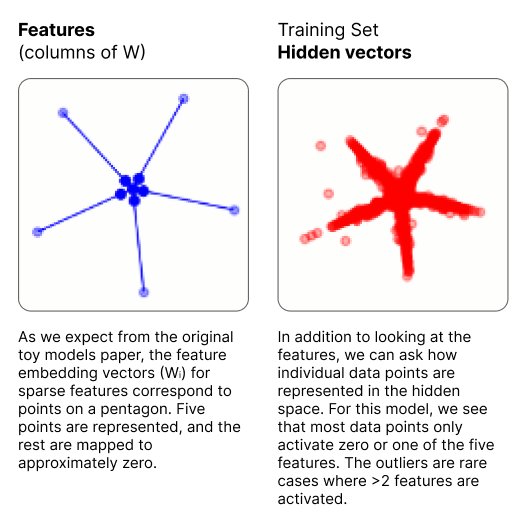
Our prior work showed that these toy models use a strategy called “superposition” to learn more features than available neurons. Here we observe how training data points, as well as features, are embedded in the hidden space.
-

Understanding Deep Learning Overfitting Through Mechanistic Analysis
By
–
We have little mechanistic understanding of how deep learning models overfit to their training data, despite it being a central problem. Here we extend our previous work on toy models to shed light on how models generalize beyond their training data. https://
transformer-circuits.pub/2023/toy-doubl
e-descent/index.html
…