"Analyzing the impact of climate change on critical infrastructure from the scientific literature" uses a weakly supervised machine learning approach to efficiently analyze a large corpus of research on climate change impacts on infrastructure. By: Tanwi Mallick @argonne
RESEARCH
-
Lossy Compression for Large Scientific Dataset Training
By
–
"The Bearable Lightness of Big Data" presents the use of lossy compression algorithms to reduce the size of large scientific datasets while maintaining data fidelity for training deep learning models. Submitted by: Wai Tong Chung @Stanford
-
Nonlinear Dimensionality Reduction for Fluid Flow Modeling
By
–
"Comparing nonlinear dimensionality reduction for data-driven unsteady fluid flow modeling" explores various NDR techniques, ie manifold learning & deep learning, noting superior spatial reconstruction & physically interpretable modes. Submitted by: Hunor Csala @UUtah
-
DC-Check: Data Quality Framework for Reliable ML Systems
By
–
"DC-Check" is a checklist-style framework aimed at guiding the creation of reliable ML systems by emphasizing data quality and preparation throughout all stages of the machine learning pipeline. Submitted by: Nabeel Seedat @Cambridge_Uni
-
FILA: Optimal Online Auditing Technique for ML Model Accuracy
By
–
"FILA" is an optimal online auditing technique for ML model accuracy that uses a sampling-based approach and Thompson Sampling to estimate accuracy under a finite labeling budget. Submitted by: Naiqing Guan @UofT
-
Data-Centric AI Conference Poster Competition Now Open
By
–
The poster competition at The Future of Data-Centric AI conf is now live! Get inspired by researchers pushing #AI and #ML boundaries. Thanks to @lambdaAPI for sponsoring the fantastic prizes. Head over to https://
future.snorkel.ai/poster/ to connect with the authors. -
AutoWS-Bench-101: Weak Supervision Evaluation Framework
By
–
"AutoWS-Bench-101" provides an evaluation of Automated Weak Supervision against zero-shot or few-shot learners, utilizing 100 labels for training models with limited labeled data. Submitted by: Nicholas Roberts @UWMadison
-
Counterfactual Fairness Reduces Dataset Bias in Weak Supervision
By
–
"Mitigating Source Bias for Fairer Weak Supervision" introduces a counterfactual fairness-based method to reduce dataset bias, improving accuracy and fairness in models trained via weak supervision. Submitted by: Changho Shin @UWMadison
-
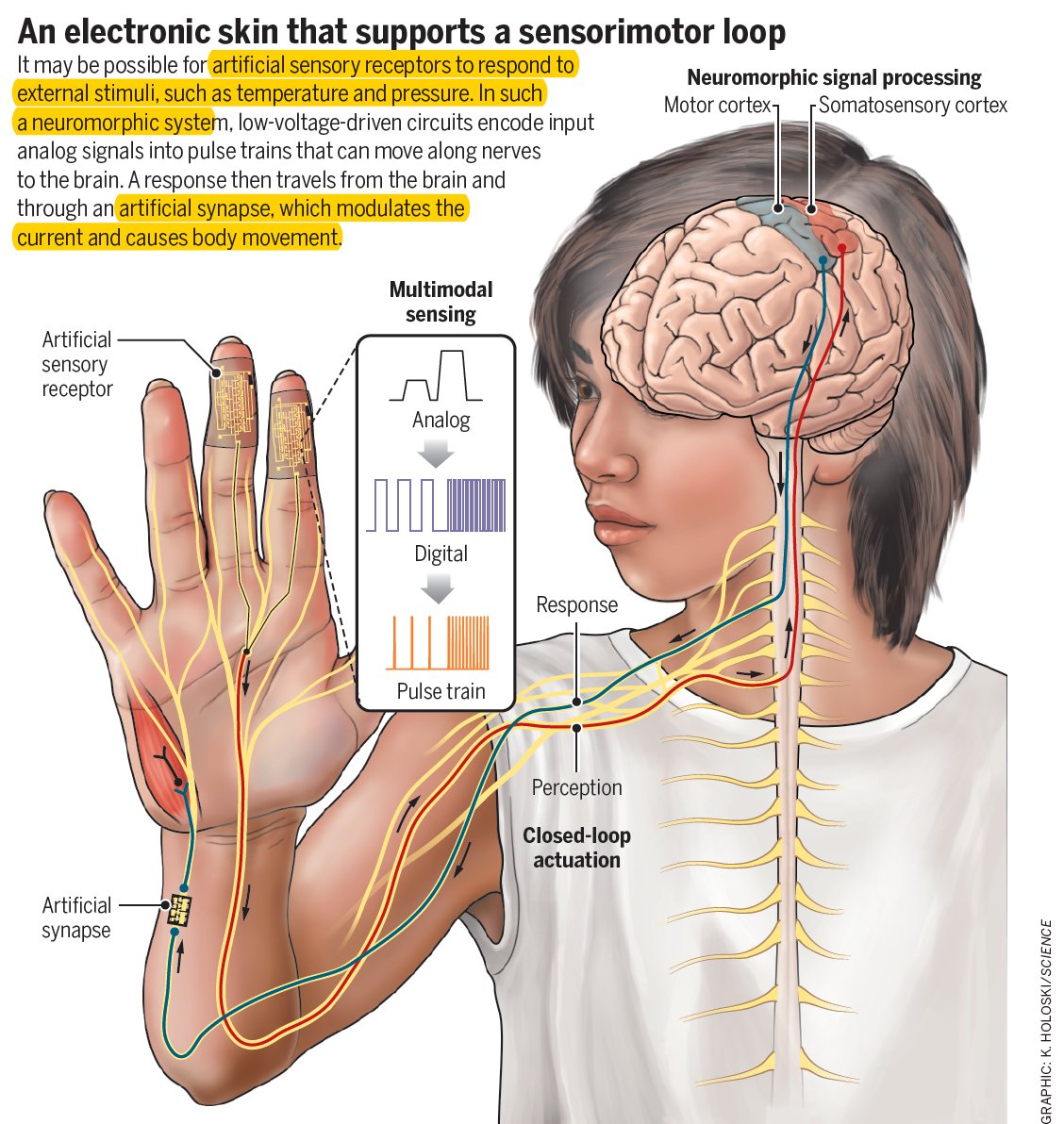
Electronic Skin Advances Blur Lines Between Organism and Machine
By
–
A significant advance in electronic skin https://
science.org/doi/10.1126/sc
ience.ade0086
… https://
science.org/doi/10.1126/sc
ience.adf0262
…
"The disappearing boundary between organism and machine" @ScienceMagazine w/
@ScienceVisuals -

Enterprises Must Invest in Exponential Technologies for Competitiveness
By
–
As enterprises embrace the next normal, it has become vital to invest in exponential technologies to remain competitive. This is particularly important given the rapid pace of technology obsolescence. #infographic by @EverestGroup via @antgrasso #innovation #technology