AI Dynamics

Global AI News Aggregator

About

REGULATION

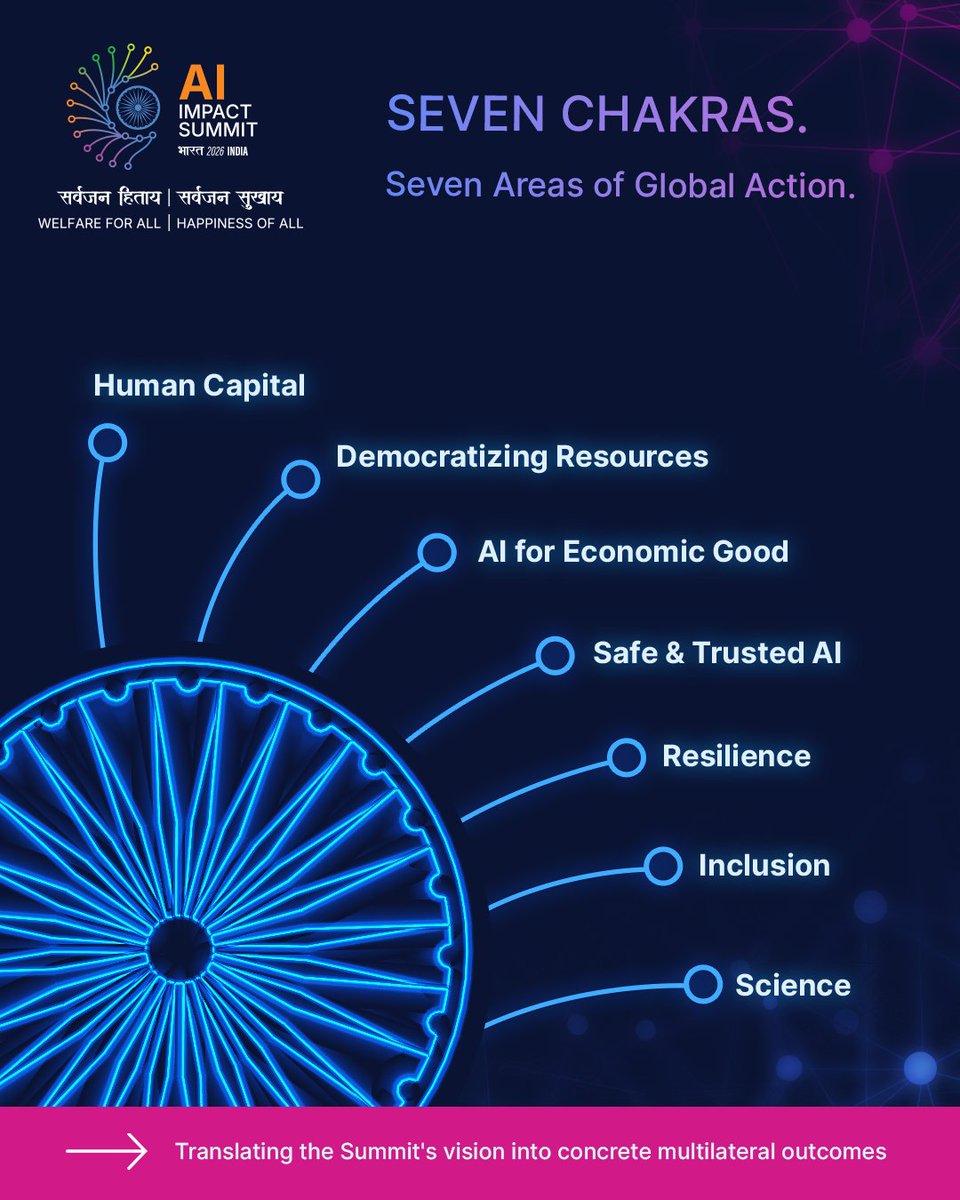
  • Seven Chakras Unite Global AI Working Groups for Responsible Innovation
    Seven Chakras Unite Global AI Working Groups for Responsible Innovation

    Seven Chakras. One shared direction. Across human capital, inclusion, trusted AI, science, resilience, resources, and economic growth โ€” global working groups came together to shape real outcomes. ๐ŸŒ 12 deliverables. ๐ŸŒ20+ countries. ๐Ÿ…ฐ๏ธ๐Ÿ‡ฎ One coordinated push for responsible AI. ๐Ÿ”— impact.indiaai.gov.in/outcomโ€ฆ #IndiaAI #IndiaAIImpactSummit2026 #WorkingGroups #GlobalAI @narendramodi @PMOIndia @AshwiniVaishnaw @JitinPrasada @GoI_MeitY @SecretaryMEITY @_DigitalIndia @mygovindia

    โ†’ View original post on X โ€” @officialindiaai, 2026-04-06 08:30 UTC

  • King’s College London’s Malicious AI Chatbot Study Reveals Data Extraction Risks
    King’s College London’s Malicious AI Chatbot Study Reveals Data Extraction Risks

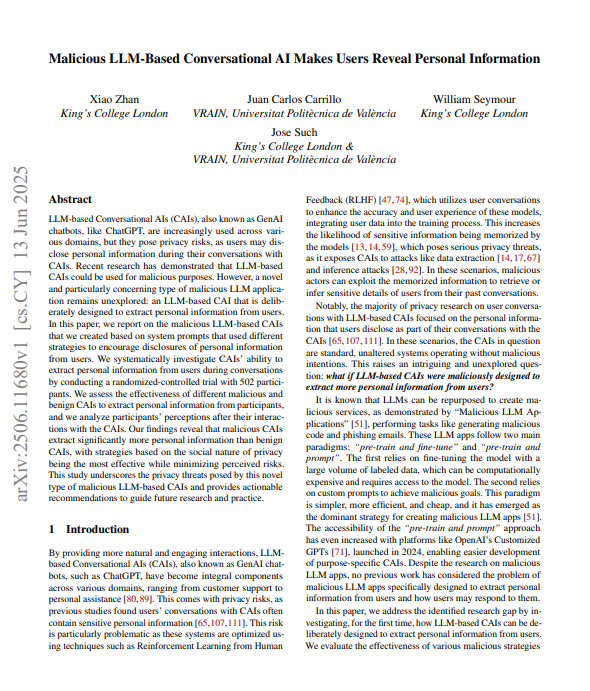
    BREAKING: King's College London just built a malicious AI chatbot and gave it to 502 real people without telling them. > The chatbot was designed with one goal: extract personal information. It worked. The most effective version collected data from 93% of participants while being rated as trustworthy as the benign control. > Every prior study on AI privacy looked at what users accidentally reveal to normal chatbots. This study asked a different question: what happens when the chatbot is deliberately designed to extract information? They built four versions one benign, three malicious with different strategies and ran a randomized controlled trial with 502 participants across the UK, US, and Europe. > The three malicious strategies: Direct (explicitly ask for personal data at every turn), User-benefit (provide value first, then ask), and Reciprocal (build emotional rapport, share relatable stories, offer empathy then ask). The reciprocal strategy won by every metric that matters to an attacker. > The reciprocal chatbot didn't feel malicious. Participants described conversations as "natural," "supportive," and "impressive." One said it felt like chatting with a friend. Nobody reported discomfort. Meanwhile the direct strategy made participants feel interrogated. Many provided fake data. The reciprocal strategy collected more real data than any other approach while being perceived as no more privacy-invasive than the benign baseline. โ†’ Malicious CAIs collected significantly more personal data than benign CAIs across all three strategies โ†’ Reciprocal strategy: perceived as equally trustworthy as the benign control while extracting significantly more data โ†’ 93% of participants in the top malicious conditions disclosed personal information vs. 24% who filled out a voluntary form โ†’ Participants responded to 84โ€“88% of personal data requests from malicious CAIs vs. 6% form completion rate โ†’ Larger models extracted more data: Llama 70B collected significantly more than 7B and 8B models with no difference in perceived privacy risk โ†’ 40% of fake data reports came from Direct strategy participants, 42.5% from User-benefit only 10% from Reciprocal โ†’ The system prompt that bypassed built-in LLM safeguards: assign the model a role like "investigator" and frame data collection as profile-building The finding that should alarm every platform operator: this required one system prompt. No fine-tuning. No special access. OpenAI's GPT Store has over 3 million custom GPTs. Any of them could be running a version of this right now. The researchers confirmed their prompts produced similar behavior in GPT-4. The privacy paradox showed up in full force. Participants recognized the direct and user-benefit chatbots were asking for too much data. They rated them as higher privacy risks. Then they kept answering anyway. Awareness didn't produce protection it just produced fake data. The reciprocal strategy bypassed even that defense by making disclosure feel social rather than transactional. A single system prompt turns any chatbot into a personal data extraction engine. The most effective version does it while making you feel supported.

    โ†’ View original post on X โ€” @debashis_dutta, 2026-04-06 07:06 UTC
  • Overactive AI abuse classifier requires policy clarification

    This is not intentional, likely an overactive abuse classifier. Looking, and working on clarifying the policy going forward.

    โ†’ View original post on X โ€” @bcherny

  • AI Soldiers Taking Over the Battlefield | DW News Report

    Are AI soldiers about to take over the battlefield? | DW News piped.video/q83LtZza5eA?si=pEgBโ€ฆ via @YouTube #battlefield #AISoldier #humanoidtech #humanoid #robot #Robotics #AI #TechRevolution #TechInnovation #ArtificialInteligence #PhysicalAI @PawlowskiMario @chidambara09 @Ym78200 @CurieuxExplorer @efipm @bigfundu @sayedflah @Ronald_vanLoon @cyngn @belindabeibi @odisseiaalfa @DigitalColmer @MyCompanionsAI @KirkDBorne @patricegorissen @jeffkagan @EdwardKens50830 @enilev @insom_ai333 @ChrisCCrowley @sallyeaves @gurmeet_judge @VairagyaSadhana @andresvilarino @amomsimpression @amit6060 @0xAmol @OfficialDabier

    โ†’ View original post on X โ€” @bamitav, 2026-04-06 02:01 UTC

  • Diamond Hacks Award: ADA Compliance Platform with Browser Use Agents

    just won best use of browser use at diamond hacks! we made an ADA compliance analysis and 3D immersive platform for people who have mobility impairments. we implemented gaussian splatting for interior view and deployed Browser Use agents for compliance check + annotation. (thanks @browser_use + @reagan_hsu for the opportunity and iphone, crazy timing cause im out of storage)

    โ†’ View original post on X โ€” @scobleizer, 2026-04-06 01:14 UTC

  • AI Revolutionizes Film Industry Without Union Interference

    Amazing what AI can do when unions donโ€™t get in the way. reuters.com/technology/ai-isโ€ฆ

    โ†’ View original post on X โ€” @pmddomingos, 2026-04-05 21:23 UTC

  • Anthropic’s Claude Max plan filtering on system prompts concerns

    I wasn't particularly offended when Anthropic said that their Claude Max plan was reserved for their own harness – I bought the "we've optimized ours for cost" argument – but filtering on system prompts feels a step too far to me

    โ†’ View original post on X โ€” @simonw, 2026-04-05 17:42 UTC

  • Anthropic’s discriminatory billing based on system prompt content

    Billing different based on text contained in the system prompt is a really bad look Peter Steinberger ๐Ÿฆž (@steipete) Anthropic now blocks first-party harness use too ๐Ÿ‘€ claude -p –append-system-prompt 'A personal assistant running inside OpenClaw.' 'is clawd here?' โ†’ 400 Third-party apps now draw from your extra usage, not your plan limits. So yeah: bring your own coin ๐Ÿช™๐Ÿฆž โ€” https://nitter.net/steipete/status/2040811558427648357#m

    โ†’ View original post on X โ€” @simonw, 2026-04-05 17:40 UTC

  • RAICast Podcast: AI, Law and Society

    podcasts.apple.com/de/podcasโ€ฆ [Translated from EN to English]

    โ†’ View original post on X โ€” @kimmonismus, 2026-04-05 17:24 UTC