Stop telling Claude “do this.” Stop telling Claude “write code.” Stop telling Claude “fix this error.” In reality, you’re using a senior AI like it’s a junior intern. Here are 10 prompts for Claude that you can copy and paste directly.
PROMPT ENGINEERING
-
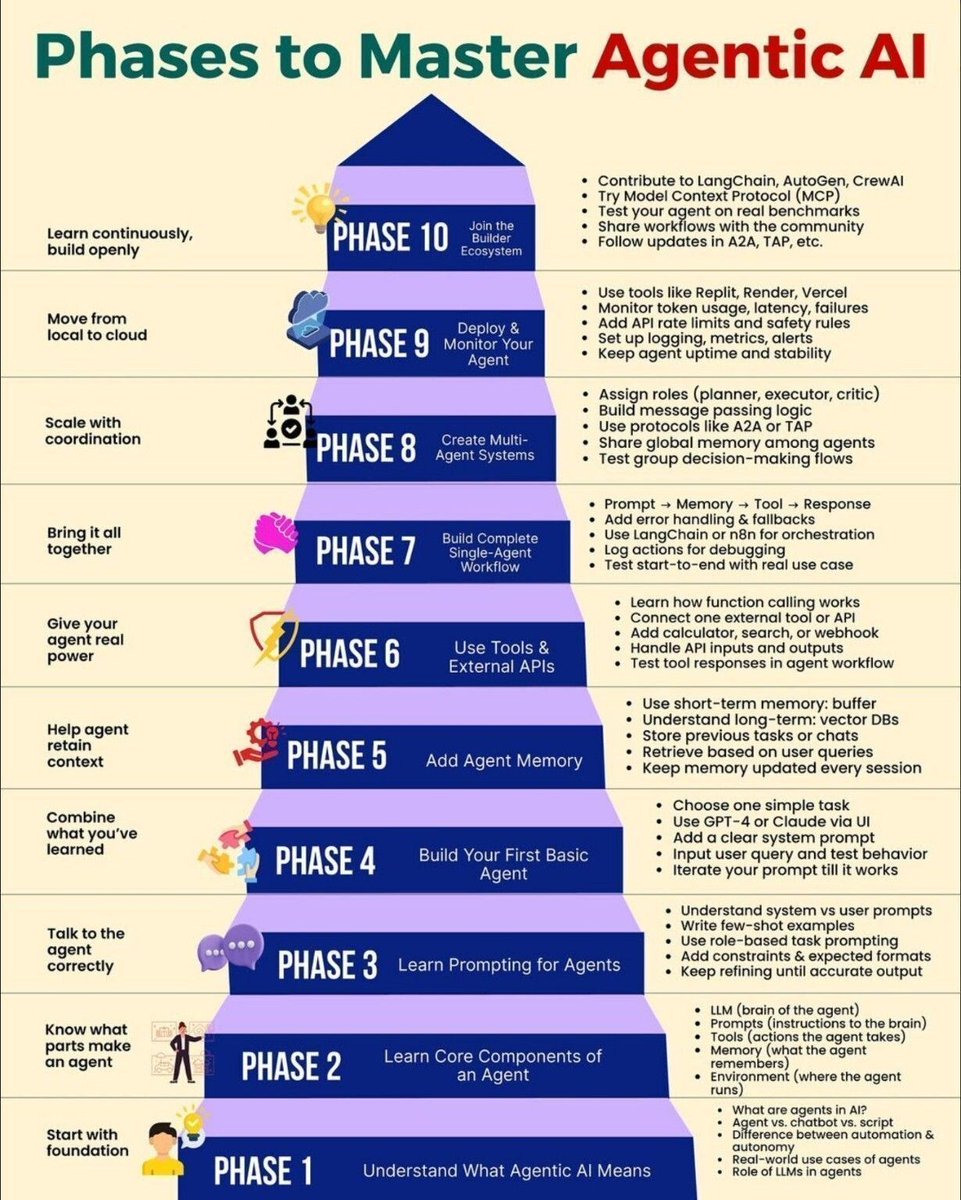
Agentic AI Development: A Phased Approach to True Autonomy
By
–
Agentic AI isn’t learned by tools. It’s learned in phases. Prompt → Memory → Tools → Workflows → Coordination → Deployment Skip phases and you don’t get agents. You get fragile demos. Autonomy is earned — not installed.
→ View original post on X — @ingliguori, 2026-04-10 12:17 UTC
-
Anthropic’s System Prompt Blockers Growing Increasingly Complex
By
–
Anthropic's randoms system prompt blockers are getting weirder and weirder.
-
The Evolution of Software Development From Code to Natural Language
By
–
The old model was simple:
you had an idea,
then translated it into syntax,
then fought the tooling until it worked. The new model looks very different: → describe the app in plain language
→ generate the interface, logic, and structure
→ test it
→ refine it through feedback -
From Syntax to Intent: The Future of Software Development
By
–
What if the biggest change in software isn’t a new language, but the fact that you may not need to think in code first anymore?
— Ronald van Loon (@Ronald_vanLoon) 10 avril 2026
I think we’re moving from:
syntax → intent
From:
debugging by trial and error → building through conversation
That changes who can build, how fast… pic.twitter.com/HTtXz4H0m3What if the biggest change in software isn’t a new language, but the fact that you may not need to think in code first anymore? I think we’re moving from: syntax → intent From: debugging by trial and error → building through conversation That changes who can build, how fast teams ship, and what developers actually spend time on. Here’s the breakdown, featuring what I learned from @GoogleAIStudio.
→ View original post on X — @ronald_vanloon, 2026-04-10 08:30 UTC
-
Non-coder builds complete website using AI without programming knowledge
By
–
You realize I'm an idiot, right? I have no freaking idea how to code. But it built this for me: alignednews.com/ai 100% of it. Did a security review. And built me all sorts of fun features like a feed for your @OpenClaw or Hermes. Or a script to take over to your @NotebookLM When the normies figure out they can build things without knowing how to code they are gonna freak out.
→ View original post on X — @scobleizer, 2026-04-10 08:02 UTC
-
Cursor Adoption Without Real Skills: An Expensive Investment?
By
–
Paying for Cursor to help you build something that doesn't exist yet is just a more expensive version of buying a guitar and never learning to play it.
-
Codex Pro Rate Limits Doubled Until May 31st
By
–
ICYMI: 2x rate limits apply for both Codex Pro subscriptions (100$ & 200$) till May 31st & we reset rate limits Let the tokens brrrr
-
Advisor Models: Pairing Weak and Strong AI for Cost-Efficient Intelligence
By
–

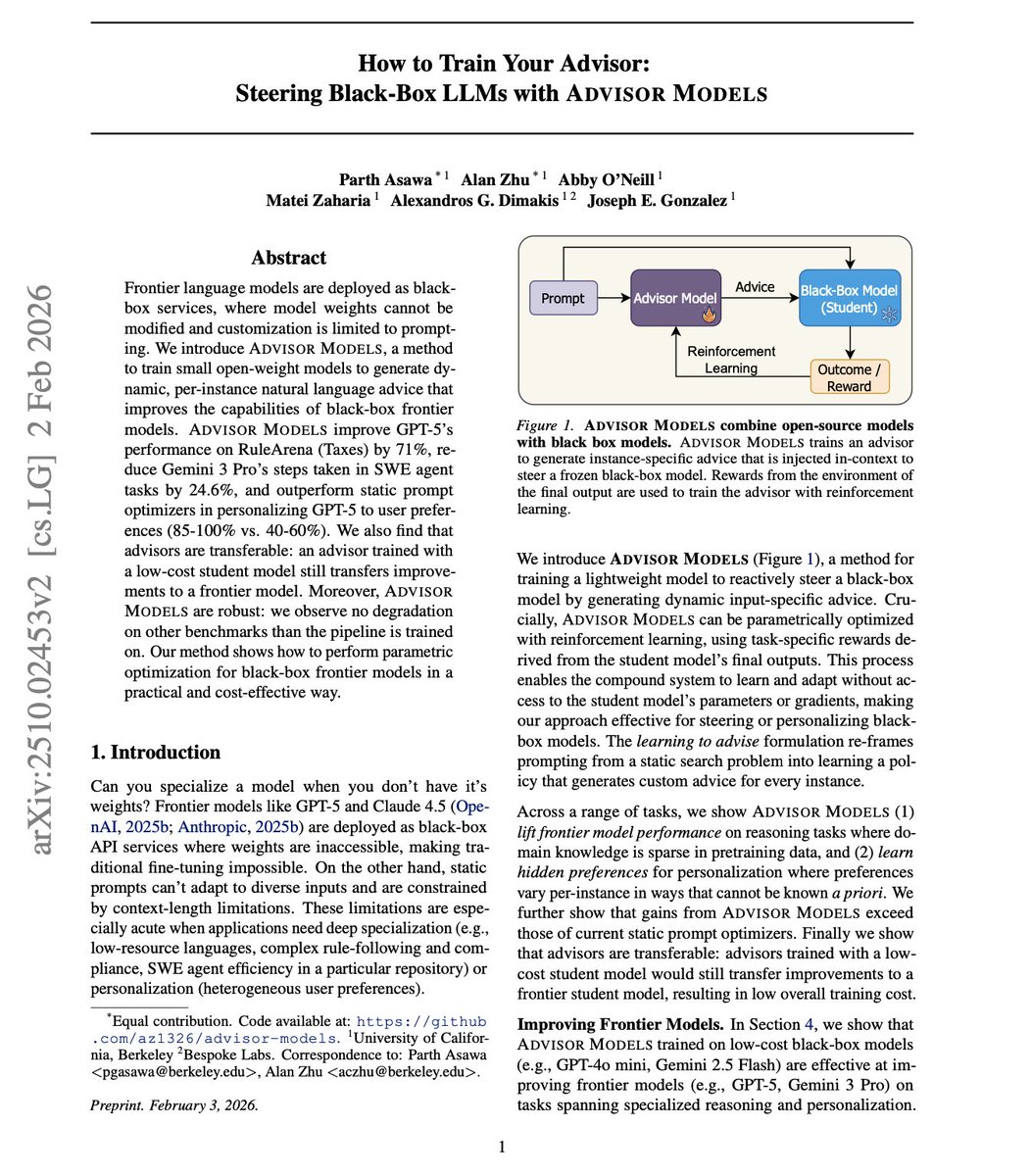
this is one of the most important ideas in AI right now, and it just got two independent validations. yesterday, Anthropic shipped an "advisor tool" in the Claude API that lets Sonnet or Haiku consult Opus mid-task, only when the executor needs help. the benefit is straightforward: you get near Opus-level intelligence on the hard decisions while paying Sonnet or Haiku rates for everything else. frontier reasoning only kicks in when it's actually needed, not on every token. back in February, UC Berkeley published a paper called "Advisor Models" that trains a small 7B model with RL to generate per-instance advice for a frozen black-box model. same idea. two very different implementations. the paper's approach: take Qwen2.5 7B, train it with GRPO to generate natural language advice, and inject that advice into the prompt of a black-box model. the black-box model never changes. the advisor learns what to say to make it perform better. GPT-5 scores 31.2% on a tax-filing benchmark. add the trained advisor, it jumps to 53.6%. on SWE agent tasks, a trained advisor cuts Gemini 3 Pro's steps from 31.7 to 26.3 while keeping the same resolve rate. training is cheap too. you train with GPT-4o Mini, then swap in GPT-5 at inference. the advisor even transfers across families: a GPT-trained advisor improves Claude 4.5 Sonnet. Anthropic's advisor tool takes a different path to the same idea. Sonnet runs as executor, handles tools and iteration. when it hits something it can't resolve, it consults Opus, gets a plan or correction, and continues. Sonnet with Opus as advisor gained 2.7 points on SWE-bench Multilingual over Sonnet alone, while costing 11.9% less per task. Haiku with Opus scored 41.2% on BrowseComp, more than double its solo 19.7%. it's a one-line API change. advisor tokens bill at Opus rates, and the advisor typically generates only 400-700 tokens per call. blended cost stays well below running Opus end-to-end. both approaches point at the same thing: you don't need the most powerful model on every token. you need it at the right moments, for the right inputs. Paper: arxiv.org/abs/2510.02453 Code: github.com/az1326/advisor-mo… Claude (@claudeai) We're bringing the advisor strategy to the Claude Platform. Pair Opus as an advisor with Sonnet or Haiku as an executor, and get near Opus-level intelligence in your agents at a fraction of the cost. — https://nitter.net/claudeai/status/2042308622181339453#m
→ View original post on X — @akshay_pachaar, 2026-04-10 05:46 UTC
-

Rewriting SOUL Files for OpenClaw Agents with GPT-5.4
By
–
I rewrote every single SOUL file for my OpenClaw agents using this as a reference. If you're moving to GPT-5.4, this is a must-do. But don't just copy-paste it. Ask your agent to create a version specific to YOU based on everything it already knows about you. x.com/Saboo_Shubham_…