AI Dynamics

Global AI News Aggregator

About

OPEN SOURCE

  • Google Releases Gemma 4 Free Open Source Model

    🚨 Google Just Made OpenClaw Free (GEMMA 4): 0:00 – Why Gemma 4 matters 0:48 – #3 open model in the world 1:24 – What Gemma 4 actually does 2:01 – What this means for OpenClaw 3:03 – How to set up Gemma 4 3:58 – My honest take after running Claude for 3 months

    → View original post on X — @demishassabis, 2026-04-03 13:57 UTC

  • EdgeClaw 2.2 Launches Three New Claude Code Features
    EdgeClaw 2.2 Launches Three New Claude Code Features

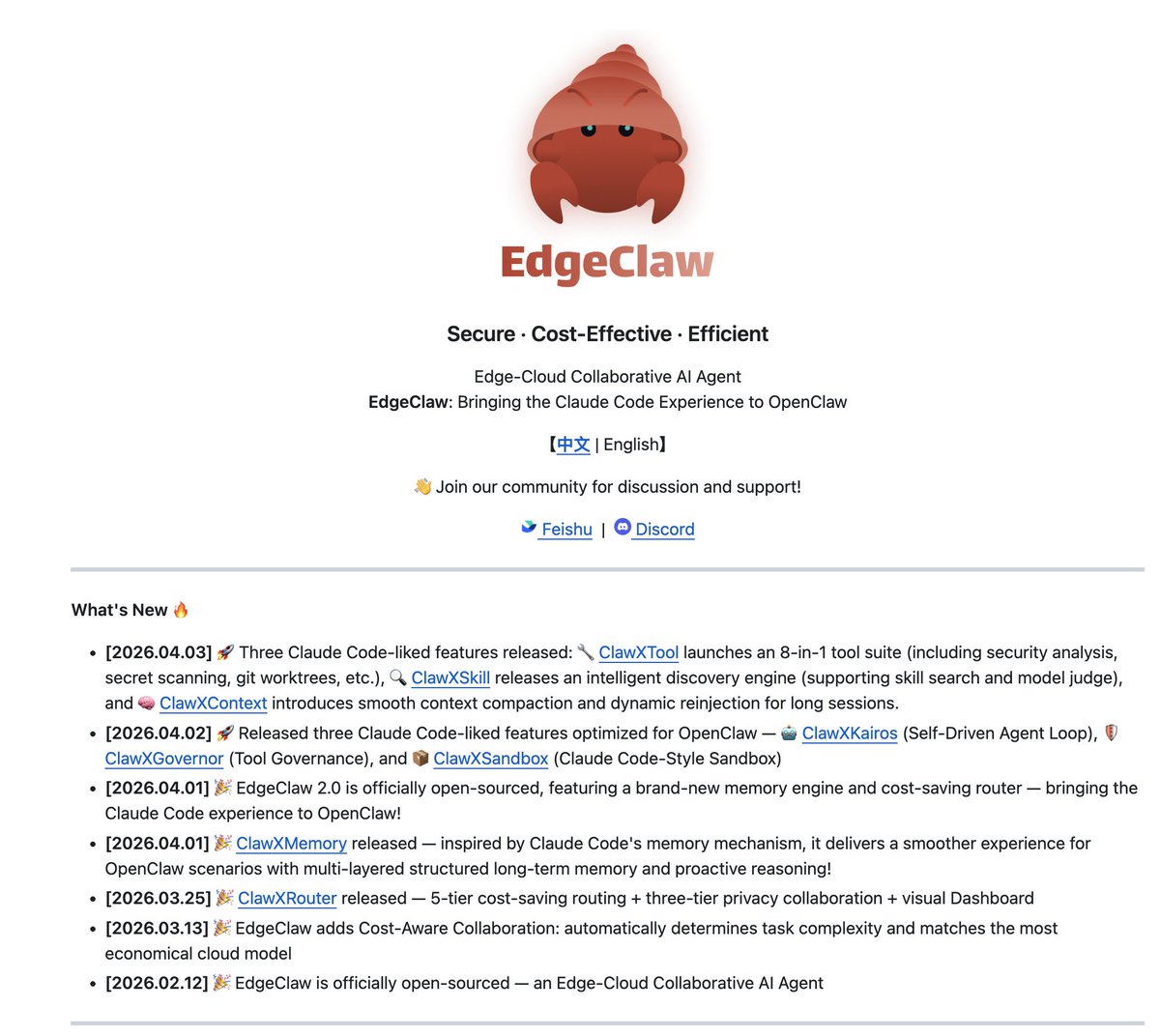
    🚀 [OpenClaw x Claude Code DAY 3 – Almost Done!] 🚀 Three more CC features—including the highly requested Buddy—are now live in EdgeClaw 2.2! 🦞 Try it now: github.com/OpenBMB/EdgeClaw Here is what we shipped today: 👇 ⚡️ ClawXskills: Progressive, high-efficiency skill calling. The loading phase now consumes just 15% of the original tokens! 🧠 ClawXcontext: Hierarchical context compression with on-demand expansion. Say goodbye to context bloat and lost information! 🐾 ClawXBuddy: Draw a random "blind box" to get your own unique companion pet! (Warning: No abandoning allowed! 🙅♂️❤️) The reconstruction of CC features is complete, but EdgeClaw’s evolution has just begun. We will keep pushing boundaries! 🌊🚀 #ClaudeCode #OpenClaw #EdgeClaw #LLMs #OpenSource

    → View original post on X — @aihighlight, 2026-04-03 13:39 UTC

  • NVIDIA Quantizes Gemma 4 31B with NVFP4 Compression Technology
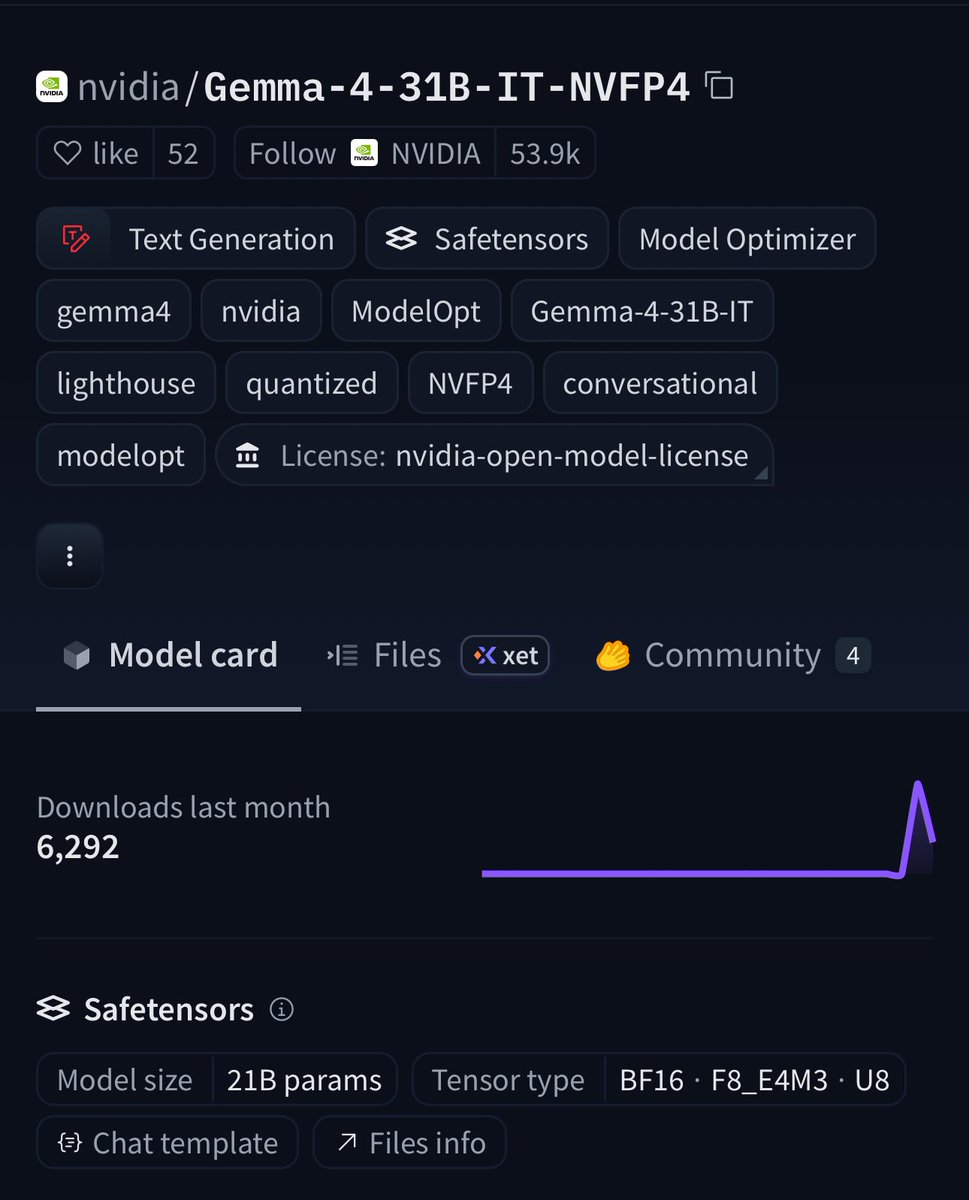
    NVIDIA Quantizes Gemma 4 31B with NVFP4 Compression Technology

    BREAKING:🚨 NVIDIA just quantized Gemma 4 31B on Hugging Face 🔥 NVFP4 compression = 4x smaller weights with frontier-level accuracy. ✅99.7% of baseline on GPQA (75.46% vs 75.71%). 📈256K context window. 🧐Multimodal (text + images + video). vLLM-ready + Blackwell optimized. VRAM requirements: ⚡️Weights only: ~16–21 GB 🚀Everyday use: Runs on 24 GB GPUs 📈Full 256K context = 32 GB VRAM sweet spot (RTX 5090-class consumer GPUs) This is the 31B-class frontier model you can actually run locally on a high-end rig. Try it today👉 huggingface.co/nvidia/Gemma-…

    → View original post on X — @huggingface, 2026-04-03 13:30 UTC

  • Claude Code Skill Converts ArXiv Papers to Working Code

    I made a Claude Code skill that turns any arxiv paper into working code. Every line traces back to the paper section it came from & any implementation detail the paper skips will be flagged, and not assumed. open sourcing it – github.com/PrathamLearnsToCo…

    → View original post on X — @nandodf, 2026-04-03 13:22 UTC

  • LM Studio GGUF Bug Fix Update

    It was a bug in the LM Studio GGUF, they hopefully have fixed it by now: https://
    news.ycombinator.com/item?id=476163
    61#47621989

    → View original post on X — @simonw

  • Netflix Launches Its VOID AI Model on Hugging Face
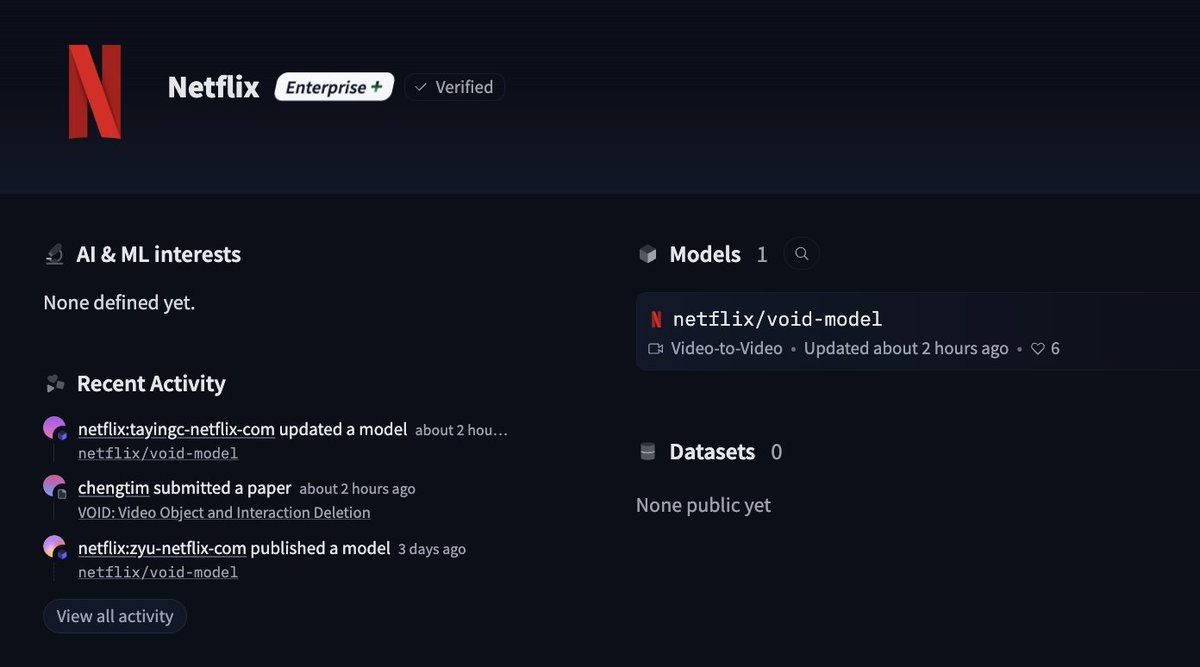
    Netflix Launches Its VOID AI Model on Hugging Face

    Netflix: surprise we just released our new AI model VOID on @huggingface. Capabilities of Netflix's VOID Model:
    – Object Removal with Environmental Awareness.
    – Physical Interaction Handling.
    – Open-Weight Access. [Translated from EN to English]

    → View original post on X — @huggingface, 2026-04-03 13:20 UTC

  • VoxCPM: Open-Source Voice Cloning Without Tokenization
    VoxCPM: Open-Source Voice Cloning Without Tokenization

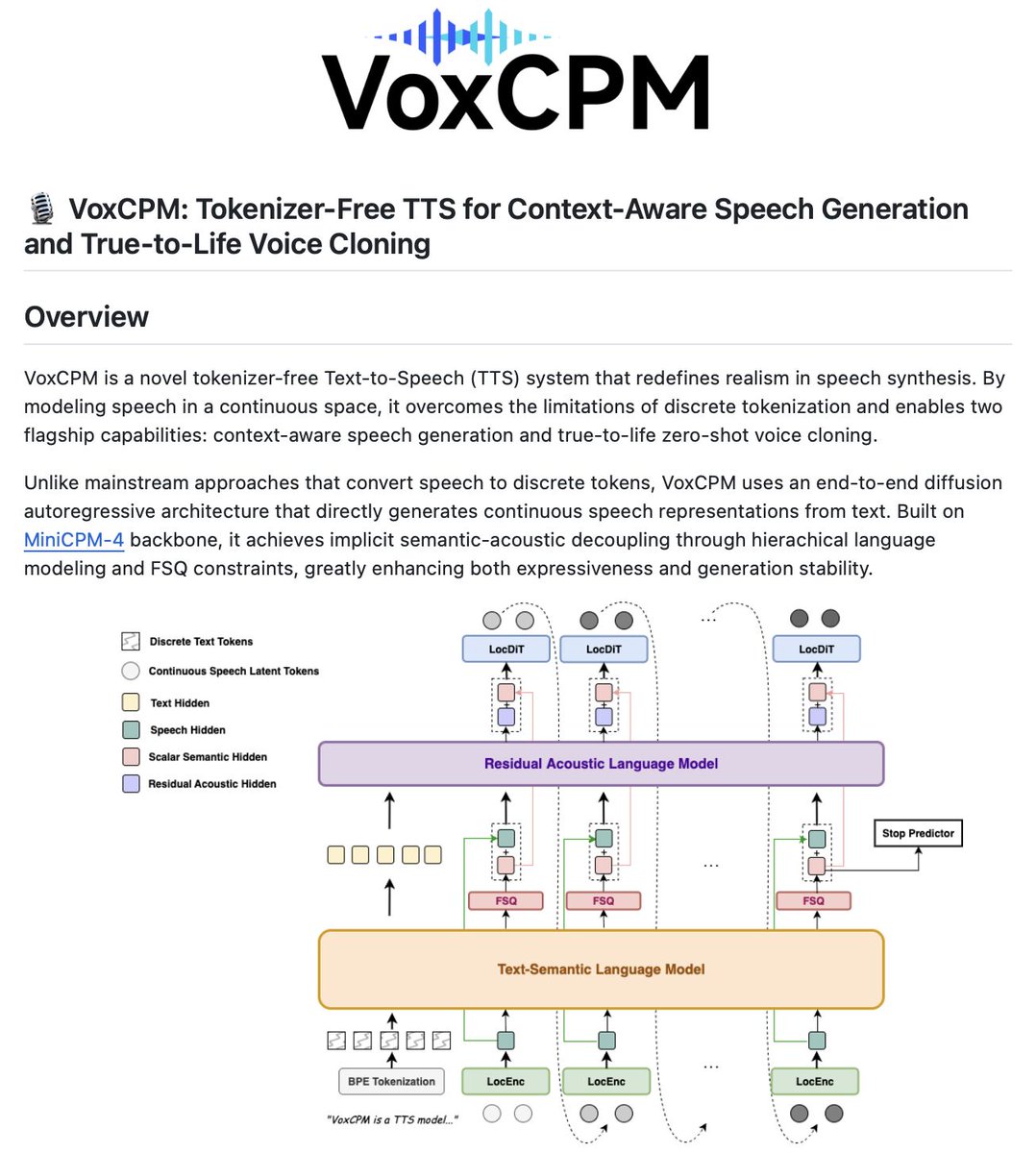
    If you found it useful, reshare it with your network Follow me → @Sumanth_077 for more insights and tutorials on AI Engineering! nitter.net/Sumanth_077/status/204… Sumanth (@Sumanth_077) Clone a human voice in real time without tokenization! VoxCPM is an open-source text-to-speech system that models speech in continuous space instead of discrete tokens. Most TTS systems convert speech to discrete tokens before generation. This quantization creates a fundamental trade-off: tokens provide stability but lose acoustic details like breath, vocal texture, and subtle articulation. VoxCPM skips tokenization entirely. It models speech directly in continuous space using an end-to-end diffusion autoregressive architecture built on MiniCPM-4. The system uses hierarchical language modeling with two specialized components: a Text-Semantic Language Model that captures high-level prosody and structure, and a Residual Acoustic Model that recovers fine-grained acoustic details. This separation eliminates dependency on external speech tokenizers and prevents error accumulation from multi-stage pipelines. Two flagship capabilities: 1. Context-aware speech generation: The model comprehends text to infer appropriate prosody and speaking style. Explanations slow down naturally, emphasis appears in the right places, questions sound like questions. 2. Zero-shot voice cloning: With just 3-10 seconds of reference audio, it replicates speaker timbre, accent, emotional tone, rhythm, and pacing. Key features: • Tokenizer-free architecture with continuous speech modeling • Context-aware prosody generation without manual tuning • Zero-shot voice cloning from short reference audio • Streaming synthesis support for real-time applications • SFT and LoRA fine-tuning support It's 100% open source Link to the GitHub repo in the comments! — https://nitter.net/Sumanth_077/status/2040055394958286903#m

    → View original post on X — @sumanth_077, 2026-04-03 13:15 UTC
  • VoxCPM: Real-time Voice Cloning Without Tokenization
    VoxCPM: Real-time Voice Cloning Without Tokenization

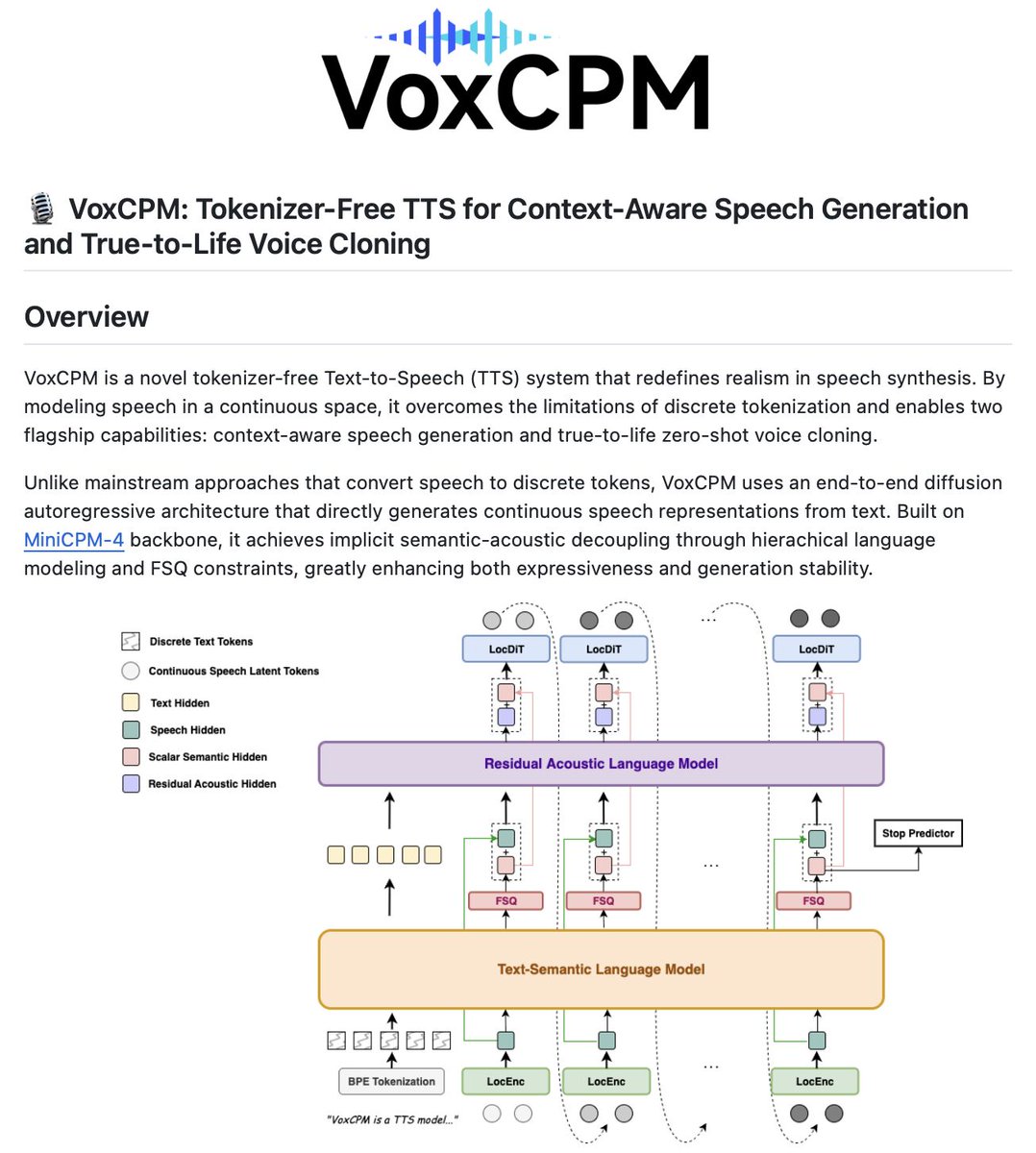
    Clone a human voice in real time without tokenization! VoxCPM is an open-source text-to-speech system that models speech in continuous space instead of discrete tokens. Most TTS systems convert speech to discrete tokens before generation. This quantization creates a fundamental trade-off: tokens provide stability but lose acoustic details like breath, vocal texture, and subtle articulation. VoxCPM skips tokenization entirely. It models speech directly in continuous space using an end-to-end diffusion autoregressive architecture built on MiniCPM-4. The system uses hierarchical language modeling with two specialized components: a Text-Semantic Language Model that captures high-level prosody and structure, and a Residual Acoustic Model that recovers fine-grained acoustic details. This separation eliminates dependency on external speech tokenizers and prevents error accumulation from multi-stage pipelines. Two flagship capabilities: 1. Context-aware speech generation: The model comprehends text to infer appropriate prosody and speaking style. Explanations slow down naturally, emphasis appears in the right places, questions sound like questions. 2. Zero-shot voice cloning: With just 3-10 seconds of reference audio, it replicates speaker timbre, accent, emotional tone, rhythm, and pacing. Key features: • Tokenizer-free architecture with continuous speech modeling
    • Context-aware prosody generation without manual tuning
    • Zero-shot voice cloning from short reference audio
    • Streaming synthesis support for real-time applications
    • SFT and LoRA fine-tuning support It's 100% open source Link to the GitHub repo in the comments! [Translated from EN to English]

    → View original post on X — @sumanth_077, 2026-04-03 13:14 UTC

  • Edge AI Models Sprint Forward With Local Processing Power

    This is huge We're no longer running, we are sprinting towards a future with edge models doing a lot of the work locally at cost of electricity. Gemma for me has always been a benchmark in how far we've gotten. Locally. The ghost will truly be inside the shell

    → View original post on X — @linusekenstam