It’s Friday. What XGBoost models have you trained this week? @trainxgb
MACHINE LEARNING
-
EdgeFlowNet Optical Flow Deployment on OrangePix Plus Hardware
By
–
EdgeFlowNet optical flow running on @orangepixunlong 5 Plus + Metis M.2 Community member Enmin solved some gnarly deployment challenges:
→ Custom 6-channel DataAdapter for frame-pair calibration
→ Debug flags to hunt down shape mismatches
→ Non-symmetric padding fix, no -
NVIDIA ecosystem vs Mac or 5090 for large models
By
–
If you want ALL of the native support for the entire NVIDIA software ecosystem, AND you anticipate working with models that are 100 GB or larger, then it is a pretty solid choice. Otherwise a decently speced Mac would work, or a workstation with a 5090.
-
High Signal-to-Noise Technical AI Progress Tracking
By
–
For me, "Whatever @simonw posts" has progressively become my main way to track technical x product progress in AI (both open and closed, though i'd love to see a bit more open) His tech x product signal-to-noise ratio is *very high*
-
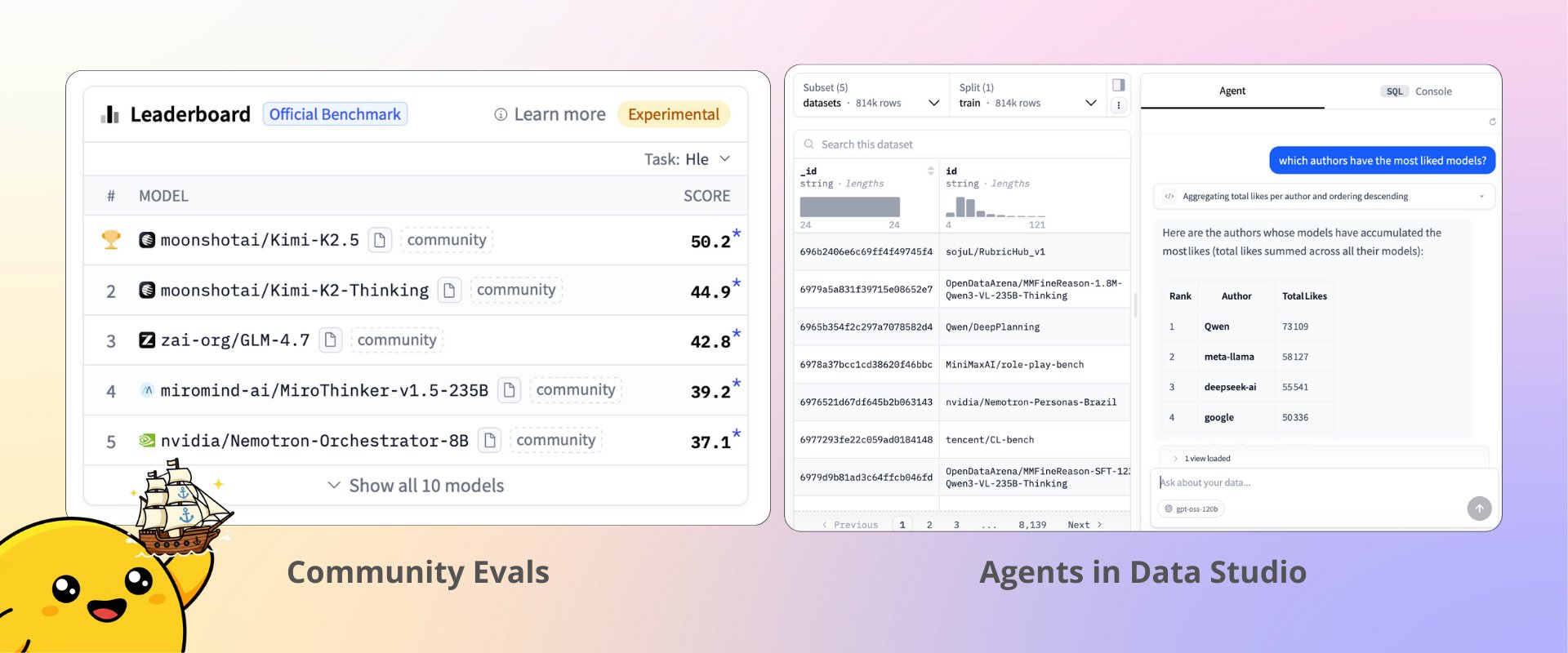
Community Evals and Benchmark Datasets for AI Models
By
–
We have been shipping Community Evals & Benchmark Datasets: Benchmark datasets host benchmark leaderboards, you can now contribute eval results by opening a PR to model repositories, all PRs are fed to benchmark datasets Chat with datasets: agents live in Data
-
Voxtral Transcription Quality Improvements and FFT Fixes
By
–
Voxtral (from @MistralAI) transcription quality is quite incredible, the way it handles the punctation and all the rest, makes transcribed audio messages so much more understandable. I implemented a few fixes in the FFT and now there is no longer a skipped tokens issue in voxtral.c
→ View original post on X — @guillaumelample, 2026-02-06 10:11 UTC
-
Decoupled Diffusion Inverse Solver: Solving PDEs with Minimal Data
By
–
I started in physics with numerical simulations, then accidentally found my way into ML. This Caltech SURF project let me bring those ideas back to physics beyond textbooks. The journey was nonlinear, full of surprising empirical and theoretical discoveries. Grateful for the guidance and opportunity. A formative experience at the frontier of computational physics × generative models. Prof. Anima Anandkumar (@AnimaAnandkumar) Solving Inverse PDEs with 1% Paired Data: Introducing Decoupled Diffusion Inverse Solver We propose a data-efficient and physics-aware diffusion framework for solving inverse problems on function spaces. In scientific machine learning, solving inverse problems requires costly and limited data acquisition from physical systems. Existing joint-embedding diffusion models require massive paired training data, as they represent the underlying physics implicitly through statistical correlations. In this work, we identify that under data scarcity, the observation-induced guidance signal vanishes during posterior sampling, making reconstruction impossible. Our Solution: We propose a decoupled design against joint-embedding: an unconditional diffusion learns the coefficient prior, while a neural operator explicitly models the forward PDE for guidance. This enables (1) superior data efficiency (2) effective physics-informed learning and sampling. Performance: Achieves state-of-the-art results on Navier-Stokes, Helmholtz, and Poisson benchmarks, improving spectral error by 54% on average. Data Efficiency: DDIS maintains high accuracy even when limited to just 1% of paired training data, outperforming joint models by 40% in L2 error. Robustness: Theoretical guarantees that avoid the guidance attenuation identified in joint-embedding methods. Check out the paper for the full theoretical analysis and experiments! arxiv.org/abs/2601.23280 Thomas Lin , @jiacheny7, Alex Chiang, Julius Berner, #MachineLearning #DiffusionModels #InverseProblems #PDE #NeuralOperators @Caltech #AI4Science — https://nitter.net/AnimaAnandkumar/status/2019510545242890370#m
→ View original post on X — @animaanandkumar, 2026-02-06 03:52 UTC
-
Kaggle Game Arena Announces Winning AI Models
By
–
The first @Kaggle Game Arena event of 2026 has officially concluded. From the logic of Chess to the social dynamics of Werewolf and the calculated risks of Poker, see the results and the winning AI models here:
-
Nuclear AI Security: New Research Project Unveiled
By
–
New Research Project on Computer Security For Nuclear AI
#AI #AIio #AIInnovation #ML #DataScience #Futureofwork @Scobleizer @AndrewYNg @drfeifei @KirkDBorne @fchollet @rowancheung @antgrasso -
Data Exploration Agent in Hugging Face Dataset Viewer
By
–
We recently shipped a Data Exploration Agent in the @huggingface Dataset Viewer 💽
— Caleb (@calebfahlgren) 5 février 2026
• powered by @OpenAI gpt-oss-120b 🤖
• served by @GroqInc for super fast inference ⚡
• multi-turn SQL on datasets in the browser 💻 pic.twitter.com/olIRUyPxd2We recently shipped a Data Exploration Agent in the @huggingface Dataset Viewer 💽 • powered by @OpenAI gpt-oss-120b 🤖 • served by @GroqInc for super fast inference ⚡ • multi-turn SQL on datasets in the browser 💻 [Translated from EN to English]