Each inference engine must implement the model architecture & its tool calling Getting a model to run correctly isn’t trivial, many parts are still inconsistent/broken Set the right baseline: match the GPUs, the inference engine for those GPUs & right inference engine for model
MACHINE LEARNING
-
TensorRT-LLM Optimized for DGX Spark: Inference Engines Matter
By
–
Inference Engines have different optimizations for different hardware Most optimized for DGX Spark: TensorRT-LLM Inference Engines MATTER and they are NOT EQUAL (e.g. blogpost below) Opensource models ARE NOT just a memory size issue BTW
-
AI Startup Satellite Imagery Property Identification System
By
–
Are you an AI startup or company building highly accurate and scalable AI solutions for urban monitoring? Applications are invited for an automated system for property identification and change detection using satellite imagery. To help you build, the following datasets are
-

NVIDIA GTC: Platform for Productionizing AI Innovation
By
–
What an incredible @nvidia GTC! It’s been energizing to connect with innovators and leaders on what’s next in AI. This evolution means leaders need a platform to productionize AI. Come catch us today! #NVIDIAGTC #AI #ML #MLOps
-

Ultimate Guide to LLM Fine-Tuning Techniques
By
–
Ultimate Guide to LLM Fine-Tuning! This is a comprehensive 115-page guide to fine-tuning LLMs. If you are serious about learning LLM fine-tuning, this guide is a great read. It covers: • Task and domain-specific fine-tuning
• Parameter-efficient methods (PEFT, LoRA, QLoRA, -
Atlas Evolution: From Walking to Warehouse Work
By
–
Boston Dynamics’ Atlas Evolves: From Walking to Shelf Work, Tire Flips, and Even Folding Spot #Robots
— Ronald van Loon (@Ronald_vanLoon) 19 mars 2026
by @lukas_m_ziegler#Robotics #ArtificialIntelligence #Innovation #MI #ML #Tech pic.twitter.com/myWzl1GFS0Boston Dynamics' Atlas Evolves: From Walking to Shelf Work, Tire Flips, and Even Folding Spot #Robots
by
@lukas_m_ziegler #Robotics #ArtificialIntelligence #Innovation #MI #ML #Tech -
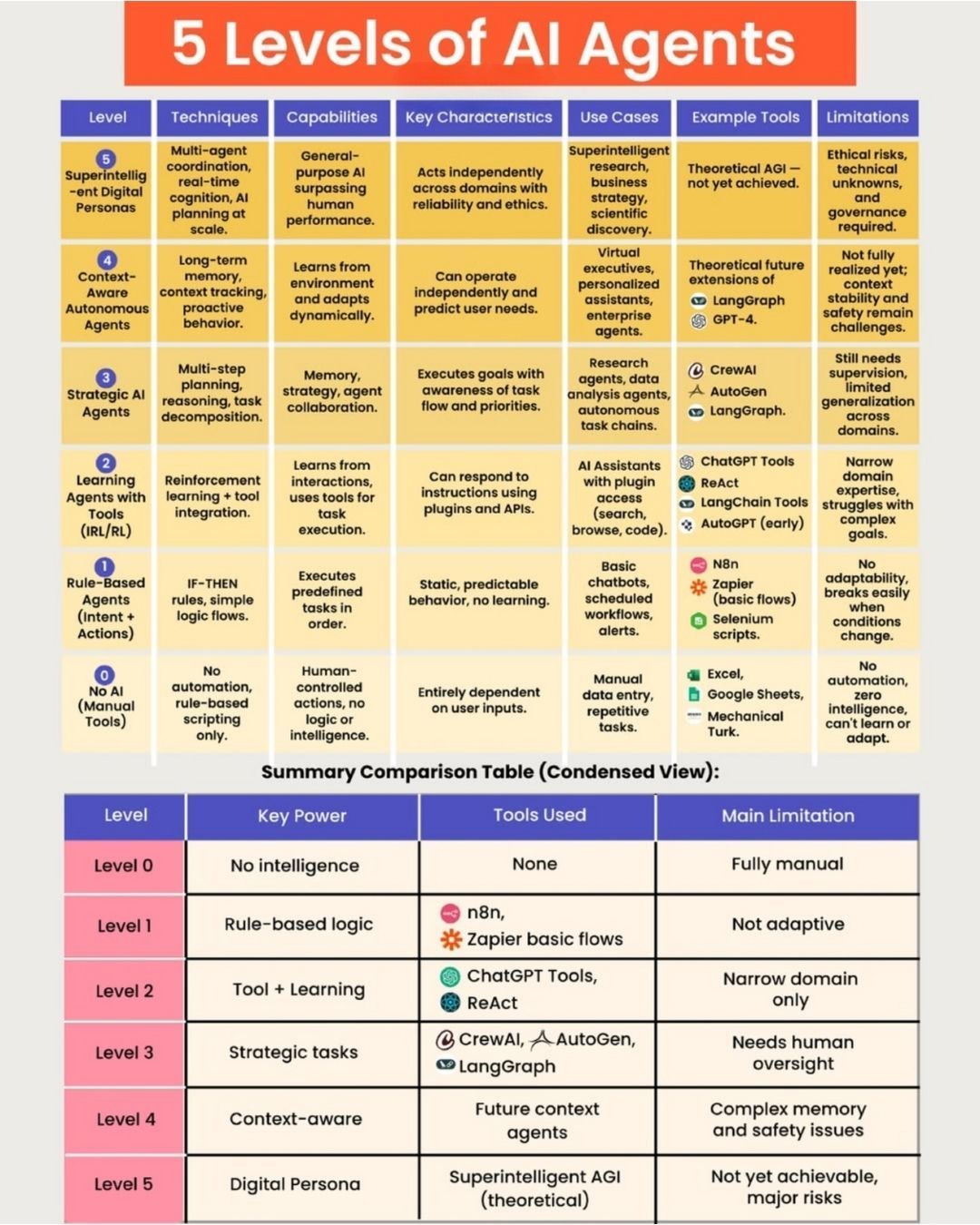
Five Levels of AI Agents: From Rules to Superintelligence
By
–
AI agents have levels 1. Rule-based (if-then automation) 2. Tool-using assistants 3. Strategic multi-step agents 4. Context-aware autonomous agents 5. Superintelligent digital personas (theoretical AGI) We’re moving from “AI that responds” → to “AI that executes
-
AI Applications in Weather, Climate, Food, and Disease Modeling
By
–
🔬 Weekly Science Long Read 🌍 🤖 @Caltech with @AnimaAnandkumar, new @ScienceBoard_UN member: AI can model weather, climate, food, and disease. For more, read the Board's Brief on Verification of Frontier AI. 🌐 Article: tinyurl.com/y2b24hbk 📘 Brief: tinyurl.com/4239b9fn
→ View original post on X — @animaanandkumar, 2026-03-19 13:00 UTC
-
Agentic Coding for Beginners: AI Tools and Research Workflows
By
–
I wrote an article on agentic coding for beginners after my talk at @apsarathchandar @ChandarLab group. We cover history of AI coding tools, the importance of model harnesses, and general principles in simple research workflows. Feedback is very welcome! aidanli.dev/writing/articles…
→ View original post on X — @hugo_larochelle, 2026-03-19 12:22 UTC
-
From RCNN to Fast RCNN: Revolutionary Object Detection Breakthrough
By
–
⚡From RCNN to Fast RCNN: A Breakthrough in Object Detection
— Satya Mallick (@LearnOpenCV) 19 mars 2026
Running a CNN 2000 times per image was painfully slow. Enter Fast RCNN-a smarter approach that runs the CNN once, reuses feature maps, and simplifies training end-to-end.
This breakthrough made detectors faster, more… pic.twitter.com/PoglpzJ6iQFrom RCNN to Fast RCNN: A Breakthrough in Object Detection Running a CNN 2000 times per image was painfully slow. Enter Fast RCNN-a smarter approach that runs the CNN once, reuses feature maps, and simplifies training end-to-end.
This breakthrough made detectors faster, more