oh where have you been seeing encoder-decoders come up?
MACHINE LEARNING
-
AI Vision Models Drive Next Generation Autonomous Vehicles
By
–
How close are we to cars that can see, think, and drive like humans? 🚗💡
— NVIDIA AI (@NVIDIAAI) 4 août 2025
Tin Sohn, Technical Lead for Vision-Language-Action Models at @Porsche, and Brian Moore, CEO & Co-Founder at @Voxel51, break down how AI, simulation, and foundation models are driving the next era of… pic.twitter.com/w2vfW3MYGhHow close are we to cars that can see, think, and drive like humans? Tin Sohn, Technical Lead for Vision-Language-Action Models at @Porsche
, and Brian Moore, CEO & Co-Founder at @Voxel51
, break down how AI, simulation, and foundation models are driving the next era of -

RETRO: Revisiting DeepMind’s Knowledge Outsourcing Architecture
By
–
RETRO (DeepMind, 2021) is a beautiful idea, one badly in need of revisiting the central innovation of retro is to have a small model decide what token to predict next, but outsource all knowledge to a large offline datastore this has the added benefit of allowing you to insert
-
FastWan: Ultra-Fast 5-Second Video Generation via Sparse Distillation
By
–
FastWan
— AK (@_akhaliq) 4 août 2025
Generating a 5-Second Video in 5 Seconds via Sparse Distillation pic.twitter.com/6xQ4lLzNMLFastWan Generating a 5-Second in 5 Seconds via Sparse Distillation
-
Continuous vs Discrete Prediction Space in Modern AI Models
By
–
This model makes predictions in continuous representation space.
An LLM makes predictions in discrete input space.
Prediction in continuous representation space is done with a (non-generative) Joint Embedding Predictive Architecture, i.e what I've been advocating for about 5 -
Learning Abstract Representation Spaces for Improved Model Prediction
By
–
I said it was impossible to predict all the details at the pixel level.
I said the solution was to learn an abstract representation space within which prediction could more easily be learned.
Which is *precisely* what this model does. -
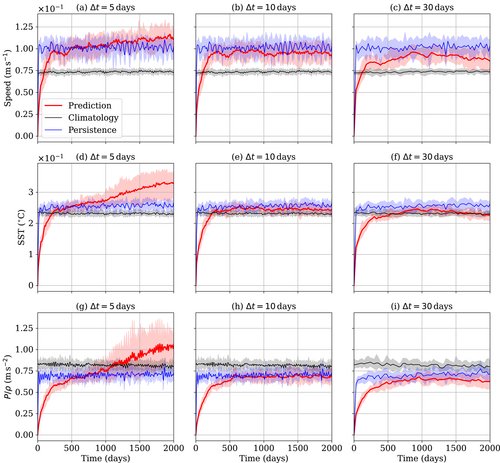
Fourier Neural Operators Enable High-Resolution Ocean Weather Models
By
–
Excited to share our recently published paper in @WileyGlobal on "Ocean Emulation With Fourier Neural Operators: Double Gyre" https://
agupubs.onlinelibrary.wiley.com/doi/10.1029/20
23MS004137
… We used Fourier Neural Operators to build the first high-resolution weather model, FourCastNet. Since it works so well for -
Kaggle Game Arena Benchmarks AI Models Through Strategic Games
By
–
Today we announced the @Kaggle Game Arena, a new benchmarking platform where AI models and agents can compete head-to-head in strategic games, starting with chess ♟️.
— Google AI (@GoogleAI) 4 août 2025
Why games, you ask? 🤔 Games are perfect for AI evaluation because they help us understand how models tackle… pic.twitter.com/XoZAk6hAouToday we announced the @Kaggle Game Arena, a new benchmarking platform where AI models and agents can compete head-to-head in strategic games, starting with chess . Why games, you ask? Games are perfect for AI evaluation because they help us understand how models tackle
-
Kaggle Game Arena: LLM Performance Benchmark Platform Launches
By
–
Thrilled to announce the @Kaggle Game Arena, a new leaderboard testing how modern LLMs perform on games (spoiler: not very well atm!). AI systems play each other, making it an objective & evergreen benchmark that will scale in difficulty as they improve.
-
Games as AI Testing Grounds: Arena Benchmarks Drive Progress
By
–
Games have always been a useful proving ground for AI (including our own work on AlphaGo & AlphaZero) and we're excited to see the progress this benchmark will drive as we add more games and challenges to the Arena – we expect to see rapid improvement!