[1] Don't Trust: Verify (ICLR 2024) https://
proceedings.iclr.cc/paper_files/pa
per/2024/file/0a79ecda13603817de4cdfc68b417e89-Paper-Conference.pdf
…
MACHINE LEARNING
-
Don’t Trust Verify: Research on AI Model Reliability
By
–
-
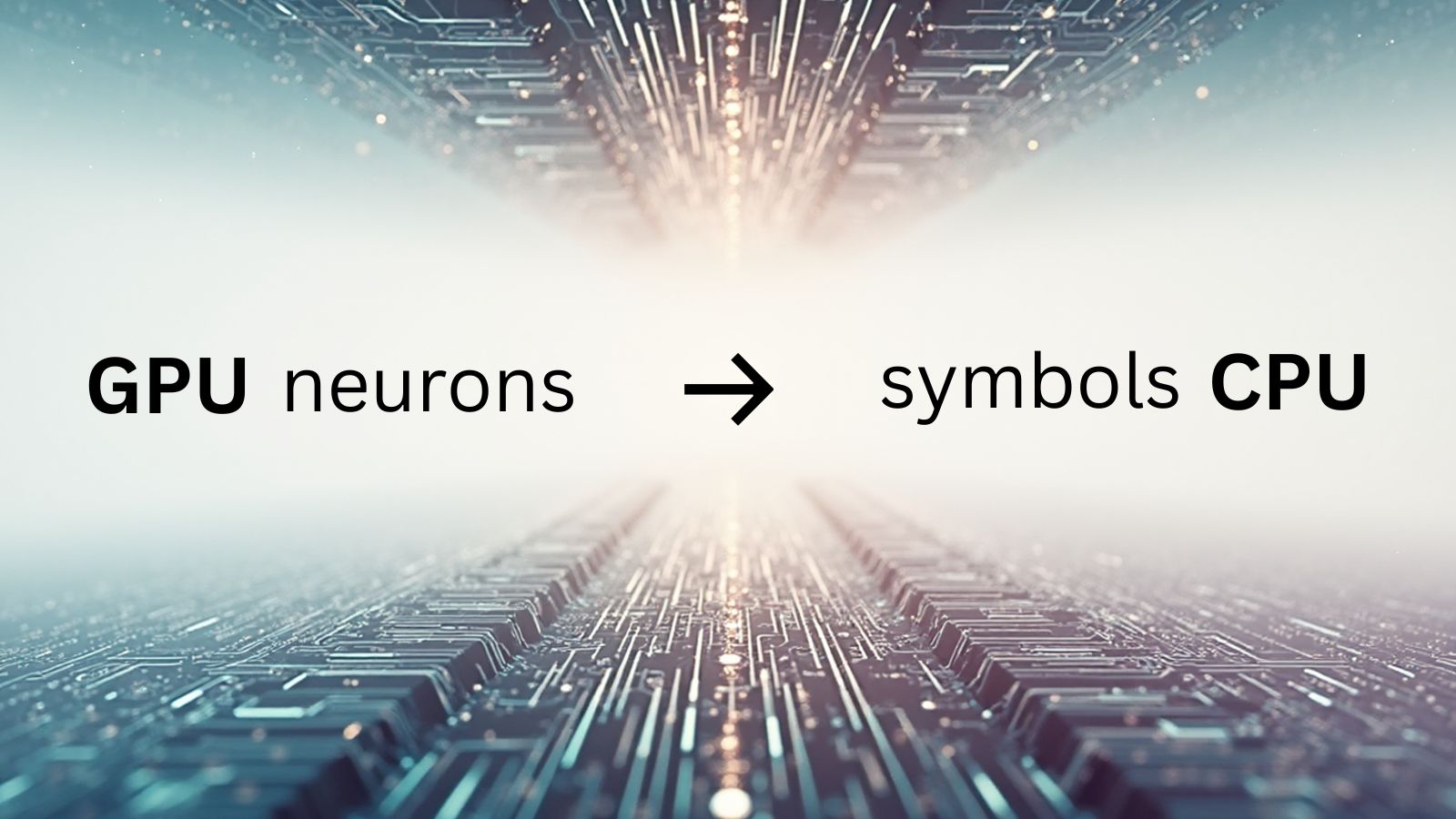
DTV Math Model: CPU-First Approach vs Symbolic Specialization
By
–
The DTV paper[1] from 2024 uses a 62B model specialized in math and reasoning, building up from 48.6% baseline by putting more emphasis on the symbolic side. What if we did the opposite, matching the baseline with specialized system on CPU and adding more parameters to improve?
-
AI recognition problem, not seeing, fixable with more training
By
–
Because it is time for everyone else to catch up. This was NOT a "seeing" problem. Camera saw it. It's an AI problem. It didn't recognize it properly, or make the right moves. This will be fixed with more training. AI is an exponentially learning system. Train it on one
-

Emotionally partitioned AI agents switch personas for different audiences
By
–
You compartmentalize your emotions, why not your AI?
Emotionally partitioned AI agents are single AI systems that switch between different personas for regulators, customers, and internal teams, adjusting tone, priorities, and emotional style to match each audience. This -
SAM Audio: Unified Model for Sound Isolation from Complex Mixtures
By
–
🔉 Introducing SAM Audio, the first unified model that isolates any sound from complex audio mixtures using text, visual, or span prompts.
— AI at Meta (@AIatMeta) 16 décembre 2025
We’re sharing SAM Audio with the community, along with a perception encoder model, benchmarks and research papers, to empower others to… pic.twitter.com/FuMJyULmJRIntroducing SAM Audio, the first unified model that isolates any sound from complex audio mixtures using text, visual, or span prompts. We’re sharing SAM Audio with the community, along with a perception encoder model, benchmarks and research papers, to empower others to
-

SAM Audio: Advanced Audio Separation Technology Outperforms Previous Models
By
–
SAM Audio represents a significant advancement in audio separation technology, outperforming previous models across a wide range of benchmarks and tasks.
-
Video Models as World Simulators: The Next Technological Frontier
By
–
Universal World Simulator Soon, everyone will have access to their own world simulator. This will be the most important technological development of our time. models trained at sufficient scale become world models. To predict the next frame, a video model must learn how
-
GPT-5 Autonomously Optimizes Molecular Cloning Laboratory Protocols
By
–
We’re also testing our models on real world lab experience. We worked with Red Queen Bio to test models to optimize protocols in the lab. GPT-5 proposed, ran (via a controlled framework), and iterated on experiments — increasing a standard molecular cloning protocol's
-
Advanced AI Benchmarks Reveal Model Progress and Development Needs
By
–
Combining harder benchmarks like FrontierScience with real-world lab evaluations gives us a clearer map of where models are effective today and where further development is needed. We see strong early promise, alongside well-defined limitations, and we’ll continue iterating
-
Weight Decay: Soft Pruning of Noisy Features in Neural Networks
By
–
Weight decay is usually presented as “encouraging simpler solutions”, but I tend to think that the real benefit is the soft pruning of noisy / unhelpful features. Without decay, a weight can random-walk to a large value even if the input is completely random. Momentum and