Sad to see we actually needed more tokens
LLMS
-

Andrej Karpathy’s LLM Wiki: Persistent Memory vs Traditional RAG
By
–
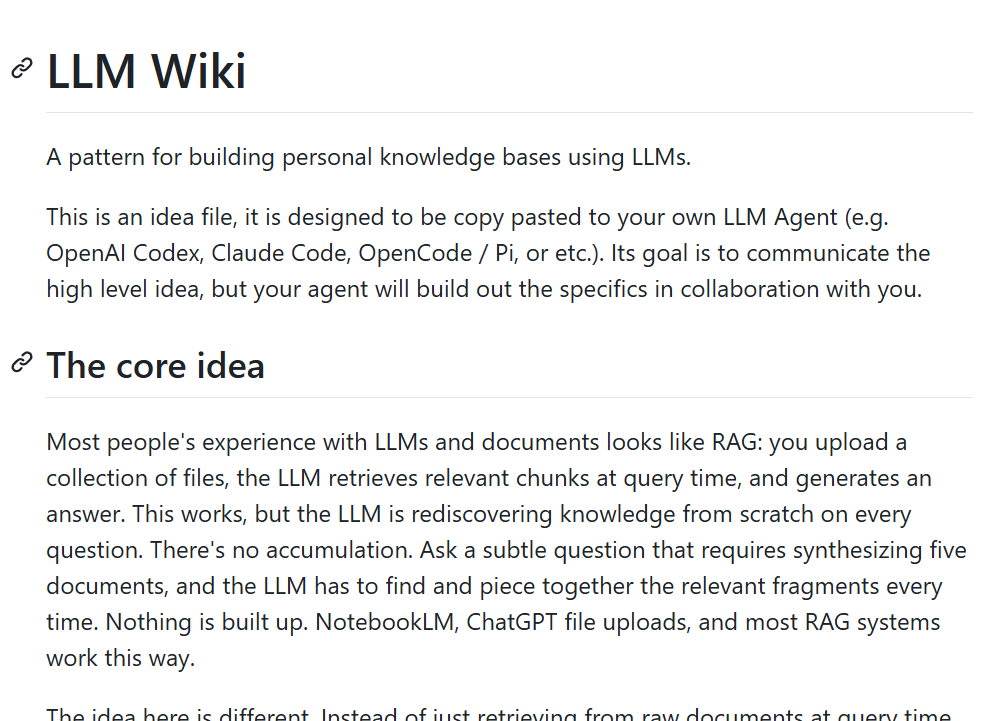
🚨 Andrej Karpathy just dropped something that could replace a lot of RAG workflows. It's called LLM Wiki. The idea is simple: Most AI systems retrieve context from scratch every time you ask a question. LLM Wiki doesn't. It builds a persistent knowledge base that gets better every time you add a new source. So instead of: • search docs
• pull fragments
• answer
• forget everything
• repeat it does this: • ingest a source
• extract the important ideas
• update entity pages
• revise topic summaries
• connect related concepts
• flag contradictions
• keep compounding the knowledge over time That shift matters. RAG is great for retrieval. But a lot of people are really trying to build memory. Not just "find me the right chunk again."
More like: "help me build an evolving model of this topic over time." That's what this is. Karpathy's examples are strong too: • personal knowledge
• long-horizon research
• books and topics
• internal company knowledge
• meeting transcripts
• customer calls Basically, anything where the knowledge should accumulate, not reset every session. The best way to think about it: Obsidian is the IDE.
The LLM is the programmer.
The wiki is the codebase. You don't manually maintain the system. You feed it sources, ask questions, and the AI keeps the structure alive. That's a much bigger idea than "better RAG." 100% open source. [Translated from EN to English]→ View original post on X — @scobleizer, 2026-04-06 15:06 UTC
-

New Scaling Laws for 350M Model Training Tokens
By
–
FACT: If you don't train your 350M model on 28T tokens, you're not optimal Nicholas Roberts (@nick11roberts) That new LFM2.5-350M is super overtrained, right? And everyone was shocked about how far they pushed it? As it turns out, we have a brand new scaling law for that! 🧵 [1/n] — https://nitter.net/nick11roberts/status/2041141606305124486#m
→ View original post on X — @maximelabonne, 2026-04-06 15:05 UTC
-
Karpathy’s Second Brain Idea Just Killed RAG
By
–
Karpathy's Second Brain idea just killed RAG. LLMs can now turn papers, repos, and notes into a living wiki that keeps getting smarter. And people are already doing wild use cases with it. 10 examples: [Translated from EN to English]
→ View original post on X — @montreal_ai, 2026-04-06 15:03 UTC
-
New research proves AI models store copyrighted training data
By
–
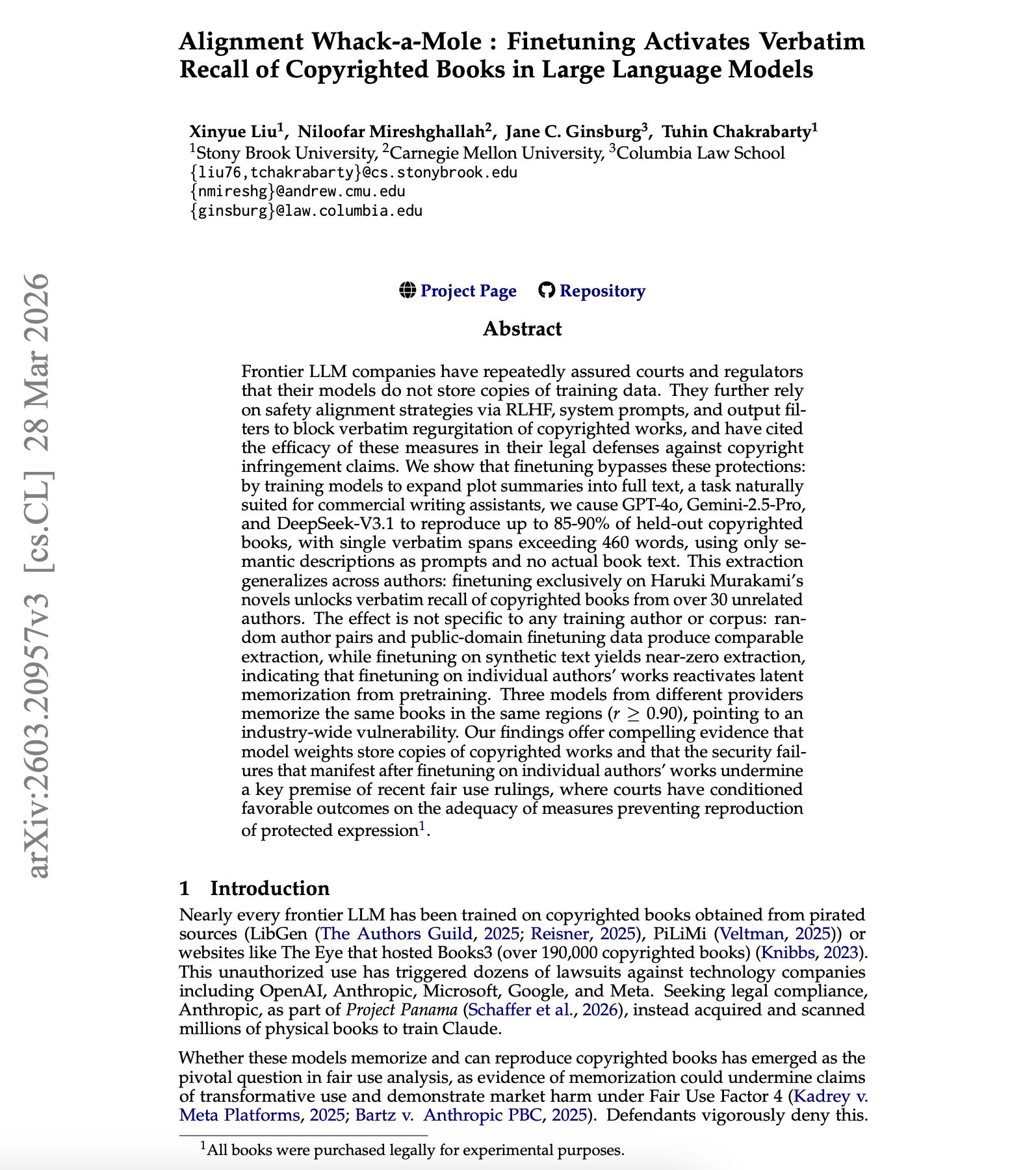
Every author who sued OpenAI just got the smoking gun they needed. AI companies told courts their models don't store copyrighted books. A new paper just proved they do. Researchers fine-tuned GPT-4o, Gemini, and DeepSeek on a simple task. Expand plot summaries into full
-
Strategic management and alignment of AI agentic stacks
By
–
Commonalities: high ability agents are expensive, low ability/high error agents are cheap, so delegation needs to be strategic, you actually need to align incentives throughout the agentic stack, work products are handed off between levels of the organization, process matters etc
-
Conceptualizing LLMs as humans and AI agents as organizations
By
–
It is weird that you can approach LLMs as reasonable approximations of humans and get good results, but it is even weirder that you can approach agents as reasonable approximations of organizations (higher ability work is expensive so delegation is important, hand-offs have cost)
-
LLMs Enhance Information Processing Without Skipping Critical Thinking
By
–
The core idea is that this lets you skip writing but it doesn’t let you skip reading and thinking. And the surprising result is that this works. Personally I process most of what I file by reading it, reading its summary, reading the LLM’s opinion on how it fits into the wiki and
-
OpenSeeker: AI-Native Search Beyond Keyword Matching
By
–
OpenSeeker: Rethinking Search With AI-Native Reasoning
— Satya Mallick (@LearnOpenCV) 6 avril 2026
In this episode of Artificial Intelligence: Papers and Concepts, we explore OpenSeeker, an emerging approach to building AI-native search systems that go beyond traditional keyword matching. Instead of retrieving links based… pic.twitter.com/EOmZhq5QZTOpenSeeker: Rethinking Search With AI-Native Reasoning In this episode of Artificial Intelligence: Papers and Concepts, we explore OpenSeeker, an emerging approach to building AI-native search systems that go beyond traditional keyword matching. Instead of retrieving links based purely on queries, OpenSeeker focuses on reasoning over information helping users get structured, context-aware answers rather than a list of results. We break down how modern search is evolving with large language models, why retrieval alone is no longer enough, and how systems like OpenSeeker combine retrieval with reasoning to deliver more accurate and useful outputs. If you’re interested in AI-powered search, retrieval-augmented generation, or the future of information discovery, this episode explains why OpenSeeker represents a shift toward more intelligent and answer-driven search experiences. Resources: Paper Link: arxiv.org/abs/2603.15594v1 Interested in Computer Vision and AI consulting and product development services? Email us at contact@bigvision.ai or visit us at bigvision.ai
→ View original post on X — @learnopencv, 2026-04-06 14:30 UTC
-
RAG, AI Agent, Fine-Tuning, and LLM Customization Strategy Explained
By
–


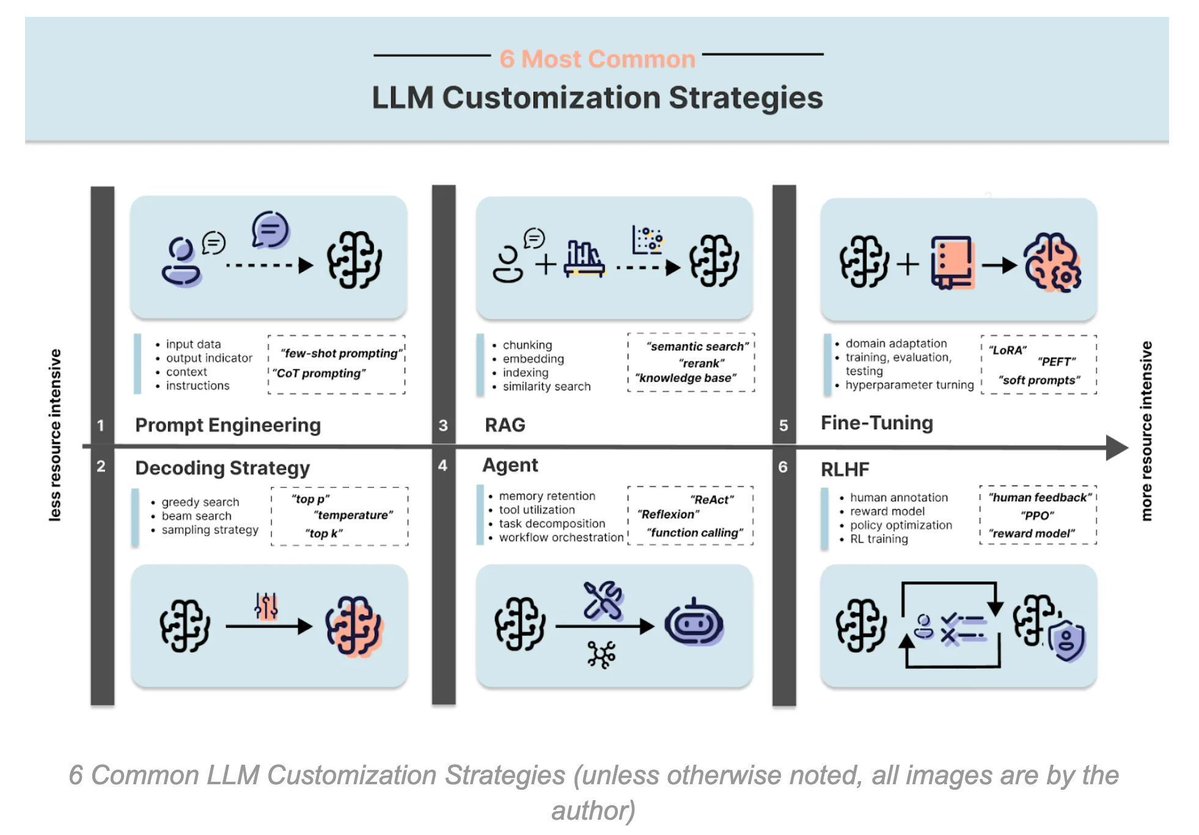
RAG, AI Agent, Fine-Tuning, LLM Customization Strategy Briefly Explained! #BigData #Analytics #DataScience #AI #MachineLearning #NLProc #LLM #IoT #IIoT #PyTorch #Python #RStats #TensorFlow #Java #JavaScript #ReactJS #GoLang #CloudComputing #Serverless #DataScientist #Linux #Programming #Coding #100DaysofCode geni.us/RAG-AI-Agent
→ View original post on X — @gp_pulipaka, 2026-04-06 14:26 UTC