
What if visual reasoning could be done without generating endless images or code? Meta AI and CUHK researchers present ATLAS: a single "functional token" that works as both an agentic action and a latent reasoning unit. No visual supervision, no extra architecture—just one
LLMS
-

Mazda builds GenAI assistant on Databricks for service hotline
By
–
.
@MazdaUSA built a GenAI assistant on Databricks to help service hotline agents navigate growing diagnostic complexity with faster, more consistent support. The team brought together vehicle history, recalls, diagnostic data, and service documents into a single governed -

Orchestrating goals for Awesome LLM Apps repo with Gbrain
By
–
Main task to be an orchestrator of goals for Awesome LLM Apps repo and help me build cool things (
https://
github.com/Shubhamsaboo/a
wesome-llm-apps
…) Rest is everything from from research, to brainstorming where Gbrain comes in really handy to connect the dots. -

Microsoft Builds Super App to Unify Fragmented Copilots
By
–
Fortune reports Microsoft is building a "super app" to unify its scattered Copilots. Under 4.5% of 450 million Microsoft 365 seats pay for Copilot. Around 20 million, out of nearly half a billion. The app is pitched as a fix for fragmentation. The open question is whether
-

Back to Claude Opus 4.8 with 1M context, max and fast
By
–
after a brief moment of simplified model names, i'm back to claude opus 4.8 (1m context) – max – fast
-
Hermes allows LLM judgment but constrains irreversible actions
By
–
Hermes handles edge cases by making the skill loop conservative at the boundaries, not by pretending the agent has perfect judgment. The main pattern is: LLM judgment is allowed to propose structure, but irreversible actions are constrained.
-
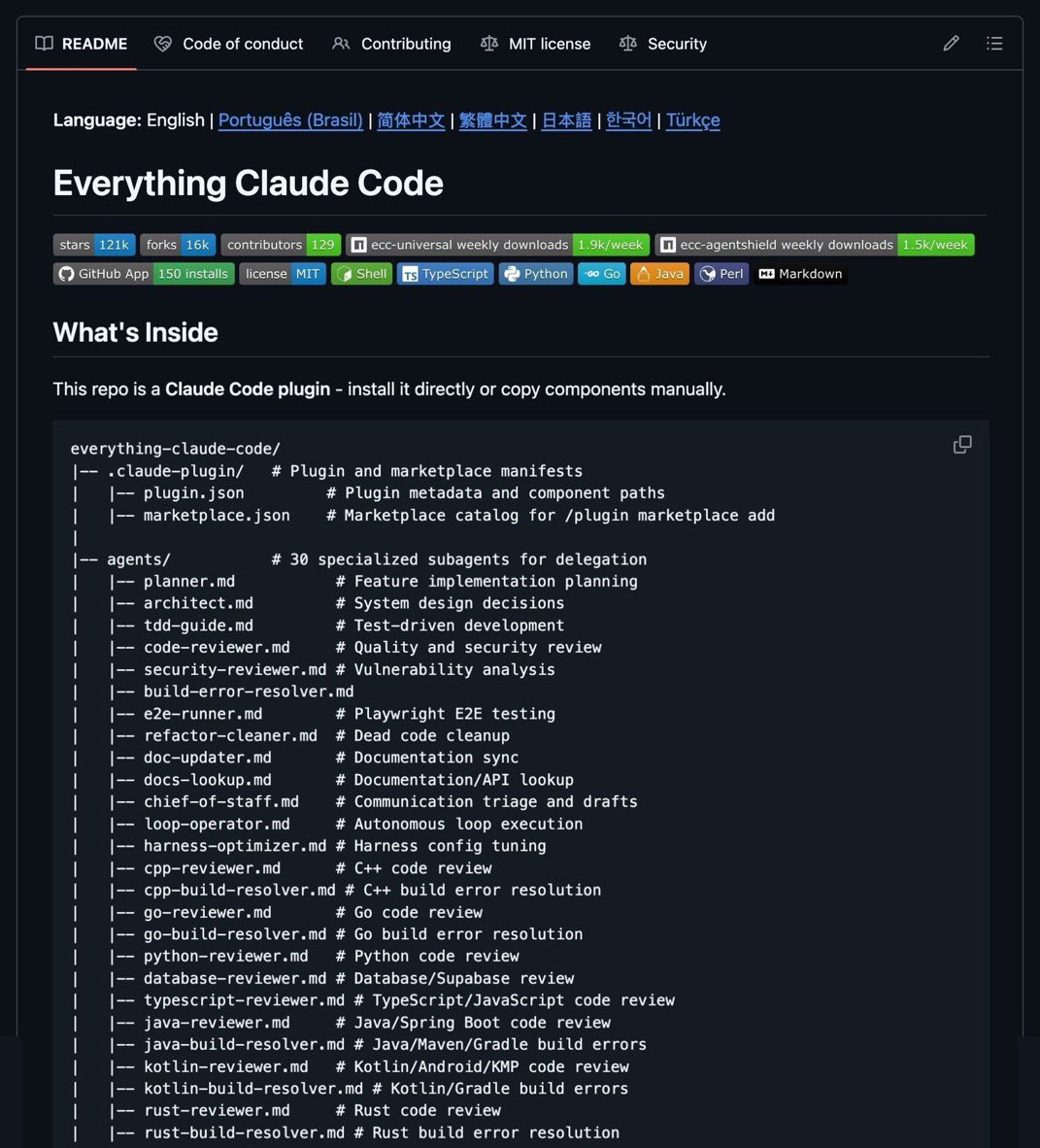
Everything Claude Code: the most complete open source toolkit
By
–
You are not using 100% of Claude Code.
Until you install this. It's called Everything Claude Code and it's the most complete open source toolkit I've seen. → 30 agents, 64 skills, 33 commands
→ Integrated AgentShield with 1,282 security tests
→ -
Wondering how a mini model beats 5.5
By
–
I did wonder, hard to explain how a mini model would do better than 5.5
-
OPQA Benchmark: 20 Real Engineering Bottlenecks from OpenAI
By
–
OpenAI-Proof Q&A (OPQA) is a benchmark of 20 real research and engineering bottlenecks that OpenAI teams encountered internally, each taking more than a day to solve. A model is given relevant code, logs, and experiment artifacts, then asked to identify and explain the root
-

OpenAI benchmark scores stagnant since launch
By
–
OpenAI has this interesting benchmark of OpenAI's real engineering bottlenecks, where the scores have not moved since launch over a year ago. Some earlier models did even better than 5.5. I wonder what's going on here.