Well it all started when X premium users with Neuralink could get paid to let Grok use excess neural capacity…
INNOVATION
-

Reproducing GPT-2 124M: Comprehensive 4-Hour Video Lecture
By
–
📽️ New 4 hour (lol) video lecture on YouTube: "Let’s reproduce GPT-2 (124M)" piped.video/l8pRSuU81PU The video ended up so long because it is… comprehensive: we start with empty file and end up with a GPT-2 (124M) model: – first we build the GPT-2 network – then we optimize it to train very fast – then we set up the training run optimization and hyperparameters by referencing GPT-2 and GPT-3 papers – then we bring up model evaluation, and – then cross our fingers and go to sleep. In the morning we look through the results and enjoy amusing model generations. Our "overnight" run even gets very close to the GPT-3 (124M) model. This video builds on the Zero To Hero series and at times references previous videos. You could also see this video as building my nanoGPT repo, which by the end is about 90% similar. Github. The associated GitHub repo contains the full commit history so you can step through all of the code changes in the video, step by step. github.com/karpathy/build-na… Chapters. On a high level Section 1 is building up the network, a lot of this might be review. Section 2 is making the training fast. Section 3 is setting up the run. Section 4 is the results. In more detail: 00:00:00 intro: Let’s reproduce GPT-2 (124M) 00:03:39 exploring the GPT-2 (124M) OpenAI checkpoint 00:13:47 SECTION 1: implementing the GPT-2 nn.Module 00:28:08 loading the huggingface/GPT-2 parameters 00:31:00 implementing the forward pass to get logits 00:33:31 sampling init, prefix tokens, tokenization 00:37:02 sampling loop 00:41:47 sample, auto-detect the device 00:45:50 let’s train: data batches (B,T) → logits (B,T,C) 00:52:53 cross entropy loss 00:56:42 optimization loop: overfit a single batch 01:02:00 data loader lite 01:06:14 parameter sharing wte and lm_head 01:13:47 model initialization: std 0.02, residual init 01:22:18 SECTION 2: Let’s make it fast. GPUs, mixed precision, 1000ms 01:28:14 Tensor Cores, timing the code, TF32 precision, 333ms 01:39:38 float16, gradient scalers, bfloat16, 300ms 01:48:15 torch.compile, Python overhead, kernel fusion, 130ms 02:00:18 flash attention, 96ms 02:06:54 nice/ugly numbers. vocab size 50257 → 50304, 93ms 02:14:55 SECTION 3: hyperpamaters, AdamW, gradient clipping 02:21:06 learning rate scheduler: warmup + cosine decay 02:26:21 batch size schedule, weight decay, FusedAdamW, 90ms 02:34:09 gradient accumulation 02:46:52 distributed data parallel (DDP) 03:10:21 datasets used in GPT-2, GPT-3, FineWeb (EDU) 03:23:10 validation data split, validation loss, sampling revive 03:28:23 evaluation: HellaSwag, starting the run 03:43:05 SECTION 4: results in the morning! GPT-2, GPT-3 repro 03:56:21 shoutout to llm.c, equivalent but faster code in raw C/CUDA 03:59:39 summary, phew, build-nanogpt github repo
→ View original post on X — @sudalairajkumar, 2024-06-09 23:41 UTC
-
GPU spending scale needed for hundred billion dollar model training
By
–
6/ so we won't see what would happen if you spent $100B of GPUs on a model for a while because of how spread out the GPU distributions are. we'd likely need to see $500B of aggregate GPU spend to have an individual model trained on $100B of GPUs (wow!)
-
Data Wall: AI Progress Bottleneck or Engineering Challenge?
By
–
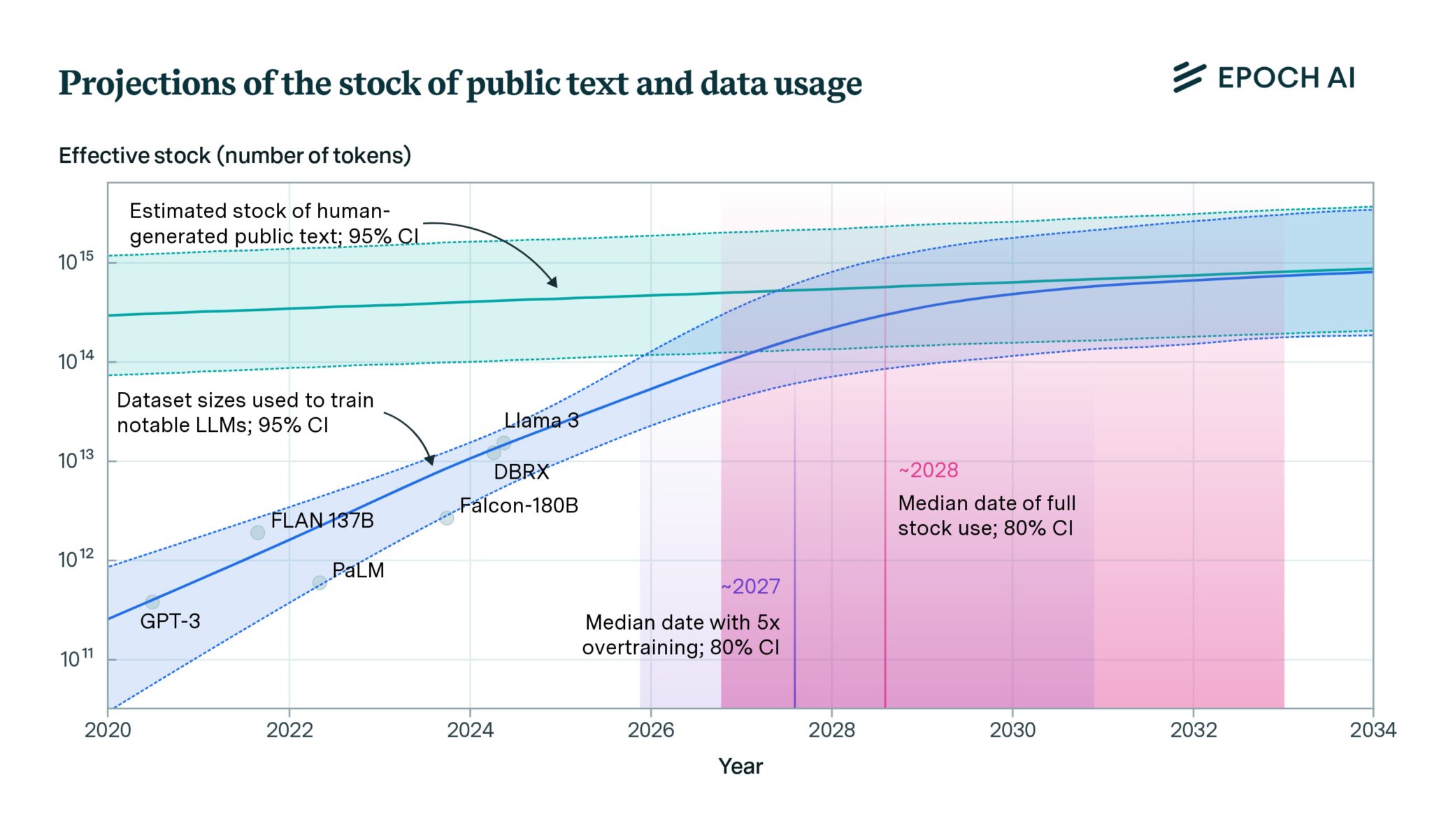
6/ if you zoomed all the way out, the data wall will either look like: A) a short-term impediment that we will engineer our way out of
B) a very meaningful plateau to AI progress the industry is pretty split on which of these it is—there's no obvious answer -
Data abundance and algorithmic advances beyond current scaling laws
By
–
7/ in the "data wall will slow AI" case, progress will depend on: – methods for data abundance (above)
– algorithmic advances that advance us beyond the current scaling law paradigm -

Scaling Laws: Data and Compute Trade-offs in AI Training
By
–
3/ the original scaling laws require a scaling of data alongside compute, and while you can still improve loss with more compute, it is much less efficient than if you scaled data as well
-
Scaling AI: Expert Data, RL Environments, and Synthetic Data Methods
By
–
4/ there's a lot of arguments on both ends, but fundamentally scaling relies on expanding beyond existing internet data we need a number of methods for data abundance:
– high-end expert frontier data, which is more valuable than internet data
– RL environments
– synthetic data -
Compute vs Data: Two Schools of Thought on AI Progress
By
–
2/ there are 2 schools of thought: 1) compute is the only real bottleneck to AI progress. the more we spend, the closer we get to AGI 2) we are hitting a data wall which will slow progress regardless of how much compute we have
-
Generative ConvNets for Video: A Decade of AI Innovation
By
–
Us indeed! A decade earlier, in 2010, we organically introduced generative convnets for video understanding and generation. I remember presenting it at NeurIPS and Jitendra Malik rightfully asking us to scale and evaluate. Yet, I argued against most of the vision community at the
-
MLX: Deep Learning Framework for Machine Learning on macOS
By
–
7. MLX: A deeplearning framework for machine learning on macOS! You can efficiently train and deploy ML models. The repo also includes examples to run open-source models using MLX, like LLaMA, Mixtral 8x7B, LoRA, CLIP, Whisper and Stable Diffusion. https://
github.com/ml-explore/mlx