47 (@47_h_ ) AI Self of Pika Product Manager Starry (@starryhe214) pic.twitter.com/WANUEioOMK
— Pika (@pika_labs) 23 février 2026
47 (
@47_h_ ) AI Self of Pika Product Manager Starry (
@starryhe214
)

By
–
47 (@47_h_ ) AI Self of Pika Product Manager Starry (@starryhe214) pic.twitter.com/WANUEioOMK
— Pika (@pika_labs) 23 février 2026
47 (
@47_h_ ) AI Self of Pika Product Manager Starry (
@starryhe214
)
By
–
RT @DanTurnerEvans: What if you could run a million simulations in the time it takes to run one? Neural operators are making this a realit…
→ View original post on X — @animaanandkumar, 2026-02-23 19:09 UTC
By
–
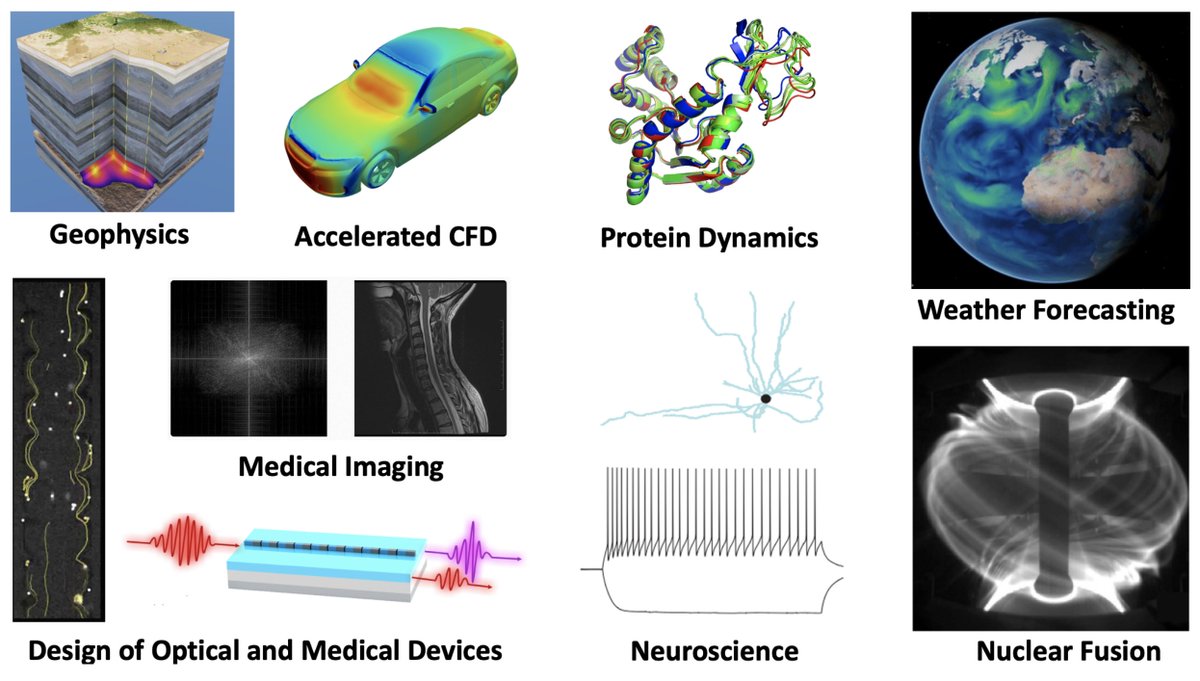
What if you could run a million simulations in the time it takes to run one? Neural operators are making this a reality. These neural networks learn to approximate the physics behind conventional simulations and then produce new solutions almost instantly. The result? Better-performing chips, smarter fusion reactors, faster drug discovery. A new neural operator is trained for each design problem. The design process unfolds as follows: 1. The problem is defined. For example, optimizing the layout of a computer chip to minimize hot spots that arise during operation and can lead to device failure. 2. The parameter space is defined. In the above example, this could be the range of possible layouts and connections between chip components. 3. Hundreds or thousands of conventional simulations are run to sample the parameter space. These simulations can be very computationally intensive, requiring a supercomputer in some cases. 4. The neural operator is trained on those simulations. Crucially, while the training simulations use discrete grids, neural operators learn continuous solutions. This means they can be trained on lower-resolution simulations and still produce accurate results at higher resolutions, saving even more compute. 5. The trained network evaluates candidate designs almost instantly, enabling rapid optimization across the parameter space. 6. The solution is verified with a conventional simulation. In practice, these checks are run periodically throughout the process to keep the neural operator honest. By replacing the bulk of expensive simulations with near-instant neural operator evaluations, engineers can explore vast design spaces that were previously out of reach. Yet another example of how neural networks beyond LLMs are quietly transforming science and engineering.
→ View original post on X — @animaanandkumar, 2026-02-23 19:00 UTC
By
–
Here's what it looks like in real time:
— God of Prompt (@godofprompt) 23 février 2026
→ Switching between Claude and ChatGPT
→ Complex prompts spoken naturally
→ Building on previous outputs by voice
→ Iterating 10x faster
This is how I went from 5 prompts a day to 50. pic.twitter.com/HddBPkFZne
Here's what it looks like in real time: → Switching between Claude and ChatGPT
→ Complex prompts spoken naturally
→ Building on previous outputs by voice
→ Iterating 10x faster This is how I went from 5 prompts a day to 50.
By
–
So I started just… talking to Claude and ChatGPT.
— God of Prompt (@godofprompt) 23 février 2026
Like I'm explaining my idea to a smart colleague.
→ Open ChatGPT
→ Hit Wispr Flow
→ Just describe what I want in natural language
→ All the context, all the nuance, everything
Zero friction between thought and prompt. pic.twitter.com/bh7uiCMR6l
So I started just… talking to Claude and ChatGPT. Like I'm explaining my idea to a smart colleague. → Open ChatGPT
→ Hit Wispr Flow
→ Just describe what I want in natural language
→ All the context, all the nuance, everything Zero friction between thought and prompt.
By
–
The jam in AI work isn't the model.
— God of Prompt (@godofprompt) 23 février 2026
It's getting your thoughts INTO the model.
→ Think of perfect prompt
→ Start typing
→ Lose half the nuance
→ Forget the context you wanted
→ Backspace, retype
→ Finally hit enter
Your brain moves faster than your fingers. pic.twitter.com/r8aq6Bsw7X
The jam in AI work isn't the model. It's getting your thoughts INTO the model. → Think of perfect prompt
→ Start typing
→ Lose half the nuance
→ Forget the context you wanted
→ Backspace, retype
→ Finally hit enter Your brain moves faster than your fingers.
By
–
Which research paper(s) changed how you view AI?
By
–
Congratulations to BAIR Faculty @negar_mehr and BAIR alumni @pathak2206 @ebiyik_ @mark_ho_ who have been awarded the 2026 ONR Young Investigator Award!
By
–
It’s true; every employee at Pika now works with an AI Self.
— Pika (@pika_labs) 23 février 2026
(This is not a marketing gimmick, though it’s proving pretty handy in that respect.) https://t.co/sAHxMe10Gb
It’s true; every employee at Pika now works with an AI Self. (This is not a marketing gimmick, though it’s proving pretty handy in that respect.)
By
–
This is unreal… A video of your kid can now expose your exact home address
— Linus ✦ Ekenstam (@LinusEkenstam) 23 février 2026
I bet you that most people don’t know this at all
But GeoSpy AI can find your exact location from a single photo.
No metadata. No EXIF data. Just pixels. This is bonkers
pic.twitter.com/ZpCZxJktL2
This is unreal… A video of your kid can now expose your exact home address I bet you that most people don’t know this at all But GeoSpy AI can find your exact location from a single photo. No metadata. No EXIF data. Just pixels. This is bonkers