Oh, they will. They’d have done by now if it wasn’t for opensource. Owning your compute / hardware is a must
HARDWARE
-
User Upgrades Laptop with 128GB RAM for AI Workloads
By
–
My existing laptop was showing its age, and I think 128GB RAM will do me for quite a while
-
Backpack-Sized Bipedal Humanoid Robot Redefines Portable Robotics
By
–
Backpack-Sized Bipedal Humanoid #Robot Redefines Portable Robotics
— Ronald van Loon (@Ronald_vanLoon) 27 mars 2026
via @ZappyZappy7
#Robotics #Engineering #ArtificialIntelligence #Innovation #Technology pic.twitter.com/wBKX3ERNuuBackpack-Sized Bipedal Humanoid #Robot Redefines Portable Robotics
via @ZappyZappy7 #Robotics #Engineering #ArtificialIntelligence #Innovation #Technology -
Day 83 GPU Programming: DeepSeek Multi-Head Latent Attention Optimization
By
–
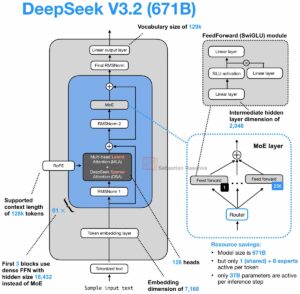
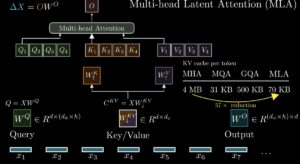
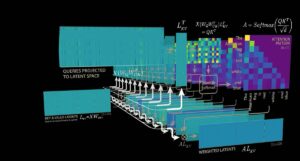
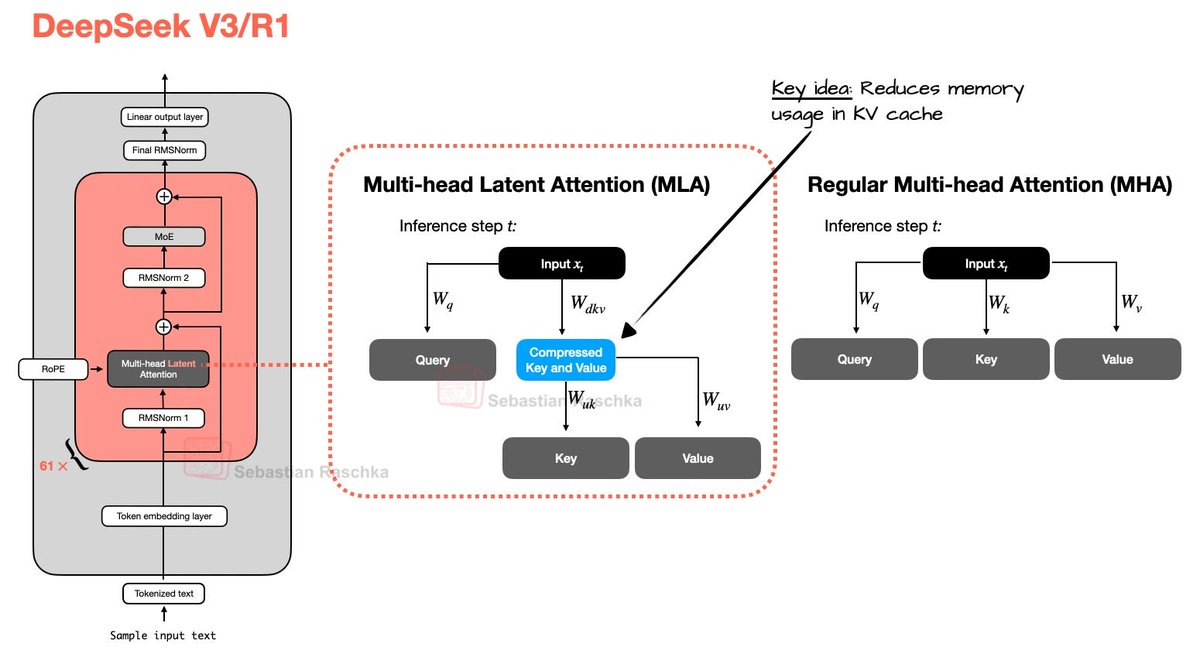
Day 83/365 of GPU Programming Looking at DeepSeek's Multi-Head Latent Attention today. The last part of the AMD challenge series is to optimize an MLA decode kernel for MI355X where the absorbed Q and compressed KV cache are given and your task is to do the attention computation. A resource that really helped internalize what MLA does was @rasbt's incredible visual guide to attention variants in LLMs (luckily he posted that last week!), which covers everything from MHA to GQA to MLA to SWA, et cetera. If there's one place to get a visual intuition for recent attention mechanisms, it's this blog post. @jbhuang0604's video on MQA, GQA,MLA and DSA was the best conceptual intro I found on the topic and progressively builds up the ideas from first principles. The Welch Labs analysis of MLA is a great watch as well. Beautiful visualization of the changes DeepSeek made for MLA. Tried out a few kernels once I had a basic understanding of MLA and I think I'm slowly getting more comfortable with at least analyzing kernels. levi (@levidiamode) Day 82/365 of GPU Programming Taking a closer look at Mixture of Experts today, so I can write better MoE kernels. Specifically, to optimize an MXFP4 MoE fused kernel for the GPU Mode challenge. I haven't had much prior exposure to MoEs, so lots of new concepts I learned today. Luckily I found the best intro to MoEs thanks to @MaartenGr visual overview of the topic. I then watched @tatsu_hashimoto's amazing Stanford CS336 lecture on MoEs, which added deeper context around why MoEs are gaining popularity, FLOPs, OLMoE, infra complexity, routing functions (mindblown this works so well…), expert sizes, training objectives, top k routing and DeepSeek variations. Once I had a basic understanding I started playing around with the some AITER kernels but progress there is tbd. Also had a nice chat with @juscallmevyom (who was kind enough to reach out!) about the AMD kernels and the challenge of materialization overhead. — https://nitter.net/levidiamode/status/2037297869518950430#m
-
GPU Chat Progress Discussion on Early Phase Topic
By
–
Still early phases for what you’re talking about, I had Alex jump in and chatted with him on the progress of that yesterday in my GPU Chat with Ahmad space
-
High-Performance Computing: The Power of a 4x GPU Setup
By
–
Just wait until you have a 4x GPUs setup bro You won’t look back
-
GPU Access Crucial for Open-Source AI Progress and Market Timing
By
–
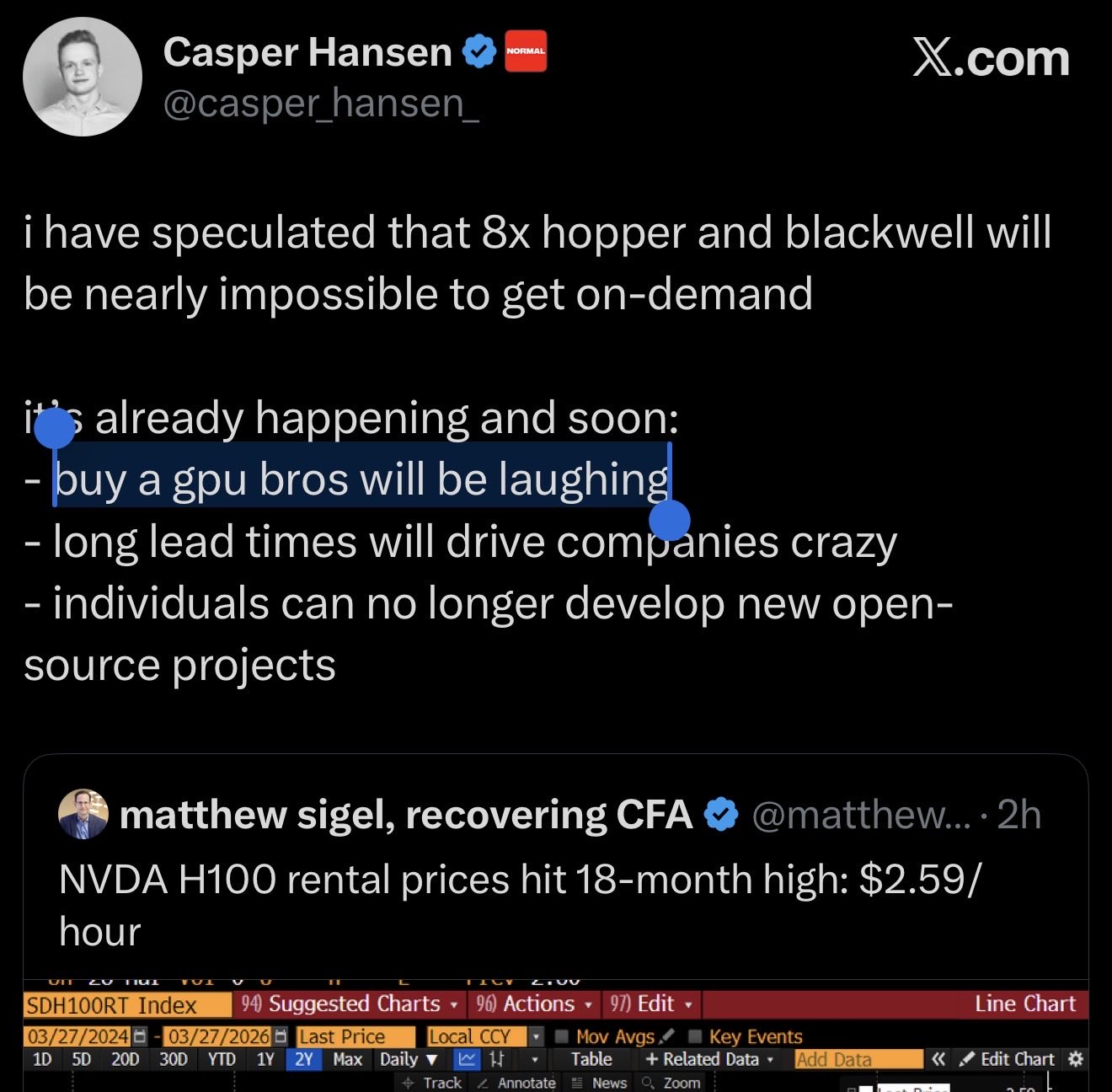
Buy a GPU was always going to win All I wanted was for smart individuals & researchers to have access to the compute they need so opensource progress doesn’t stall, I wasn’t making anything up There’s still time to secure your compute before prices go wild btw
-

Crusoe AI Opens 900 MW Campus Supporting Microsoft Infrastructure
By
–
@CrusoeAI Announces New 900 MW AI Factory Campus in Abilene, Texas to Support Microsoft AI Infrastructure New dedicated campus designed to support large-scale AI workloads; combined with Crusoe’s existing Abilene infrastructure, the full site is expected to reach approximately
-
Liquid Computing Integrates Physical Sensors Digital Data Human Intelligence
By
–
Liquid Computing synchronizes Atoms, Bits, and Neurons.
— Lucian Fogoros (@fogoros) 27 mars 2026
Physical goods, digital data, and human intelligence flow together. When sensors detect pressure drift, operators get instant AR-guided SOPs on wearables. pic.twitter.com/y1SfUxEsApLiquid Computing synchronizes Atoms, Bits, and Neurons.
Physical goods, digital data, and human intelligence flow together. When sensors detect pressure drift, operators get instant AR-guided SOPs on wearables.