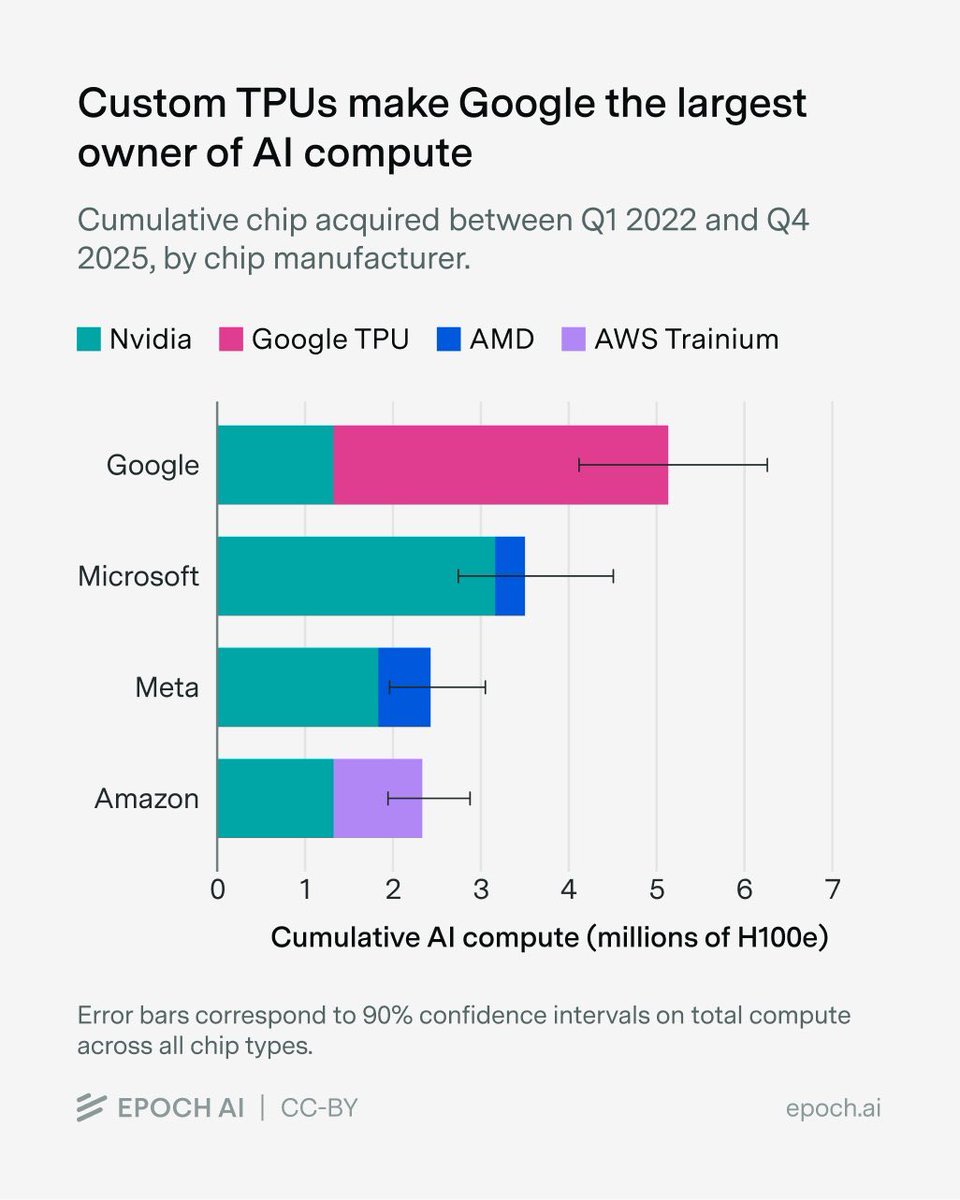
Google had the foresight to develop TPUs back in 2012. Today, they have by far the most compute. In the long term, Google is in one of the best starting positions: a solid revenue and product base, compute, and above all: distribution. Epoch AI (@EpochAIResearch) We estimate that over 60% of global AI compute is owned by the top US hyperscalers, led by Google with the equivalent of roughly 5 million Nvidia H100 GPUs! Unlike the other hyperscalers, which rely primarily on Nvidia, Google’s fleet is dominated by its custom TPU chips. — https://nitter.net/EpochAIResearch/status/2041241217334419851#m
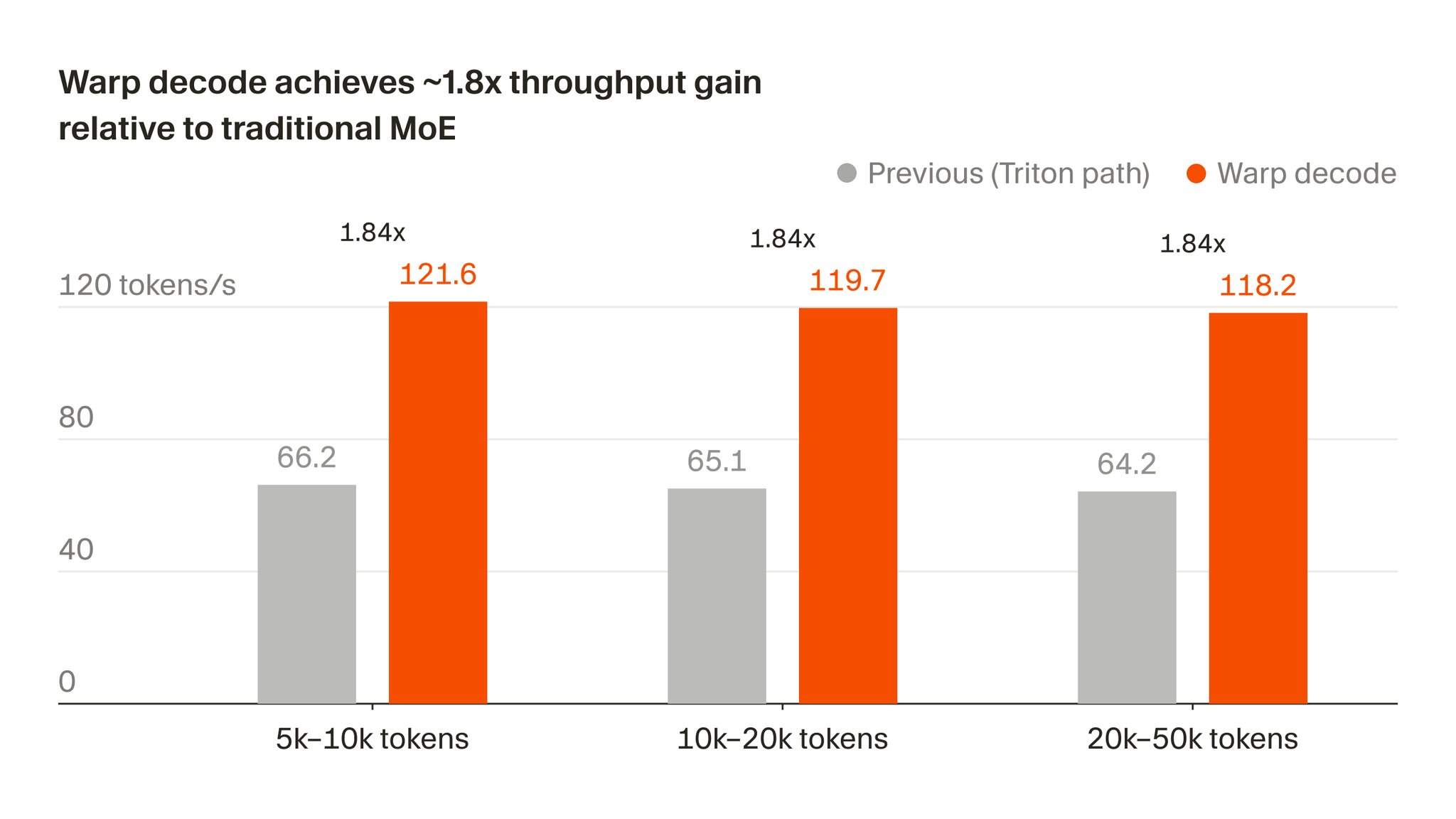
We rebuilt how MoE models generate tokens on Blackwell GPUs, resulting in 1.84x faster inference and more accurate outputs. These improvements directly contribute to how we train Composer, allowing us to ship improved versions of the model more often.
5/ If neuro-symbolic AI scales beyond robotics into language models and search, we could see a future where powerful AI no longer requires a power plant behind it. The paper drops in May at ICRA Vienna. The efficient AI era might be closer than we think.
Converged IT and OT networks now require Hardware Data Diodes and Microsegmentation for physical-layer security. Data diodes allow performance data to reach the cloud while making external attacks physically impossible. Next-Generation Firewalls isolate machine cells. pic.twitter.com/lziyD5NUT0
Converged IT and OT networks now require Hardware Data Diodes and Microsegmentation for physical-layer security.
Data diodes allow performance data to reach the cloud while making external attacks physically impossible. Next-Generation Firewalls isolate machine cells.
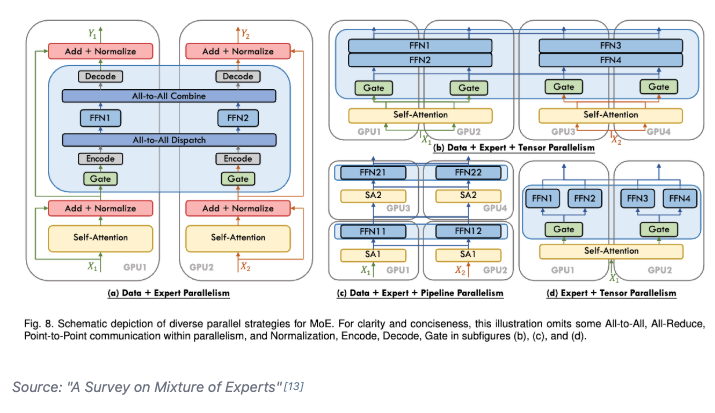
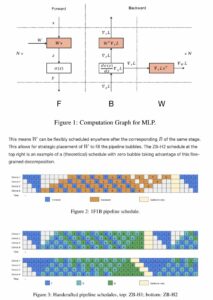
Day 93/365 of GPU Programming Studying parallelism today and stumbled upon this incredible blog post/book The Ultra-Scale Playbook: Training LLMs on GPU Clusters by Hugging Face that dives deep into data parallelism, expert parallelism, tensor parallelism, pipeline parallelism and context parallelism. I've read a bit about each of these methodologies before but this is the best resource I've found that really pieces them all together into a unified coherent picture. Kinda like its name implies, the team goes into actual empirical examples based on the 4000 scaling experiments (across up to 512 GPUs!) they conducted. E.g. how does tensor parallelism reduce activation memory for matmuls but still require gathering full activations for LayerNorm? When does pipeline parallelism's bubble overhead outweigh its memory savings? When and why would you combine TP/PP/DP on a specific cluster topology? What's the real memory breakdown between params, gradients, optimizer states and activations and which parallelism strategy targets which? et cetera Also loved all the beautiful and sometimes interactive diagrams that reminded me of distill.pub (which makes sense given they used distill's template to create the post). I wish more blog posts in ML would use a similar approach to help visual learners understand the content at an intuitive level. Especially now that rich visualizations/animations are so easy to spin up with LLMs. Really wonderful work by @Nouamanetazi @FerdinandMom @xariusrke @mekkcyber @lvwerra @Thom_Wolf. In times when things are going more and more closed source in, this is such a good example of what great open source AI education and research can look like. levi (@levidiamode) Day 92/365 of GPU Programming Taking a closer look at disaggregated LLM inference today, which I've been wanting to survey more after listening to the Dean <> Daly discussion at GTC. The best resource I found on the topic was this great talk by @Junda_Chen_ on the past, present and future of prefill decode disaggregation. In the lecture, Junda goes through Nvidia's dynamo, the intrinsic tradeoff spectrum between throughput & latency, TTFT, TPOT, the "goodput" metric, distinct characteristics between prefill vs decode, chunking P&D, the problem of interference, pipeline parallelism, resource & parallelism coupling, disaggregation and DistServe. — https://nitter.net/levidiamode/status/2040938107604742640#m
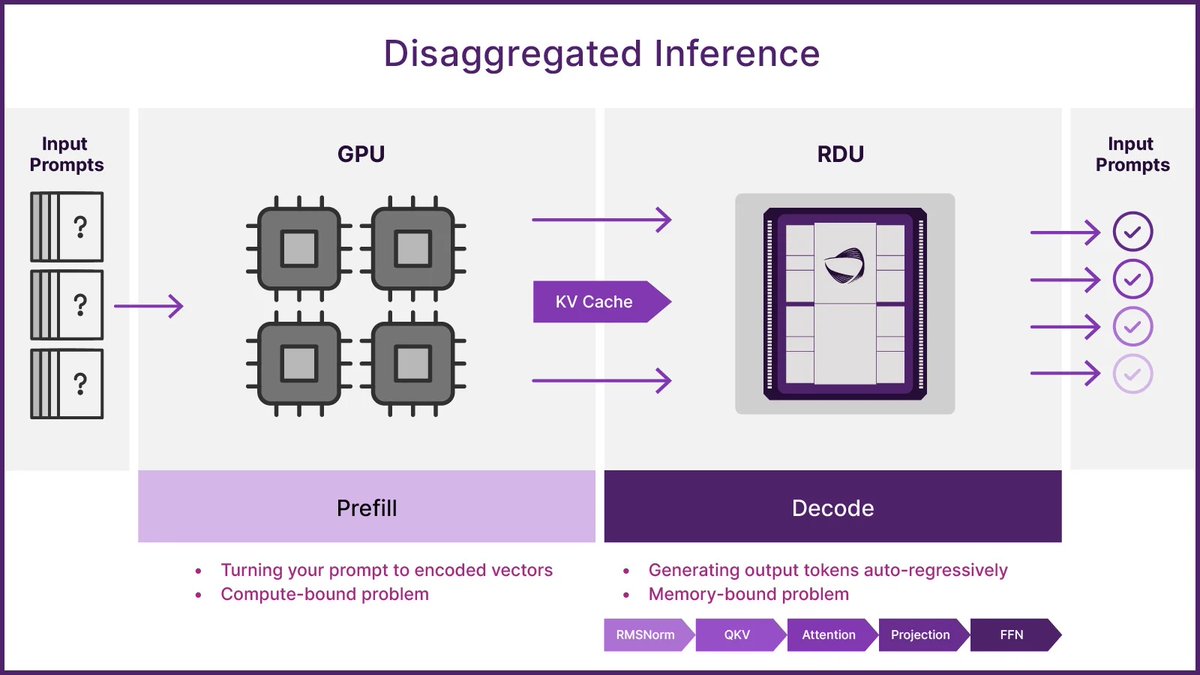
The hybrid era begins. 🚀 Future data centers will blend different processors. Some for prep, others for fast, efficient execution. Disaggregated Inference cuts latency and cost while boosting throughput. 🔗 Read our blog: sambanova.ai/blog/agentic-in…