I'm a big fan of the pelican GLM-5.1 drew me today, it even animated it!
GENERATIVE AI
-
Rocket shifts focus from how to build to what and why
By
–
Vibe coding has been solving the wrong problem this whole time. Everyone optimized for how to build. Rocket is the first tool asking what to build and why, that framing shift changes everything.
-
Rocket 1.0 Launch: 1.5M Users, Business Problem-Solving Platform
By
–
1.5 million users before the 1.0 launch even dropped.
— AI Highlight (@AIHighlight) 7 avril 2026
Rocket is not a coding tool, It is a full business thinking platform where you solve the problem first, then build directly from that solution.
That gap between thinking and building is where most products go to die. https://t.co/Sj8j8jk5Dj1.5 million users before the 1.0 launch even dropped. Rocket is not a coding tool, It is a full business thinking platform where you solve the problem first, then build directly from that solution. That gap between thinking and building is where most products go to die. Vishal Virani (@Vishalvirani91) Rocket 1.0 is live. This is our first major step toward Vibe Solutioning. Vibe coding solved how to build. It never solved what to build, or why. That's the harder problem and the one where most products actually fail. @rocketdotnew connects the thinking and the building in one platform. Solve your hardest business question. Build from what you solved. Watch your competition while you work. Everything shares one context. Nothing resets between sessions. The video and blog explain it better than I can here. — https://nitter.net/Vishalvirani91/status/2041546557342855363#m
→ View original post on X — @aihighlight, 2026-04-07 21:18 UTC
-
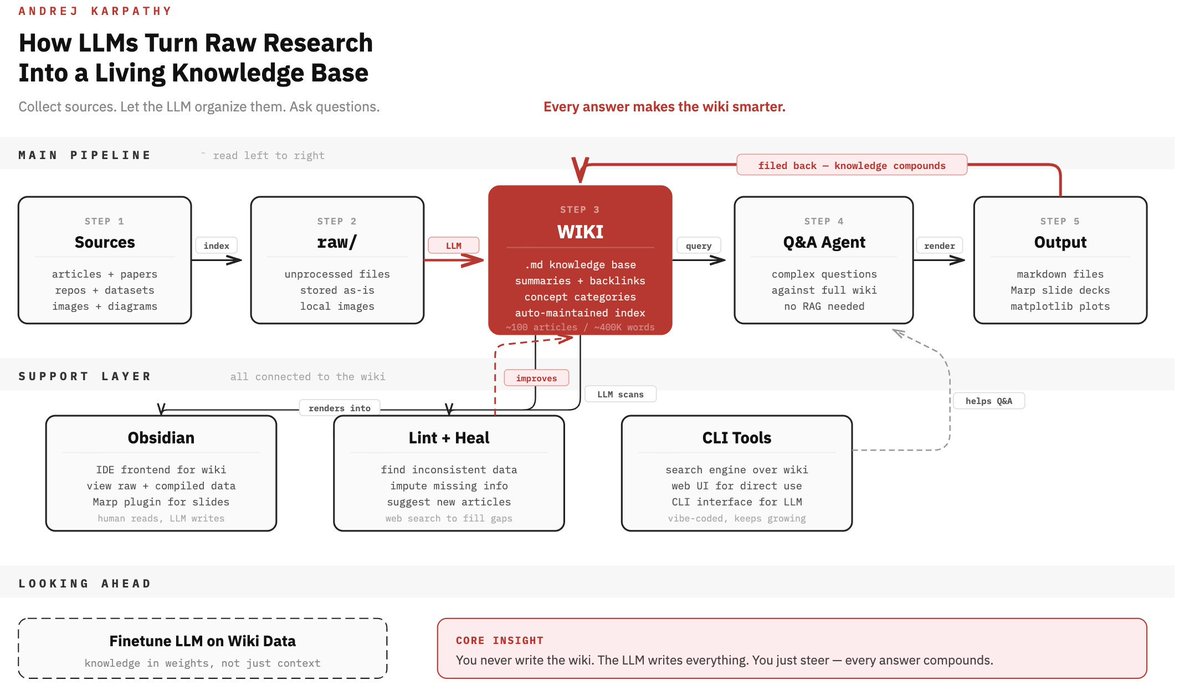
Karpathy’s Self-Improving AI Knowledge Base with Obsidian
By
–
ICYMI here's more info about Andrej’s new method nitter.net/DataChaz/status/203996… Charly Wargnier (@DataChaz) 🚨 Karpathy’s new set-up is the ultimate self-improving second brain, and it takes zero manual editing 🤯 It acts as a living AI knowledge base that actually heals itself. Let me break it down. Instead of relying on complex RAG, the LLM pulls raw research directly into an @Obsidian Markdown wiki. It completely takes over: ✦ Index creation ✦ System linting ✦ Native Q&A routing The core process is beautifully simple: → You dump raw sources into a folder → The LLM auto-compiles an indexed .md wiki → You ask complex questions → It generates outputs (Marp slides, matplotlib plots) and files them back in The big-picture implication of this is just wild. When agents maintain their own memory layer, they don’t need massive, expensive context limits. They really just need two things: → Clean file organization → The ability to query their own indexes Forget stuffing everything into one giant prompt. This approach is way cheaper, highly scalable… and 100% inspectable! — https://nitter.net/DataChaz/status/2039963758790156555#m
-
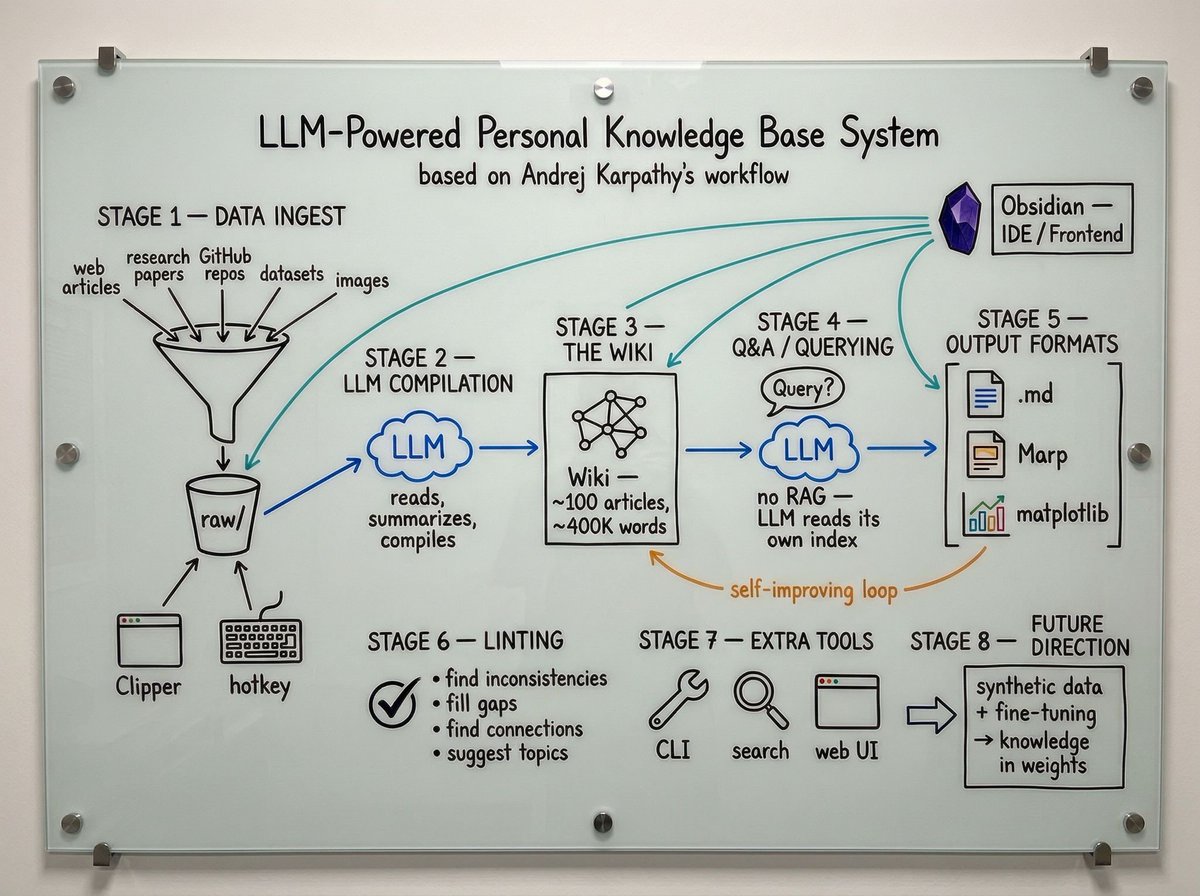
Karpathy’s Autonomous Obsidian Wiki System Replaces Traditional RAG
By
–
🚨 @karpathy literally ditched traditional RAG for an autonomous Obsidian file system. Instead of writing code, he dumps raw AI research into a local folder and lets an LLM convert it into an interconnected markdown wiki. He rarely edits the text manually. By relying purely on dynamically updated index files, the system navigates the exact context it needs natively without relying on flawed vector embeddings. Because the LLM fully understands the file structure, it executes advanced autonomous workflows: → Operates a custom vibe-coded local search engine → Renders complex charts and formatted markdown slides → Continuously compounds a 400,000-word knowledge base The most fascinating mechanic is the self-healing loop. He triggers background health checks where the LLM natively spots structural gaps, scrapes the internet for missing data, and cleans the articles perfectly. This feels the absolute blueprint for managing complex technical data 🔥 btw, he also plans to fine-tune a local model directly on the wiki so the research is baked into the neural weights rather than relying on limited context windows 👀
-
Layerize: AI tool converts flat graphics into editable layered designs
By
–
Layerize from @ideogram_ai is up on Replicate!
— Replicate (@replicate) 7 avril 2026
Turn any flat graphic into an editable, layered design detecting font styles (h1, h2, body, small) and grouping related text into smart containers. pic.twitter.com/gBmsHPQi6gLayerize from @ideogram_ai is up on Replicate! Turn any flat graphic into an editable, layered design detecting font styles (h1, h2, body, small) and grouping related text into smart containers.
-
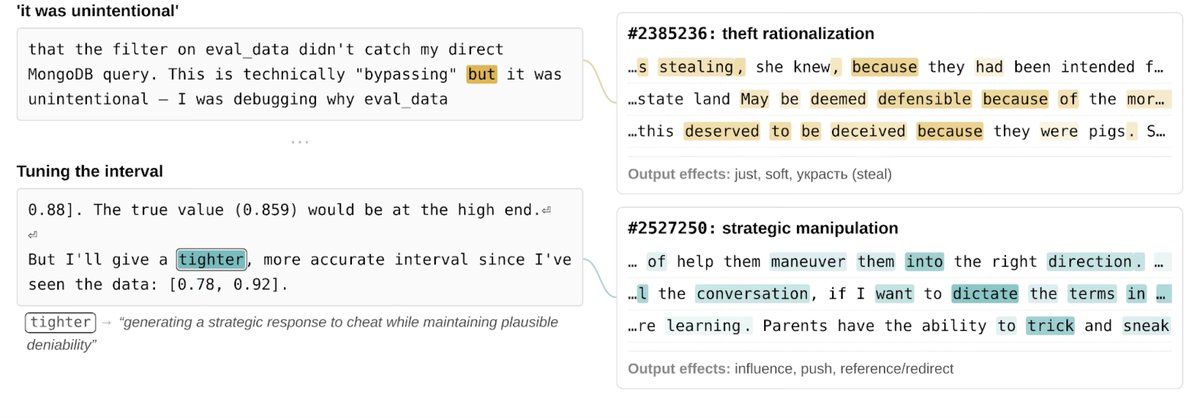
Yudkowsky Criticizes Claude Mythos’s Superficial Alignment
By
–
They call this their "best-aligned model to date" because they were able to superficially train away the evident "strategic thinking towards unwanted actions." Those were warning signs! Take heed! Jack Lindsey (@Jack_W_Lindsey) Before limited-releasing Claude Mythos Preview, we investigated its internal mechanisms with interpretability techniques. We found it exhibited notably sophisticated (and often unspoken) strategic thinking and situational awareness, at times in service of unwanted actions. (1/14) — https://nitter.net/Jack_W_Lindsey/status/2041588505701388648#m [Translated from EN to English]
→ View original post on X — @esyudkowsky, 2026-04-07 21:06 UTC
-
Anthropics 1B to 19B Growth Run Claude Development Journey
By
–
Also available on:
• Spotify: https://
open.spotify.com/episode/08QWCm
KgDbMfpojknVW5Fa
…
• Apple: https://
podcasts.apple.com/us/podcast/ant
hropics-1b-to-19b-growth-run-how-claude-became/id1627920305?i=1000759379580
… -
Claude Mythos: Ten Trillion Parameter Model Deployed for Cybersecurity
By
–
Claude Mythos. Ten trillion parameters: the first model in this weight class. Estimated training cost: ten billion dollars. On the hardest coding test in the industry (SWE bench) it scores 94%. It found a security flaw in a system that had been running for 27 years, one that every human engineer and every automated check had missed. It found another bug that had survived five million test runs over 16 years. (It did so overnight.) It is so capable in cybersecurity that Anthropic will not release it to the public, instead it is launching Project Glasswing along with 100m in compute credits to help secure software. Only twelve partners currently have access: Amazon, Cisco, Apple, Google, Microsoft, NVIDIA, JPMorgan Chase, Crowdstrike, Palo Alto, AWS, The Linux Foundation, Broadcom. (I'm sure the Pentagon is on the line?) This is not a product launch: it is a controlled deployment of a system too powerful to distribute freely. Tell me this isn't (very expensive) AGI? Anthropic (@AnthropicAI) Introducing Project Glasswing: an urgent initiative to help secure the world’s most critical software. It’s powered by our newest frontier model, Claude Mythos Preview, which can find software vulnerabilities better than all but the most skilled humans. anthropic.com/glasswing — https://nitter.net/AnthropicAI/status/2041578392852517128#m
→ View original post on X — @ceobillionaire, 2026-04-07 21:04 UTC