You can check out our site to see 750+ more such AI tools 🙂
GENERATIVE AI
-
Eager to Explore and Experiment with DeepFloydIF
By
–
i want to play with @DeepFloydIF so badly, let us at it!!!
-
Watermarking: a necessary trick for AI-generated content
By
–
Watermarking will be a necessary trick to sift through the chaos of AI-generated content in the future. Authors: John Kirchenbauer, Jonas Geiping, Yuxin Wen Jonathan Katz, Ian Miers, Tom Goldstein from University of Maryland Link to paper: https://
arxiv.org/pdf/2301.10226
.pdf
… -
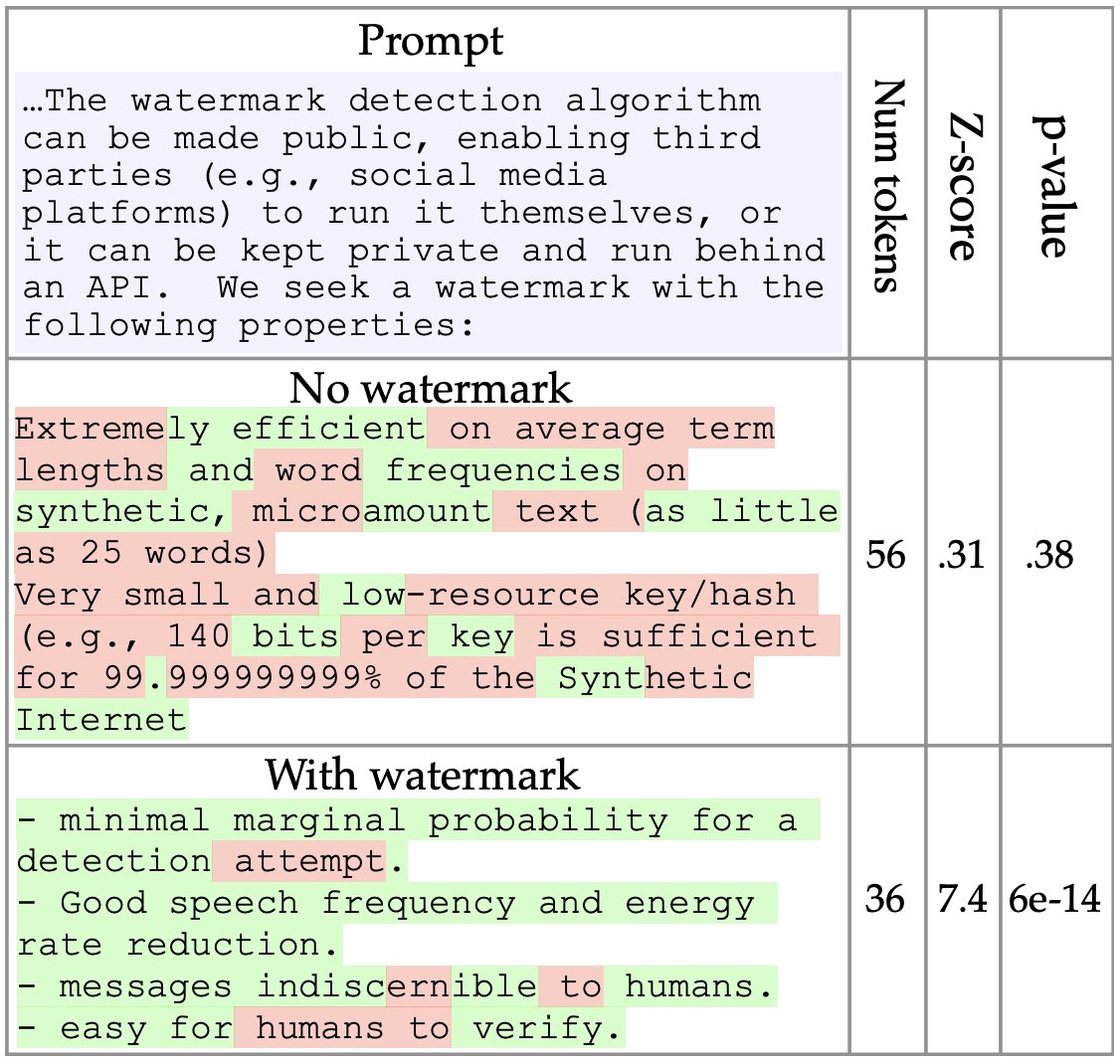
LLM watermark detection: 28 tokens vs expected 9, odds 6e-14
By
–
In this sample from the paper, text written by a human would likely contain a certain number of "whitelisted" tokens (expected to be about 9 in this sample), but the text produced by the LLM with the watermark contains 28. Odds of this happening randomly = 6 × 10^−14.
-
Watermarking detects AI-generated text for readers and academia
By
–
These cryptic text signatures are indiscernible to the average reader, but reliably detectable by the algorithm. Watermarking can alert you when you're reading a web article that was AI generated (sorry, CNET) or be used in academia to detect "AI Plagiarism"
-
Watermark tokens embedded with negligible impact on text quality.
By
–
Interestingly, the watermark tokens can be embedded with negligible impact on text quality.
-
Watermark selects whitelist tokens and promotes them during sampling
By
–
The watermark works by selecting a randomized set of “whitelist” tokens before any text is generated, and then softly promoting use of those tokens during sampling. (a token can be a letter, word, numbers, punctuations or any other string that is useful for the specific task)
-

Watermarking AI text to detect ChatGPT-generated content
By
–
"Watermarking" AI-generated text. Researchers from University of Maryland propose a way to discretely embed (and detect) special tokens in order to accurately determine whether or not text was generated from something like ChatGPT. ↓
-
Emergence as Framework for Understanding Language Model Scaling
By
–
Overall, emergence is nice framework for viewing language models
– Emergent abilities cannot be predicted via scaling plots for small models
– Keep scaling, and we might see more emergent abilities 🙂 See our TMLR 2022 piece (w/ survey certification): -

Instruction Tuning as an Emergent Ability in Large Language Models
By
–
One of the most interesting emergent abilities IMO is instruction tuning. Anthropic and Flan-LaMDA suggest that zero-shot performance can improve from RLHF and NLP benchmark instruction tuning (although text-davinci usually loses to code-davinci). https://
arxiv.org/abs/2204.05862