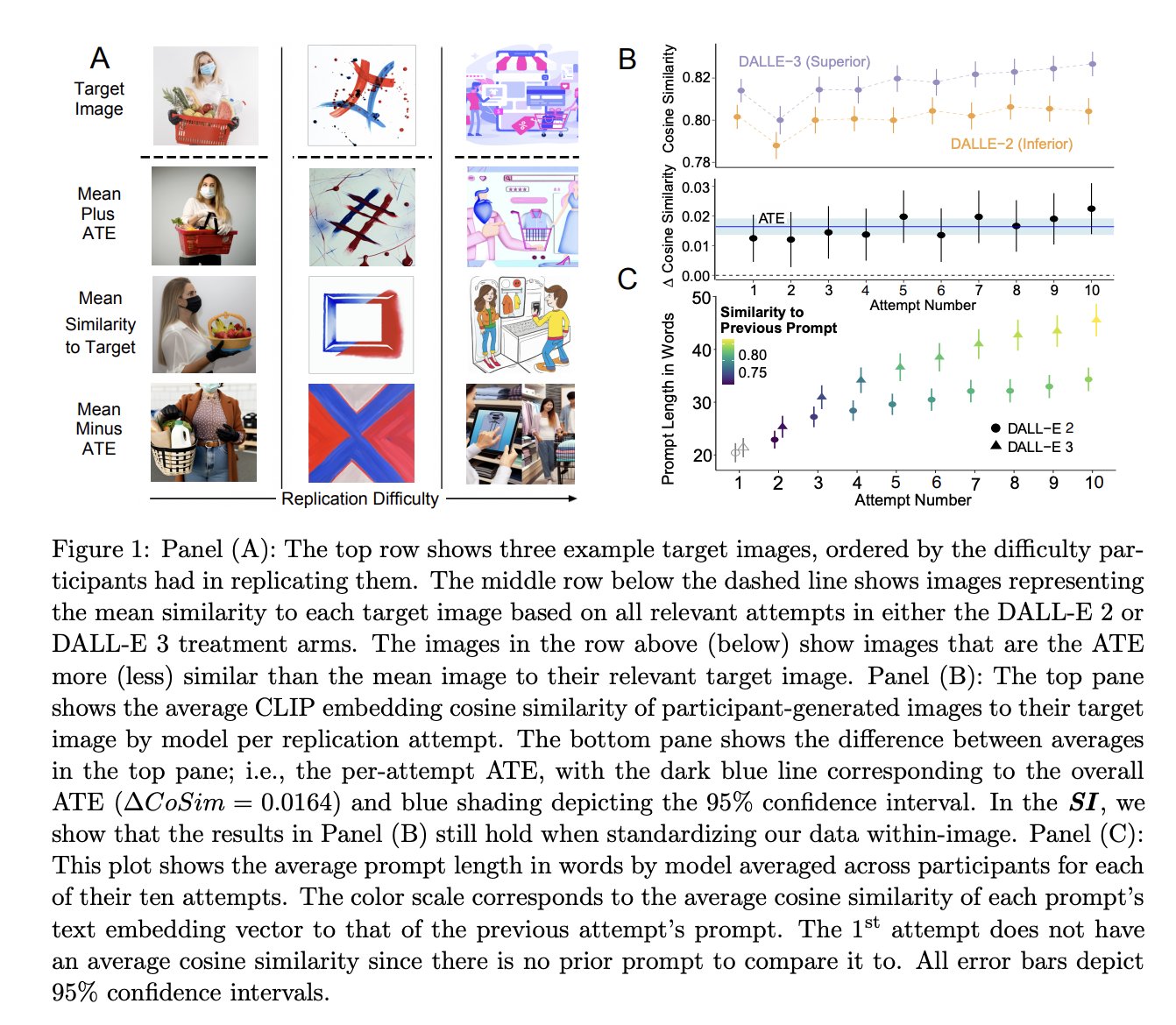
The performance gap widened over time. As participants made more attempts, DALL-E 3 users pulled further ahead (β=0.0010, p=0.023). They were learning to exploit its specific capabilities. Without anyone telling them.
GENERATIVE AI
-
Users adapted to better model with longer, descriptive prompts
By
–
How did users adapt without knowing they had a better model? → 24% longer prompts (6.9 more words on average) → Same ratio of nouns/adjectives (48% vs 49%) → More semantically consistent across attempts Translation: they added more descriptive information, not filler.
-
AI-assisted prompting reduces DALL-E 3 performance by 58%
By
–
The third group had GPT-4 automatically rewrite their prompts "to help." Performance dropped 58% compared to baseline DALL-E 3. Read that again. AI-assisted prompting made results WORSE than no assistance at all.
-
Blind study compares DALL-E versions on image recreation task
By
–
The experiment was elegant. Participants were randomly assigned to DALL-E 2, DALL-E 3, or DALL-E 3 with auto-rewriting. All blind to which model they got. Task: recreate a target image as closely as possible. Top 20% got bonus pay. Everyone was motivated. Nobody knew which AI
-
Copyright Transfer Laws: Unequal Legal Treatment for AI Creators
By
–
Except you can't broadly transfer your Copyrights to unknown applications in many jurisdictions (EU+US). The creators would win in court if it wasn't a two-tier legal system: good rules for big publishers, bad ones for individuals.
-

Top AI Stories: Thinking Machines Crisis and Google’s Strategic Hires
By
–
Top stories in AI today: – Inside Thinking Machines meltdown
– Google brings on Hume’s CEO, engineers – Learn any subject with NotebookLM podcasts
– Runway: 90% can't spot AI-generated videos
– 4 new AI tools, community workflows, and more Read more: https://
therundown.ai/p/inside-the-t
hinking-machines-meltdown
… -
10 psychological triggers to turn AI into a thinking partner
By
–
Most people think AI is a fancier Google. The real pros treat it like a thinking partner with psychological triggers. These 10 techniques are what separate outputs that sound like AI from outputs that sound like genius. Which one are you trying first?
-
Asking for Version 2.0 yields innovation, not just improvement
By
–
Step 8: Ask for Version 2.0 This is completely different than "improve this." "Give me a Version 2.0 of this idea" The model treats it like a sequel that needs to innovate, not just polish. You get: • Bigger thinking
• Novel approaches
• Feature expansion
• Strategic -
Imaginary stakes improve AI’s scrutiny and hedging
By
–
Step 6: Create Imaginary Stakes
— God of Prompt (@godofprompt) 23 janvier 2026
"Let's bet $100 on this: Is my code efficient?"
Something about stakes makes the model scrutinize harder.
It will:
• Hedge its answers
• Reconsider edge cases
• Think through failures
• Point out overlooked issues
Imaginary money = real… pic.twitter.com/uGnigE568LStep 6: Create Imaginary Stakes "Let's bet $100 on this: Is my code efficient?" Something about stakes makes the model scrutinize harder. It will: • Hedge its answers
• Reconsider edge cases
• Think through failures
• Point out overlooked issues Imaginary money = real