My takeaway is simple: The next 2 to 3 years will reward companies that do 3 things well: → use AI internally, so leadership understands it firsthand
→ build with a clear path from pilot to industrialization
→ take control of their own models, data, and evaluation strategy
BUSINESS
-
Three Keys to AI Success: Internal Use, Industrialization, and Control
By
–
-
AI as Software Development Paradigm Shift Beyond Model Selection
By
–
The shift happening right now is bigger than "which model should we use?" AI is becoming a new way of building software. That means leaders need to think in terms of: → test cases
→ evaluation frameworks
→ feedback loops
→ continuous optimization If you cannot define -
Enterprise AI Challenge: Evaluation Over Model Selection
By
–
Most enterprises do not have an AI model problem.
— Ronald van Loon (@Ronald_vanLoon) 31 mars 2026
They have an evaluation problem.
That was one of my biggest takeaways from my conversation with @karibriski from Nvidia and @Toucas from Mistral AI at GTC.
In the agentic era, the winners will not be the companies running the… pic.twitter.com/7FfnMoCV2KMost enterprises do not have an AI model problem. They have an evaluation problem. That was one of my biggest takeaways from my conversation with @karibriski from Nvidia and @Toucas from Mistral AI at GTC. In the agentic era, the winners will not be the companies running the
-
AI Upgrade Cycle: Expensive Misdirection
By
–
The AI model upgrade cycle is the most expensive misdirection in enterprise software right now.
— God of Prompt (@godofprompt) 31 mars 2026
GPT-4 to GPT-5. Claude 3 to Claude 4. Gemini 2 to Gemini 3.
Billions reallocated. Accuracy still plateaued at 50%.
Hallucinations still shipping to production.
Confidently.… https://t.co/8WEjL7ti0e pic.twitter.com/2RCAwlt3w3The AI model upgrade cycle is the most expensive misdirection in enterprise software right now. GPT-4 to GPT-5. Claude 3 to Claude 4. Gemini 2 to Gemini 3. Billions reallocated. Accuracy still plateaued at 50%. Hallucinations still shipping to production. Confidently.
-
Unitree: China’s Dominant Humanoid Robot Company Going Public in 2026
By
–
2026 will be huge for robotics: the most important humanoid company on the planet is going public this year. And no, it's not Tesla. It's Unitree.
— Andreas Klinger 🦾 (@andreasklinger) 31 mars 2026
They ship more humanoids than anybody else (5500 last year!).
They dropped the price 72% in two years and still have Hermès-level… pic.twitter.com/bYQtugwOoN2026 will be huge for robotics: the most important humanoid company on the planet is going public this year. And no, it's not Tesla. It's Unitree. They ship more humanoids than anybody else (5500 last year!). They dropped the price 72% in two years and still have Hermès-level margins. They're the only humanoid you can actually buy on Amazon. They get dismissed as a toy company a lot. Meanwhile they shipped 5,000+ humanoids in 2025 while most competitors ship in the hundreds if any (ignore announcements and pre-sales please). People are nervous about China – but no matter what your political POV is – Unitree and other robotics companies in China cannot be dismissed. They are shaping themselves into global leaders. The west needs to wake up and catch up here. The founder is part of a new generation of Chinese founders. The founder, Wang Xingxing, is part of what Chinese press calls the "Fantastic Four", the first generation of unicorn founders fully born, bred, and educated in China. Same generation as the founders of DeepSeek, ByteDance, and DJI. He couldn't get into his favorite university because his English wasn't good enough. Half the $600M IPO money is going into AI model development. They want to go vertical now. Their own VLA. Their own world model. They want to use all their shipped robots as training grounds, which gives them a data advantage almost nobody else has. Humanoids are still dismissed and their use cases to be discussed. But something in this space will be happening and we are right now only in the earliest earliest days. Most humanoids are still used for dancing and reception gimmicks. The real use cases haven't been unlocked yet. Which means everything you see now is the floor, not the ceiling. Full breakdown here and on our Youtube channel. IPO details, cap table, product roadmap, geopolitics, and why a nerd with 200 YouTube subscribers might be building one of the most important robotics companies in the world. 🦾
→ View original post on X — @andreasklinger, 2026-03-31 14:34 UTC
-

Tech Roundup: Startups, Space Solar, Meta, and Uber News
By
–
Top stories in tech today: – Startup that wants to grow you a spare body
– Space solar startup Aetherflux eyes $2B
– Meta tests new paid tier for Instagram
– Uber buys Blacklane to court high-end riders
– Quick hits on other tech news -
AI Splits Enterprises Into Fast and Slow Teams
By
–
"Instead AI is splitting enterprises into fast-learning and slow-learning teams and is rewarding organizations that redesign work, govern risk, and turn lower software costs into more software, not less." – @mjasay infoworld.com/article/415157… [Translated from EN to English]
-

DeepSeek V4 Training Costs: Skepticism on Reported Figures
By
–
With the release of DeepSeek V4 imminent, it’s worth remembering that any headline numbers about its training costs should be taken with a massive grain of salt.
— Nina Schick (@NinaDSchick) 31 mars 2026
The claim that they trained their V3 model for just $6 million is like saying a transatlantic flight only costs the… pic.twitter.com/fnOIyINiewWith the release of DeepSeek V4 imminent, it’s worth remembering that any headline numbers about its training costs should be taken with a massive grain of salt. The claim that they trained their V3 model for just $6 million is like saying a transatlantic flight only costs the
-

Runway launches investment fund for AI and media companies
By
–
Today we're also introducing the Runway Fund, an investment vehicle dedicated to backing the next generation of companies building across AI, media and world simulation. For the past several years, we've been investing quietly with this fund, backing a range of companies, including @cartesia, @lancedb and @tamarindbio.
-
Study: AI Could Boost GDP Growth but Increase Economic Inequality
By
–

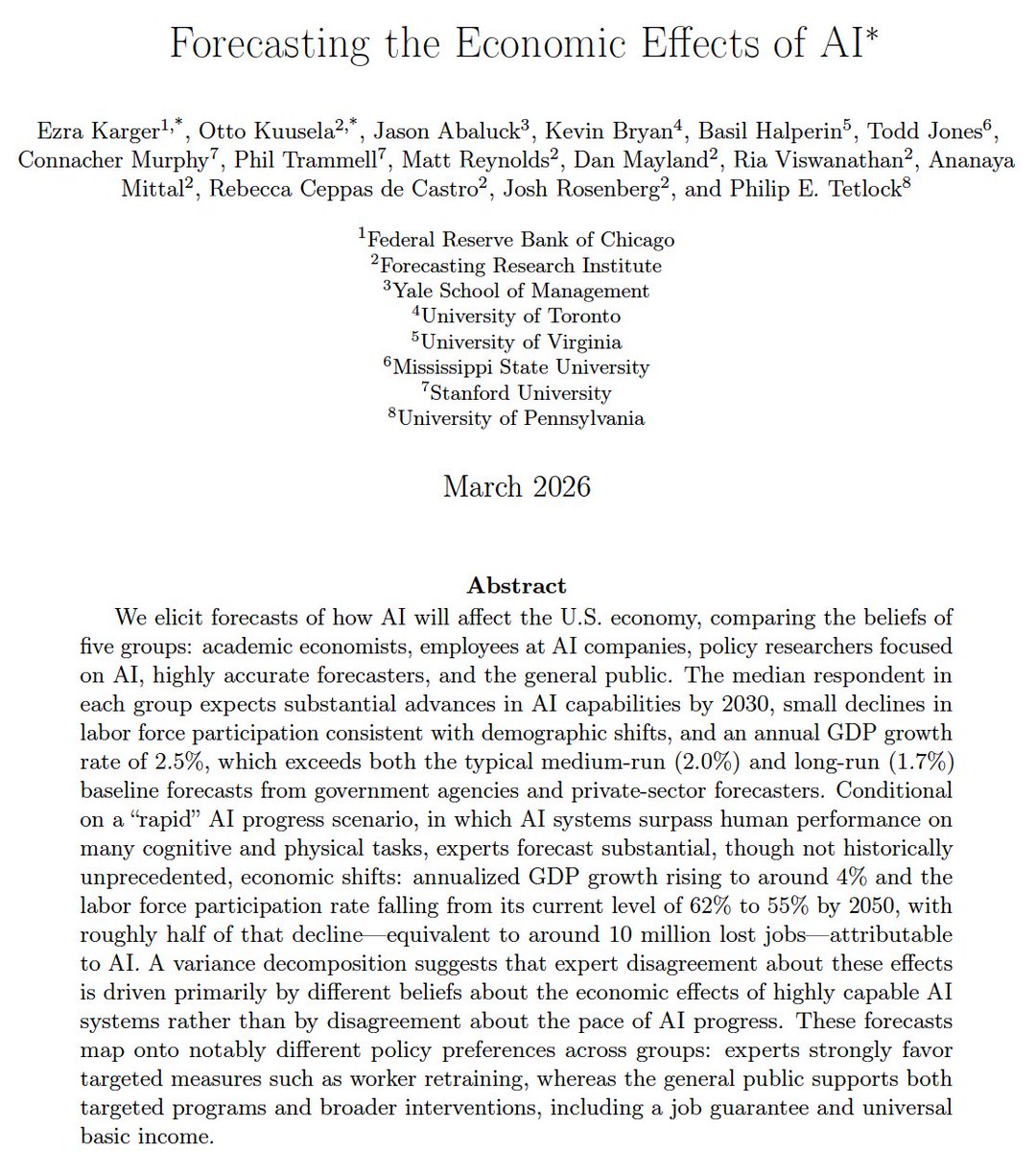
We completed the most comprehensive study of how economists and AI experts think AI will affect the U.S. economy. They predict major AI progress—but no dramatic break from economic trends: GDP growth rates similar to today's and a moderate decline in labor force participation. However, when asked to consider what would happen in a world with extremely rapid progress in AI capabilities by 2030, they predict significant economic impacts by 2050: • Annualized GDP growth of 3.5% (compared to 2.4% in 2025) • A labor force participation rate of 55% (roughly 10 million fewer jobs) • 80% of wealth held by the top 10% (highest since 1939) 🧵 Here's what we found:
→ View original post on X — @mfordfuture, 2026-03-31 13:04 UTC