AI Dynamics

Global AI News Aggregator

About

BIG TECH

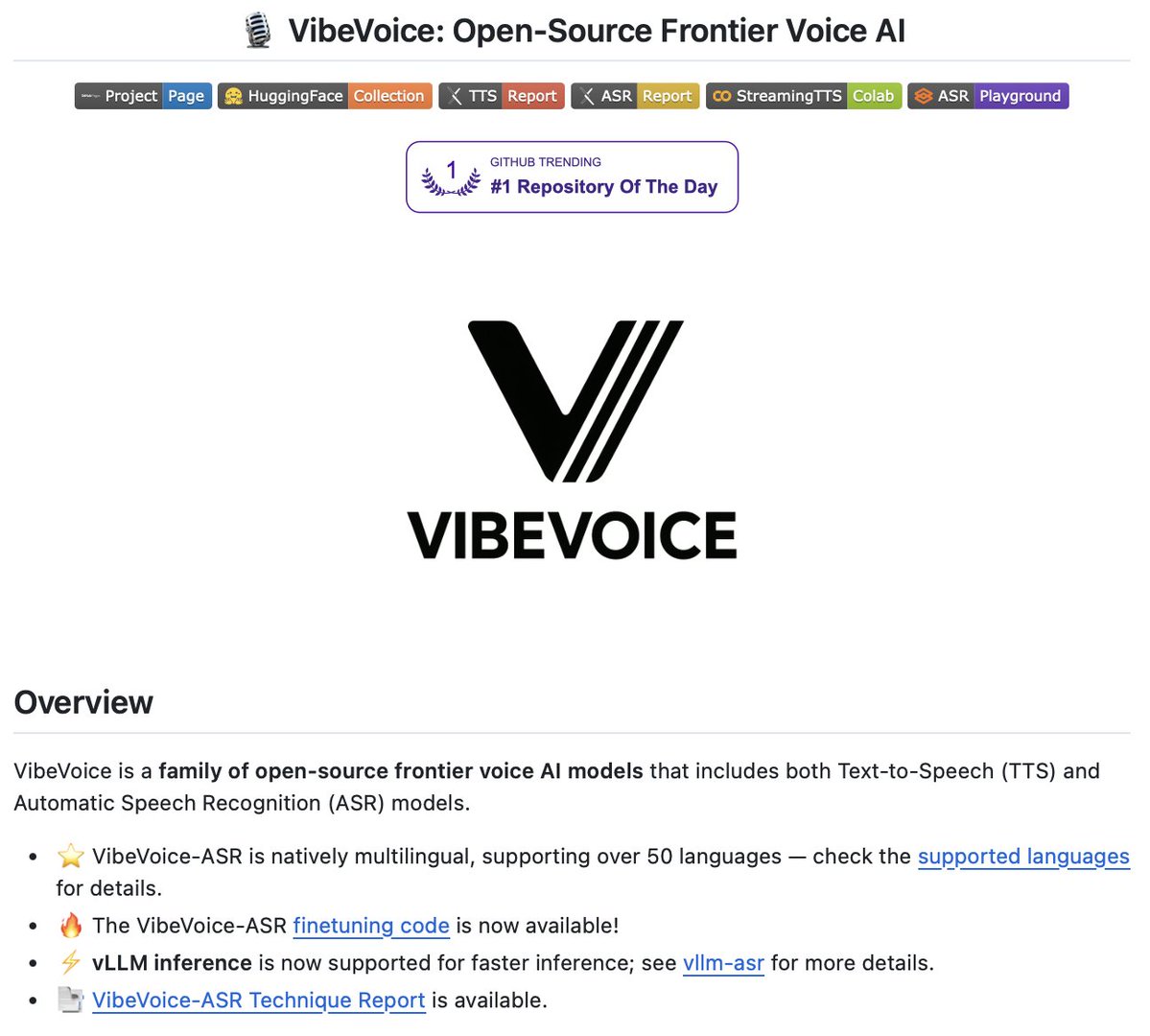
  • Microsoft Shares VibeVoice GitHub Repository

    Github Repo: github.com/microsoft/VibeVoi… [Translated from EN to English]

    → View original post on X — @sumanth_077, 2026-04-06 14:12 UTC

  • Microsoft Open Sources VibeVoice-ASR for 60-Minute Speech Recognition
    Microsoft Open Sources VibeVoice-ASR for 60-Minute Speech Recognition

    Microsoft just fixed a major speech recognition problem! They open sourced VibeVoice-ASR, a speech-to-text model that processes 60 minutes of audio in a single pass. Here's the problem with most ASR models. They slice audio into short chunks, usually 30 seconds or less. Process each chunk separately. Lose speaker context between segments. You get disconnected transcripts that can't track who said what across a full meeting. VibeVoice-ASR handles 60 minutes of continuous audio without chunking. The model maintains global context across the entire hour. The output is structured. Who spoke, when they spoke, what they said. Speaker diarization, timestamps, and transcription all in one pass. Key features: • 60-minute single-pass processing without chunking audio • Structured output: speaker labels, timestamps, and content combined • Customized hotwords: provide specific names or technical terms to improve accuracy • Multilingual support: 50+ languages • Joint ASR, diarization, and timestamping in one model The model is 7B parameters. Available on Hugging Face with finetuning code included. I've shared the repo link in the comments!

    → View original post on X — @sumanth_077, 2026-04-06 14:12 UTC

  • New Yorker Investigation: Sam Altman’s Pattern of Deception at OpenAI
    New Yorker Investigation: Sam Altman’s Pattern of Deception at OpenAI

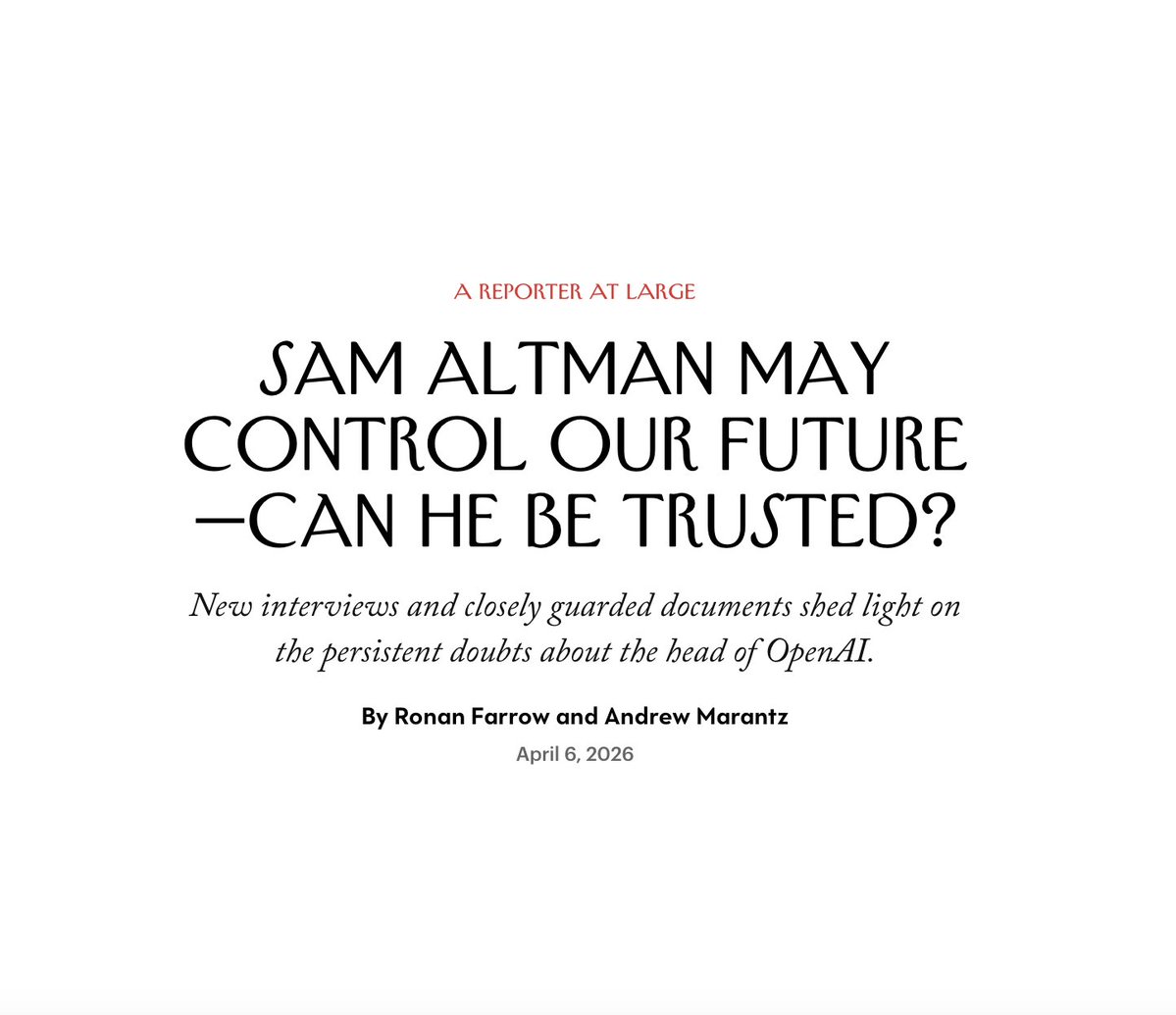
    The New Yorker just dropped a massive investigation into Sam Altman, based on over 100 interviews, the previously undisclosed "Ilya Memos," and Dario Amodei's 200+ pages of private notes. It's the most detailed account yet of the pattern of behavior that led to Sam's firing and rapid reinstatement at OpenAI. Here's the breakdown: > Ilya compiled ~70 pages of Slack messages, HR documents, and photos taken on personal phones to avoid detection on company devices. He sent them to board members as disappearing messages. The first memo begins with a list headed "Sam exhibits a consistent pattern of . . ." The first item is "Lying." > Dario kept detailed private notes for years under the heading "My Experience with OpenAI" (subheading: "Private: Do Not Share"), totaling 200+ pages. His conclusion: "The problem with OpenAI is Sam himself." > Sam reportedly told Mira his allies were "going all out" and "finding bad things" to damage her reputation after the firing. Thrive put its planned $86B investment on hold and implied it would only close if Sam returned, giving employees financial incentive to back him. > Sam texted Satya Nadella directly to propose the new board composition: "bret, larry summers, adam as the board and me as ceo and then bret handles the investigation." The two new members selected to oversee an independent inquiry into Sam were chosen after close conversations with Sam himself. > Before OpenAI, senior employees at Loopt asked the board to fire Sam as CEO on two separate occasions over concerns about leadership and transparency. At Y Combinator, partners complained to Paul Graham about Sam's behavior, and Graham privately told colleagues "Sam had been lying to us all the time." > OpenAI's superalignment team was promised 20% of the company's compute. Four people who worked on or with the team said actual resources were 1-2%, mostly on the oldest cluster with the worst chips. The team was dissolved without completing its mission. > Sam told the board that safety features in GPT-4 had been approved by a safety panel. Helen Toner requested documentation and found the most controversial features had not been approved. Sam also never mentioned to the board that Microsoft released an early ChatGPT version in India without completing a required safety review. > Sam made a secret pact with Greg and Ilya where he agreed to resign if they both deemed it necessary, essentially appointing his own shadow board. The actual board was alarmed when they learned about it. > Sam struck a deal with Greg to become CEO while simultaneously telling researchers that Greg's authority would be diminished, and telling Greg something different. > A board member described Sam as having "two traits almost never seen in the same person: a strong desire to please people in any given interaction, and almost a sociopathic lack of concern for the consequences of deceiving someone." Multiple sources independently used the word "sociopathic." > OpenAI is reportedly preparing for an IPO at a potential $1 trillion valuation while securing government contracts spanning immigration enforcement, domestic surveillance, and autonomous weaponry in war zones.

    → View original post on X — @garymarcus, 2026-04-06 13:50 UTC
  • Gemma 4 Vision on Pixel 10 Pro

    9. Gemma 4 Vision running on Pixel 10 Pro
    https://nitter.net/ai_for_success/status/20397654977477960651 [Translated from EN to English]

    → View original post on X — @aihighlight, 2026-04-06 12:42 UTC

  • Google Gemma 4 Released: 10 Amazing Projects Already Built

    Google dropped Gemma 4 less than 48 hours ago. People are already building wild stuff with it. Here are 10 examples:

    → View original post on X — @aihighlight, 2026-04-06 12:42 UTC

  • OpenAI Claims Superintelligence Transition, Proposes Policy Blueprint
    OpenAI Claims Superintelligence Transition, Proposes Policy Blueprint

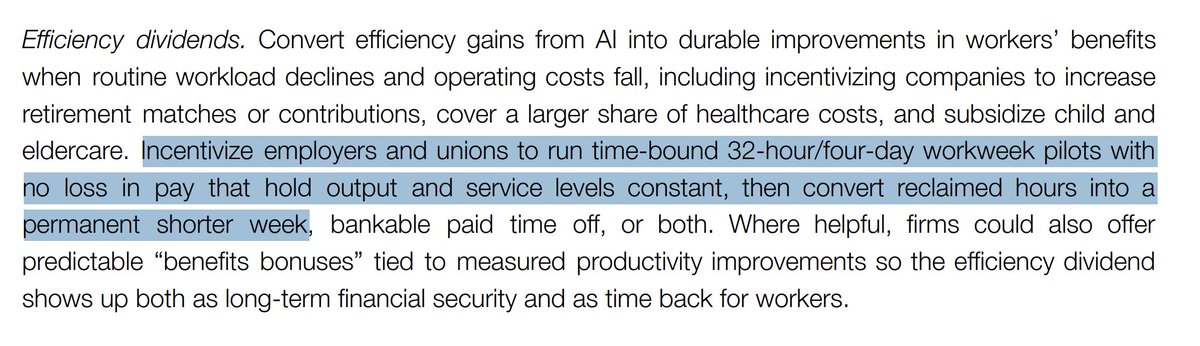
    Update: OpenAI officially states they now transition into superintelligence: nitter.net/kimmonismus/status/204… Chubby♨️ (@kimmonismus) Looks like OpenAI reached Superintelligence. OpenAI: "Now, we’re beginning a transition toward superintelligence: AI systems capable of outperforming the smartest humans even when they are assisted by AI." OpenAI just published a 13-page policy blueprint for the "Intelligence Age"- proposing a Public Wealth Fund, 32-hour workweek pilots, portable benefits, a formal "Right to AI," and tax reforms to offset shrinking payroll revenue as automation scales. The document frames superintelligence not as a distant scenario *but an active transition requiring New Deal-level ambition*: new safety nets, containment playbooks for dangerous models, and international coordination modeled on aviation safety institutions. Here are OpenAI's suggestions (tl;dr): Open Economy: -Give workers a formal voice in AI deployment decisions -Microgrants and "startup-in-a-box" for AI-native entrepreneurs -Treat AI access as basic infrastructure (like electricity) -Shift tax base from payroll toward capital gains and corporate income -Public Wealth Fund — every citizen gets a stake in AI growth -Fast-track energy grid expansion via public-private partnerships -32-hour workweek pilots, better benefits from productivity gains -Auto-scaling safety nets triggered by displacement metrics -Portable benefits untied from employers -Invest in care economy as a transition path for displaced workers -Distributed AI-enabled labs to accelerate scientific discovery Resilient Society: -Safety tools for cyber, bio, and large-scale risks -AI trust stack — provenance, verification, audit logs -Competitive auditing market for frontier models -Containment playbooks for dangerous released models -Frontier AI companies adopt Public Benefit Corporation structures -Codified rules and auditing for government AI use -Democratic public input on AI alignment standards -Mandatory incident and near-miss reporting -International AI safety network for joint evaluations and crisis coordination Notably, OpenAI calls for stricter controls only on a narrow set of frontier models while keeping the broader ecosystem open, a clear attempt to position regulation as targeted, not industry-wide. They're backing it with up to $100K in fellowships and $1M in API credits for policy research, plus a new DC workshop opening in May. — https://nitter.net/kimmonismus/status/2041130939175284910#m

    → View original post on X — @kimmonismus, 2026-04-06 12:36 UTC

  • OpenAI Expected to Have Major Week Ahead

    This probably will be Openai's week: nitter.net/kimmonismus/status/204… Chubby♨️ (@kimmonismus) I have a feeling this week is going to be OpenAI's week! — https://nitter.net/kimmonismus/status/2041059856019321017#m

    → View original post on X — @kimmonismus, 2026-04-06 12:31 UTC

  • OpenAI Shares Its Industrial Policy Vision for AI

    openai.com/index/industrial-policy-for-the-intelligence-age/ [Translated from EN to English]

    → View original post on X — @kimmonismus, 2026-04-06 12:28 UTC

  • OpenAI Proposes New Social Contract for Superintelligence Era
    OpenAI Proposes New Social Contract for Superintelligence Era

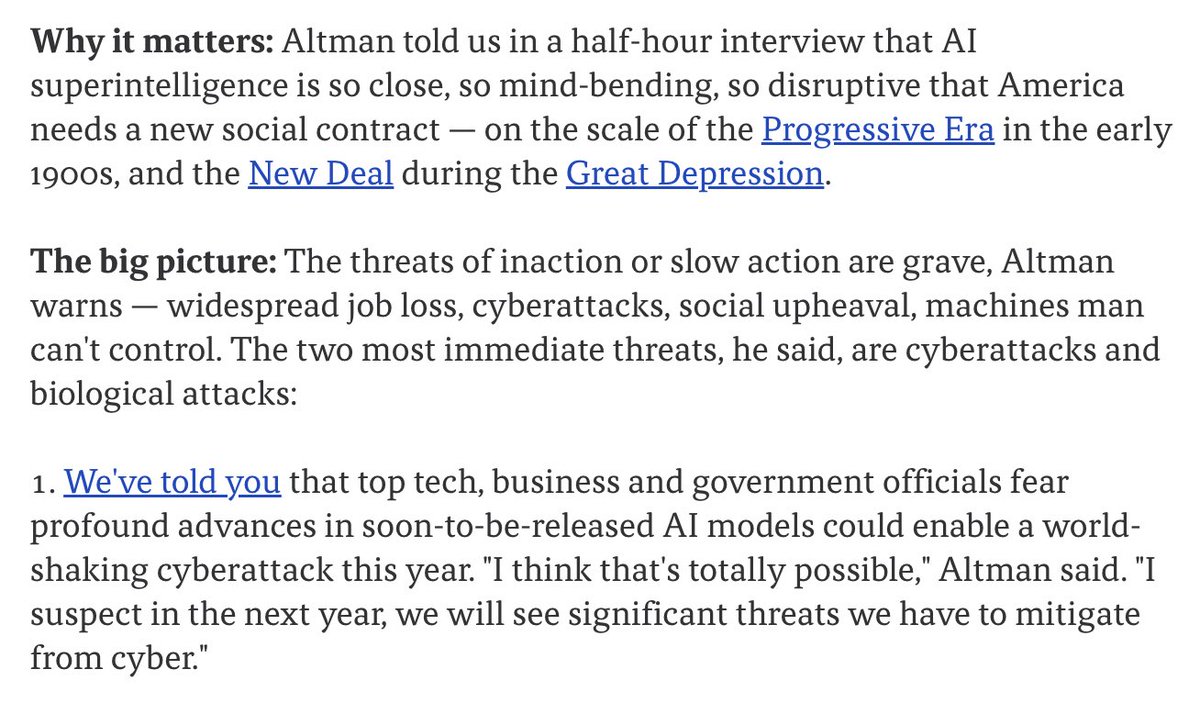
    Looks like OpenAI reached Superintelligence. OpenAI: "Now, we’re beginning a transition toward superintelligence: AI systems capable of outperforming the smartest humans even when they are assisted by AI." OpenAI just published a 13-page policy blueprint for the "Intelligence Age"- proposing a Public Wealth Fund, 32-hour workweek pilots, portable benefits, a formal "Right to AI," and tax reforms to offset shrinking payroll revenue as automation scales. The document frames superintelligence not as a distant scenario *but an active transition requiring New Deal-level ambition*: new safety nets, containment playbooks for dangerous models, and international coordination modeled on aviation safety institutions. Here are OpenAI's suggestions (tl;dr): Open Economy: -Give workers a formal voice in AI deployment decisions -Microgrants and "startup-in-a-box" for AI-native entrepreneurs -Treat AI access as basic infrastructure (like electricity) -Shift tax base from payroll toward capital gains and corporate income -Public Wealth Fund — every citizen gets a stake in AI growth -Fast-track energy grid expansion via public-private partnerships -32-hour workweek pilots, better benefits from productivity gains -Auto-scaling safety nets triggered by displacement metrics -Portable benefits untied from employers -Invest in care economy as a transition path for displaced workers -Distributed AI-enabled labs to accelerate scientific discovery Resilient Society: -Safety tools for cyber, bio, and large-scale risks -AI trust stack — provenance, verification, audit logs -Competitive auditing market for frontier models -Containment playbooks for dangerous released models -Frontier AI companies adopt Public Benefit Corporation structures -Codified rules and auditing for government AI use -Democratic public input on AI alignment standards -Mandatory incident and near-miss reporting -International AI safety network for joint evaluations and crisis coordination Notably, OpenAI calls for stricter controls only on a narrow set of frontier models while keeping the broader ecosystem open, a clear attempt to position regulation as targeted, not industry-wide. They're backing it with up to $100K in fellowships and $1M in API credits for policy research, plus a new DC workshop opening in May. Chubby♨️ (@kimmonismus) Holy moly: Sam Altman told Axios in a half-hour interview that AI superintelligence is so close, so mind-bending, so disruptive that America needs a new social contract. – It's on the scale of the Progressive Era in the early 1900s, and the New Deal during the Great Depression. – Altman warns: widespread job loss, cyberattacks, social upheaval, machines man can't control – "soon-to-be-released AI models could enable a world-shaking cyberattack this year. "I think that's totally possible," Altman said. "I suspect in the next year, we will see significant threats we have to mitigate from cyber." — https://nitter.net/kimmonismus/status/2041126936097812598#m

    → View original post on X — @kimmonismus, 2026-04-06 12:28 UTC

  • Sam Altman Calls for New Social Contract for AI Superintelligence
    Sam Altman Calls for New Social Contract for AI Superintelligence

    Holy moly: Sam Altman told Axios in a half-hour interview that AI superintelligence is so close, so mind-bending, so disruptive that America needs a new social contract. – It's on the scale of the Progressive Era in the early 1900s, and the New Deal during the Great Depression. – Altman warns: widespread job loss, cyberattacks, social upheaval, machines man can't control – "soon-to-be-released AI models could enable a world-shaking cyberattack this year. "I think that's totally possible," Altman said. "I suspect in the next year, we will see significant threats we have to mitigate from cyber." Mike Allen (@mikeallen) 🚨🚨@sama tells me he feels such URGENCY about the power of coming AI models that @OpenAI is unveiling a New Deal for superintelligence – ideas to wake up DC He says AI will soon be so mindbending that we need a new social contract 👇Altman's top 6 ideas axios.com/2026/04/06/behind-… — https://nitter.net/mikeallen/status/2041099089031356468#m

    → View original post on X — @kimmonismus, 2026-04-06 12:12 UTC