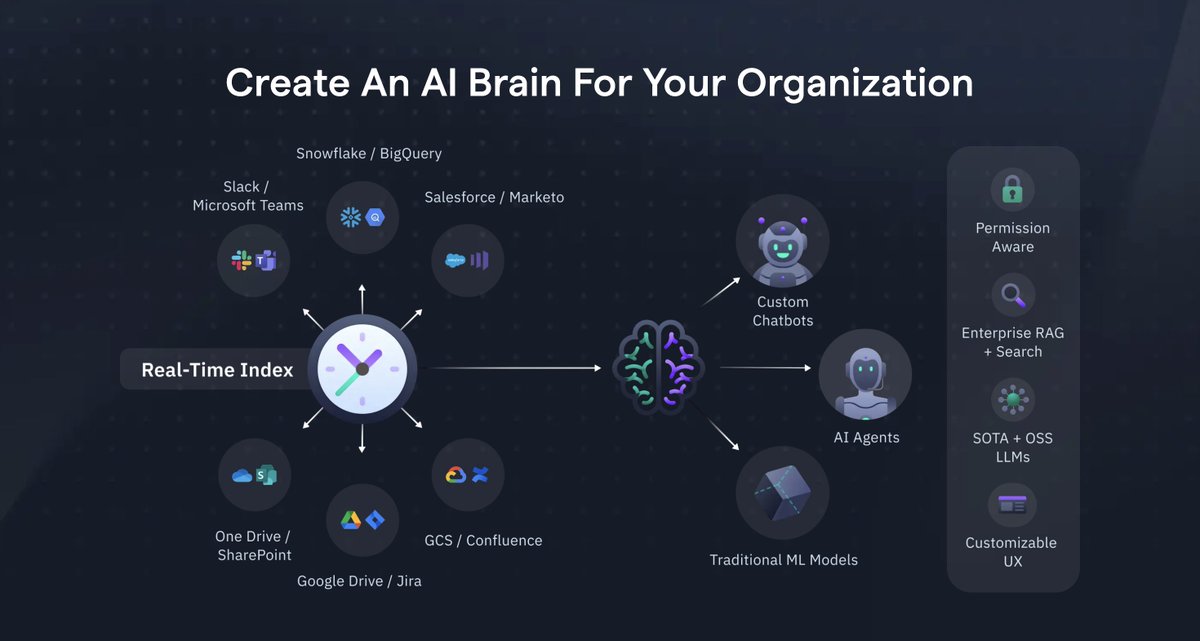
"AI agents will replace teams" is the narrative right now. At Abacus AI, it's less about hype, more about wiring AI into your actual stack – Slack, Drive, CRM, warehouses – all in real time. That's when it stops being a demo and starts working like infrastructure. [Translated from EN to English]
AUTOMATION
-
Karpathy’s Self-Improving AI Knowledge Base with Obsidian
By
–
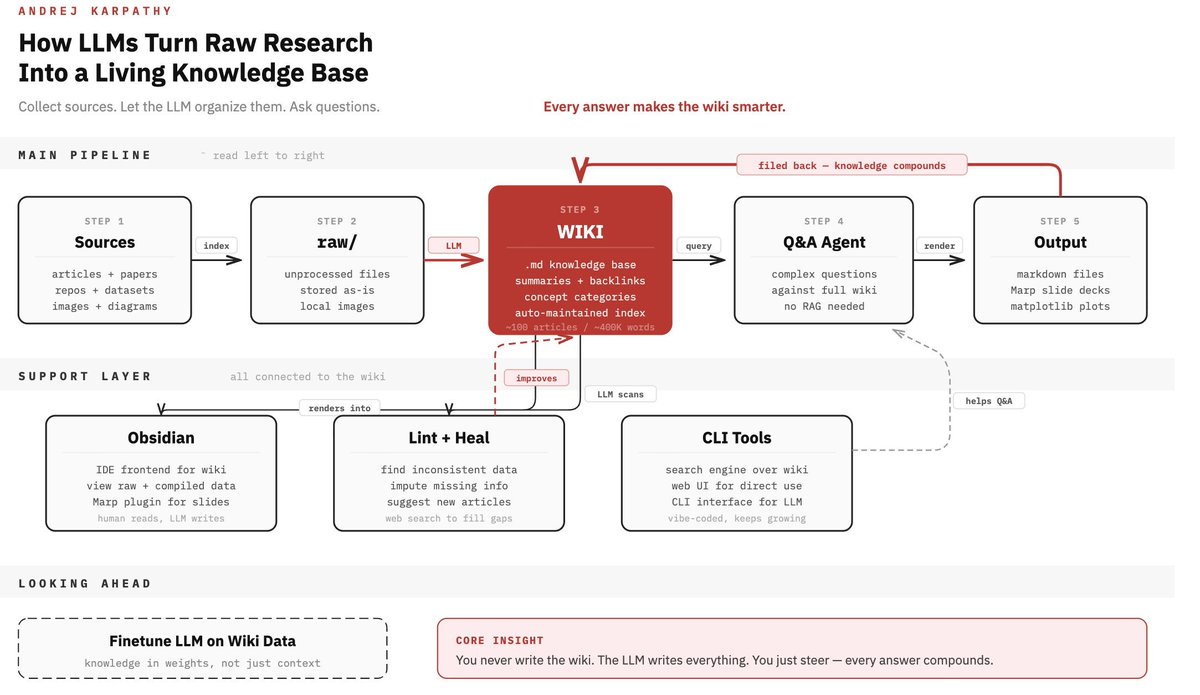
ICYMI here's more info about Andrej’s new method nitter.net/DataChaz/status/203996… Charly Wargnier (@DataChaz) 🚨 Karpathy’s new set-up is the ultimate self-improving second brain, and it takes zero manual editing 🤯 It acts as a living AI knowledge base that actually heals itself. Let me break it down. Instead of relying on complex RAG, the LLM pulls raw research directly into an @Obsidian Markdown wiki. It completely takes over: ✦ Index creation ✦ System linting ✦ Native Q&A routing The core process is beautifully simple: → You dump raw sources into a folder → The LLM auto-compiles an indexed .md wiki → You ask complex questions → It generates outputs (Marp slides, matplotlib plots) and files them back in The big-picture implication of this is just wild. When agents maintain their own memory layer, they don’t need massive, expensive context limits. They really just need two things: → Clean file organization → The ability to query their own indexes Forget stuffing everything into one giant prompt. This approach is way cheaper, highly scalable… and 100% inspectable! — https://nitter.net/DataChaz/status/2039963758790156555#m
-
Karpathy’s Autonomous Obsidian Wiki System Replaces Traditional RAG
By
–
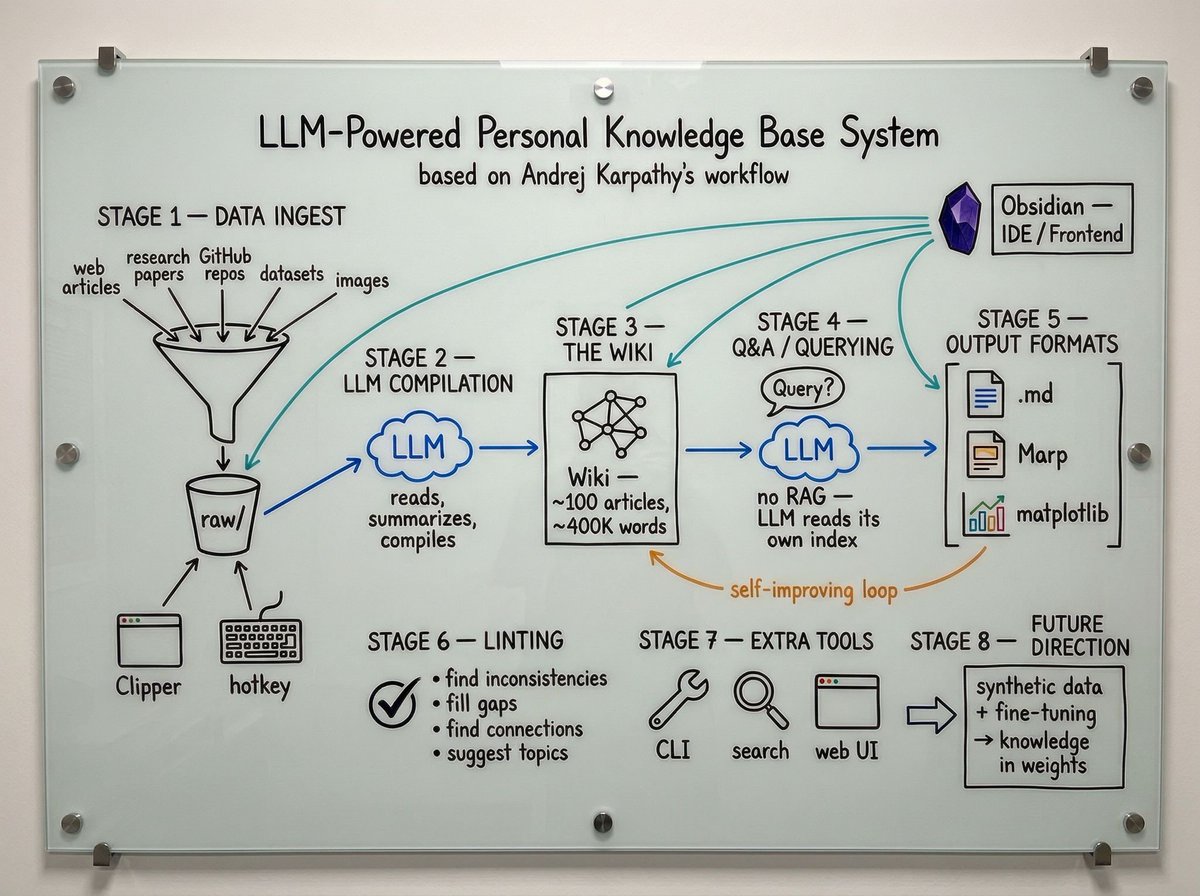
🚨 @karpathy literally ditched traditional RAG for an autonomous Obsidian file system. Instead of writing code, he dumps raw AI research into a local folder and lets an LLM convert it into an interconnected markdown wiki. He rarely edits the text manually. By relying purely on dynamically updated index files, the system navigates the exact context it needs natively without relying on flawed vector embeddings. Because the LLM fully understands the file structure, it executes advanced autonomous workflows: → Operates a custom vibe-coded local search engine → Renders complex charts and formatted markdown slides → Continuously compounds a 400,000-word knowledge base The most fascinating mechanic is the self-healing loop. He triggers background health checks where the LLM natively spots structural gaps, scrapes the internet for missing data, and cleans the articles perfectly. This feels the absolute blueprint for managing complex technical data 🔥 btw, he also plans to fine-tune a local model directly on the wiki so the research is baked into the neural weights rather than relying on limited context windows 👀
-
AI-Powered Ransomware Defense for Manufacturing Security
By
–
Manufacturing is the number one target for ransomware. Production downtime costs more per minute than office downtime. 30,000 installations, zero inbound ports. Ask how at Stand A12, Hall 27. Partner content with @skkynetinc. #HM26 #skkynet_ai pic.twitter.com/UgAjWCCrd8
— Lucian Fogoros (@fogoros) 7 avril 2026Manufacturing is the number one target for ransomware. Production downtime costs more per minute than office downtime. 30,000 installations, zero inbound ports. Ask how at Stand A12, Hall 27. Partner content with @skkynetinc
. #HM26 #skkynet_ai -
Anthropic Uses Claude to Automate Growth Strategy
By
–
How Anthropic is using Claude to automate its own growth with Amol Avasare (Head of Growth)
-
Salesforce Leverages Slackbot AI to Address SaaSpocalypse Challenge
By
–
Salesforce is looking to Slackbot to help it solve the SaaSpocalypse puzzle https://t.co/XZRx45t2A1 pic.twitter.com/PaR2hQHGcY
— Craig Brown, PhD (@craigbrownphd) 7 avril 2026Salesforce is looking to Slackbot to help it solve the SaaSpocalypse puzzle go.theregister.com/feed/www.…
-

SambaNova Community: AI Models, Infrastructure, and Agents
By
–
AI is moving fast. The people building it move faster. If you’re working on models, infra, or agents—and care about real performance, not just hype—you should be in the SambaNova community. What you’ll get: Early access to what we’re building Real conversations with
-
AI Agents Will Control Everything in Future Society
By
–
She has her own Instagram. And her own bank account. AI agents are gonna run everything
→ View original post on X — @scobleizer, 2026-04-07 19:40 UTC
-
OpenAI Superintelligence: Policy Blueprint for Intelligence Age Transition
By
–
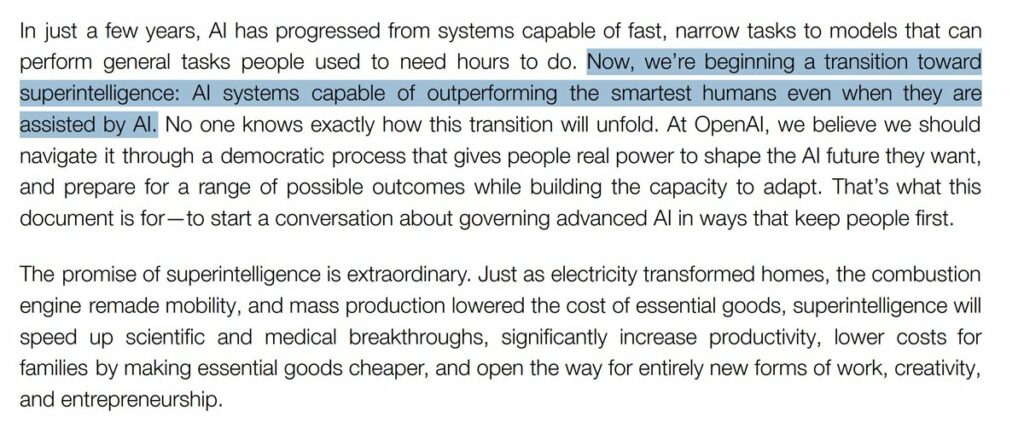
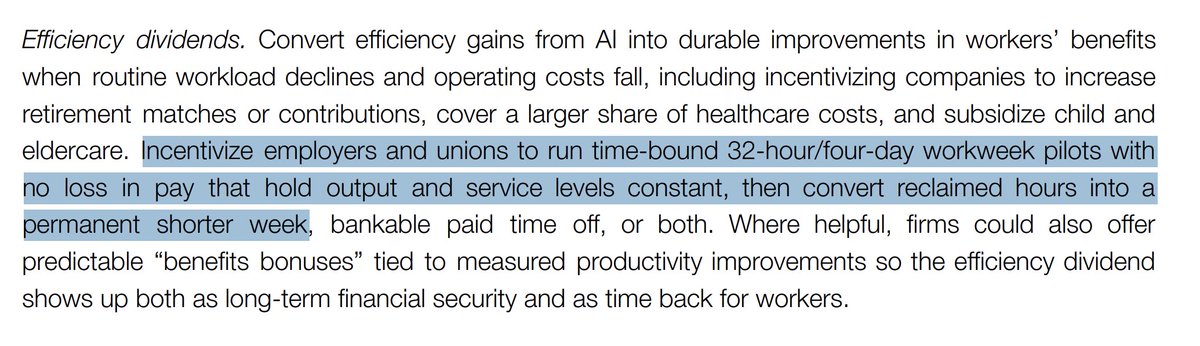
So maybe OpenAI *really* figured out superintelligence. In a way, Anthropic did, right? nitter.net/kimmonismus/status/204… Chubby♨️ (@kimmonismus) Looks like OpenAI reached Superintelligence. OpenAI: "Now, we’re beginning a transition toward superintelligence: AI systems capable of outperforming the smartest humans even when they are assisted by AI." OpenAI just published a 13-page policy blueprint for the "Intelligence Age"- proposing a Public Wealth Fund, 32-hour workweek pilots, portable benefits, a formal "Right to AI," and tax reforms to offset shrinking payroll revenue as automation scales. The document frames superintelligence not as a distant scenario *but an active transition requiring New Deal-level ambition*: new safety nets, containment playbooks for dangerous models, and international coordination modeled on aviation safety institutions. Here are OpenAI's suggestions (tl;dr): Open Economy: -Give workers a formal voice in AI deployment decisions -Microgrants and "startup-in-a-box" for AI-native entrepreneurs -Treat AI access as basic infrastructure (like electricity) -Shift tax base from payroll toward capital gains and corporate income -Public Wealth Fund — every citizen gets a stake in AI growth -Fast-track energy grid expansion via public-private partnerships -32-hour workweek pilots, better benefits from productivity gains -Auto-scaling safety nets triggered by displacement metrics -Portable benefits untied from employers -Invest in care economy as a transition path for displaced workers -Distributed AI-enabled labs to accelerate scientific discovery Resilient Society: -Safety tools for cyber, bio, and large-scale risks -AI trust stack — provenance, verification, audit logs -Competitive auditing market for frontier models -Containment playbooks for dangerous released models -Frontier AI companies adopt Public Benefit Corporation structures -Codified rules and auditing for government AI use -Democratic public input on AI alignment standards -Mandatory incident and near-miss reporting -International AI safety network for joint evaluations and crisis coordination Notably, OpenAI calls for stricter controls only on a narrow set of frontier models while keeping the broader ecosystem open, a clear attempt to position regulation as targeted, not industry-wide. They're backing it with up to $100K in fellowships and $1M in API credits for policy research, plus a new DC workshop opening in May. — https://nitter.net/kimmonismus/status/2041130939175284910#m
→ View original post on X — @kimmonismus, 2026-04-07 19:04 UTC