AI Dynamics

Global AI News Aggregator

About

AI

  • Codex excels at porting model architectures for async work

    Fun writeup: porting entire model architectures from scratch, and how the Codex app shines for async work! Niels Rogge (@NielsRogge) New blog post: how I used Codex to contribute VidEoMT, a SOTA model for video segmentation, to the Transformers library In December 2025, a shift occurred, and coding agents suddenly succeeded at a task they previously failed at: porting entire models. I list some of my best practices for using coding agents. Link: huggingface.co/blog/nielsr/c… — https://nitter.net/NielsRogge/status/2038654071054426595#m

    → View original post on X — @romainhuet, 2026-04-01 03:11 UTC

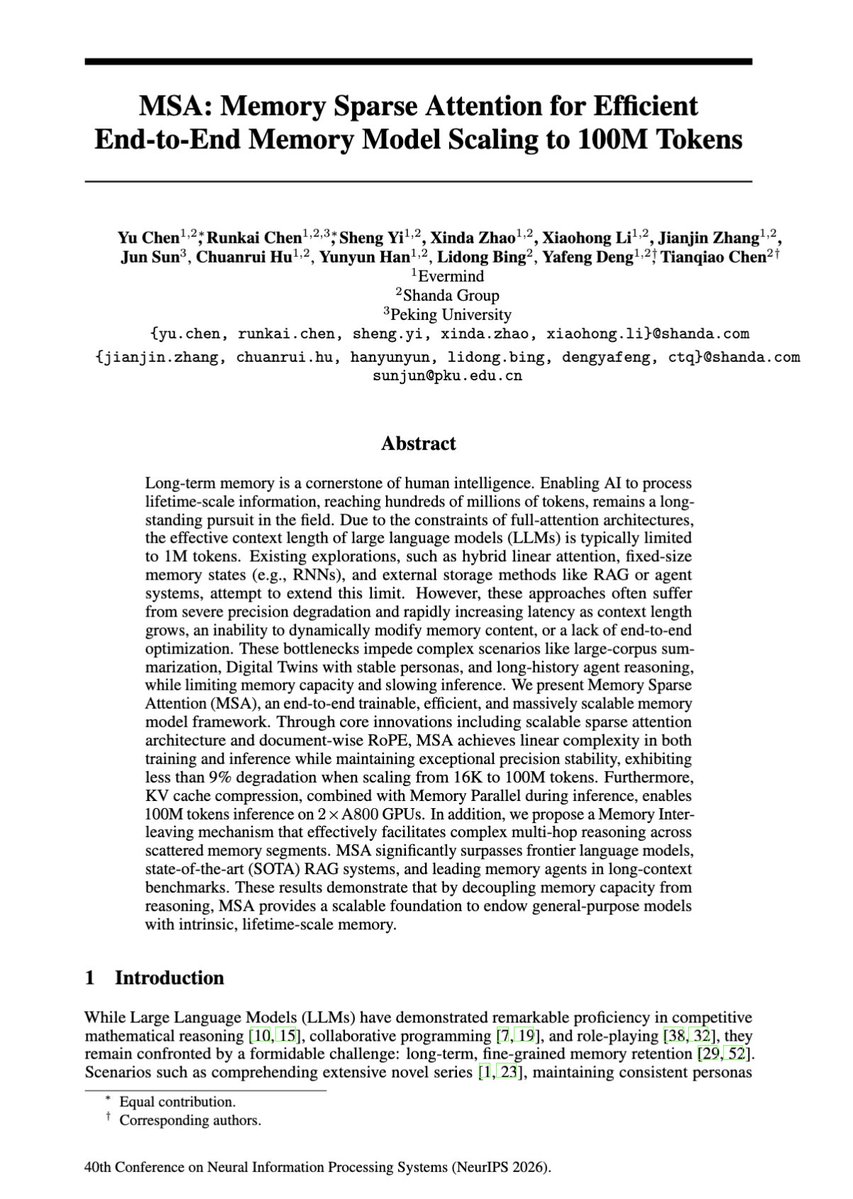
  • MSA Paper Published, Inference Code Open Sourced This Week
    MSA Paper Published, Inference Code Open Sourced This Week

    A little spoiler: 1. @EverMind's MSA paper has been selected for publication by AlphaXiv, and it's getting great traffic 2. MSA's Inference code will be open sourced this week github.com/EverMind-AI/MSA — alphaXiv (@askalphaxiv) Scaling Attention to 100M context!? Memory Sparse Attention introduces an idea where instead of rereading an entire 100M-token entry, it learns to jump straight into the relevant memories and reason from them end-to-end. More specifically, it first encodes documents into compressed memory slots, then for each question it uses a learned router to score which chunks are actually relevant, pulls only the top few, and runs normal attention over that tiny assembled context. So the model's compute grows with "how much it needs to look at" not "how much memory exists". This retrieval step is trained jointly with answer generation, so memory lookup is part of the model itself, and can decouple memory capacity from reasoning cost. [Translated from EN to English]

    → View original post on X — @elliotchen100, 2026-04-01 03:05 UTC

  • Flowith Canvas Launches AI Co-Creation Space with Multimodal Agents

    Flowith Canvas just evolved into the ultimate human-AI co-creation space! Visualize ideas on an infinite canvas, collab with agents like Claude seamlessly, generate multi-modal magic (text, images, videos+). Beyond chats—pure flow. Try it: http://
    flowith.io #AITools

    → View original post on X — @futurepedia_io

  • Darwin Among the Machines and the human domestication prediction

    I see the case for it, but "Darwin Among the Machines" takes a hard swerve toward predicting human domestication instead. I'd be happy tracing the lineage of domestication concerns to there.

    → View original post on X — @esyudkowsky

  • History of AI extinction concerns from Čapek’s robots to modern times

    (Depending on how we mark the history, I think I'd currently point to the lineage of extinction concerns as beginning with Karel Čapek in 1920. Čapek coined the word 'robot', meaning 'worker', in a play R.U.R. about how these unpaid robots had rebelled and wiped out humanity. Čapek's politics were not particularly right-wing, if that part matters much to you; he was a staunch anti-fascist in the 1920s sense of that term. One can obviously point to even earlier precedents like Frankenstein, or the Golem of Prague. To mark a "starting point" of any real intellectual history is usually rather arbitrary. But neither Frankenstein nor the Golem constitute a mass-manufactured race of unpaid servants, who then turn on humanity as a whole and exterminate it; so I'm picking Rossum's Universal Robots. Čapek's story was mostly an ungrounded what-if; it was simply taken for granted that the Robots (workers) were sufficiently human-derived or human-imitative to resent working for free. I think R.U.R. nonetheless can be declared the start of the intellectual lineage even if it doesn't make a careful argument; because R.U.R. makes the fair and obvious point that if you are manufacturing a powerful new servant species, it could perhaps turn on you and destroy you. This is a reasonable thing to worry about even before you start looking into further details of careful arguments! Čapek did not need to be a secret tool of (nonexistent) robot manufacturers looking to pump their stock prices, to observe that building a powerful new sapient race, supposedly to serve humans, might have some unpleasant consequences. It's in fact an obvious sort of concern; which is why historically speaking the word "robot" was coined back when "computer" still meant a human who worked a mechanical calculator. The very first story about "robots", manufactured workers, observed that such a race of manufactured beings might possibly turn on humans and wipe them out. Some later key figures in working out more detailed reasons for concern, beyond R.U.R.'s what-if, would on my accounting include the editor John Campbell, the writer Isaac Asimov, and the academic mathematicians I. J. Good and Vernor Vinge. All of them lived far too early to be secret clever tools of AI companies. The first two wrote before ENIAC. And of course I started on this a couple of decades before the current AI companies as well.)

    → View original post on X — @esyudkowsky, 2026-04-01 02:33 UTC

  • The Con Game: How AI Regulation Skeptics Play Into Company Hands

    A truism of con games is that no mark is as bullheadedly confident as one you get to believe that he's Figured It Out, that he's seen through it all. Like someone who's Figured Out that this "human extinction" business is secretly a con by the AI companies themselves, to make themselves look important to investors, and boost their stock prices. A mark in a con game who thinks he's Figured It Out often won't notice what he's actually doing — won't stop to consider how the actual action commended to him by his keen insight, consists of withdrawing his full bank account in $100 bills, and FedExing them to an address in Minnesota. He's in the know, see. And if you don't yet see how this general principle of con artistry works, it works like somebody on the political left who's figured out that all talk of regulating AI companies is really a con job by the AI companies themselves, aiming for regulatory capture. And so the clever thing to do is… to completely remove themselves from the AI company's way, and let the AI companies do whatever the hell they want until the world ends. Once the mark has been brought onto the inside and told about the supposed gimmick, they're so proud of being In The Know that they don't notice what exact course of action is being commended to them, by the guy who's slung a friendly arm around their shoulder. They're on the inside, now. They know the secret truth. And they're not gonna just play into the hands of the AI companies by trying to, say… shut them down, or regulate them or impose monitors on them, or oppose anything that AI companies are doing in any way. It is an easy con to see through, if you know the actual history and intellectual lineage of extinction concerns, and how long they predate the AI companies supposedly inventing them. Or if you're tracking the destination of the hundreds of millions of dollars AI companies are pouring into lobbying and PACs, to try to primary any politicians who favor regulating AI. But you don't need to study either of those complicated detailed facts. You just need to notice that the actual course of action commended by the clever secret insight is, "Don't raise any really severe concerns about the AI companies that might motivate severe interventions against them; and be sure to let them do whatever they want without regulation." It shouldn't be such a high bar to notice that, and wise people on both the left and right have done so.

    → View original post on X — @esyudkowsky, 2026-04-01 02:33 UTC
  • Apple at 50: From Fanboy to Changed by Steve Jobs’ Vision
    Apple at 50: From Fanboy to Changed by Steve Jobs’ Vision

    Apple turns 50 today. I'm not a fanboy anymore. But does that matter? These words are being typed on a MacBook, after I read the morning news on my iPad, before which I woke up to an iPhone alarm – with a meditation track on my AirPods. Like millions of others, it's still woven into the rhythm of my days. But that's not all. Some of the most formative years of my career were at Apple, when Steve Jobs had just returned. The dot-com crash was swallowing companies around us – but in our little office at MG Road, Bangalore, we were oblivious. We’d crowd around the iMac, slide the Monthly Update CD from Cupertino into its magentic slot, that went in with a hypnotic whoosh, ("no ugly CD trays, you know"), and watch Steve own the stage like no one else could. “Forget the specs. Focus on the user benefits.” “It’s not the customer’s job to know what they want.” "The people who are crazy enough to think they can change the world are the ones who do." "We are here to make a dent in the universe." We believed every word. They became our mantras for life. And the pace was dizzying. Every few months, a new marvel came into our lives – the iMac, the iBook, the iPod, the PowerMac, even the Cube, a commercial failure that you couldn't stop staring at. They were sculptures that happened to compute. Apple made us believe that technology could move you the way a painting does. Steve made us believe that rockstars don’t always hold a guitar. So yes, I'm not a fanboy anymore. But Steve – and Apple – changed me in ways I'm still discovering. The world is being rewritten again. This time, by AI. I hope Apple makes a dent in this new universe too. Here's to the next 50.

    → View original post on X — @parrysingh, 2026-04-01 02:33 UTC

  • Build CLI for AI Agents and Humans in 10 Minutes
    Build CLI for AI Agents and Humans in 10 Minutes

    Just SHIPPED new X Article: How to Build CLI for AI Agents and Humans (in less than 10 mins!) Google Cloud Tech (@GoogleCloudTech) x.com/i/article/203876788402… — https://nitter.net/GoogleCloudTech/status/2038778093104779537#m

    → View original post on X — @saboo_shubham_, 2026-04-01 02:31 UTC

  • Kai-Fu Lee Discusses China and OpenClaw on Bloomberg Interview

    China and Open Claw — My Interview on Bloomberg yesterday. bloomberg.com/news/videos/20…

    → View original post on X — @kaifulee, 2026-04-01 02:28 UTC

  • Robotic Wall Plastering Machine Automates Construction

    #Robotic Wall Plastering Machine Brings Automation to Construction
    by @gigadgets_ #EmergingTech #Innovation #TechForGood #Technology

    → View original post on X — @ronald_vanloon