AI Dynamics

Global AI News Aggregator

About

AI

  • Claude Code Vindication: Neurosymbolic AI Emerges as Next Paradigm

    Couldn’t agree more! We’re moving towards Nuerosymbolic AI – there’s masses just haven’t realized it yet, in the sense of understanding what the literature proposed and why the latest developments are starkly aligned Gary Marcus (@GaryMarcus) Claude Code is not AGI, but it is the single biggest advance in AI since the LLM. But the thing is, Claude Code is NOT a pure LLM. And it’s not pure deep learning. Not even close. And that changes everything. The source code leak proves it. Tucked away at its center is a 3,167 line kernel called print.ts. print.ts is a pattern matching. And pattern matching is supposed to be the *strength* of LLMs. But Anthropic figured out that if you really need to get your patterns right, you can’t trust a pure LLM. They are too probabilistic. And too erratic. Instead, the way Anthropic built that kernel is straight out of classical symbolic AI. For example, it is in large part a big IF-THEN conditional, with 486 branch points and 12 levels of nesting — all inside a deterministic, symbolic loop that the real godfathers of AI, people like John McCarthy and Marvin Minsky and Herb Simon, would have instantly recognized.* Putting things differently, Anthropic, when push came to shove, went exactly where I long said the field needed to go (and where @geoffreyhinton said we didn’t need to go): to Neurosymbolic AI. That’s right, the biggest advance since the LLM was neurosymbolic. AlphaFold, AlphaEvolve, AlphaProof, and AlphaGeometry are all neurosymbolic, too; so is Code Interpreter; when you are calling code, you are asking symbolic AI do an important part of the work. Claude Code isn’t better because of scaling. It’s better because Anthropic accepted the importance of using classical AI techniques alongside neural networks — precisely marriage I have long advocated. It’s *massive* vindication for me (go see my 2019 debate with Bengio for context, or to my 2001 book, The Algebraic Mind), but it still ain’t perfect, or even close. What we really need to do to get trustworthy AI rather than the current unpredictable “jagged” mess, is to go in the knowledge-, reasoning-, and world-model driven direction I laid out in 2020, in an article called the Next Decade in AI, in which neurosymbolic AI is just the *starting point* in a longer journey.* Read that article if you want to know what else we need to do next. The first part has already come to pass. In time, other three will, too. Meanwhile, the implications for the allocation of capital are pretty massive: smartly adding in bits of symbolic AI can do a lot more than scaling alone, and even Anthropic as now discovered (though they won’t say) scaling is no longer the essence of innovation. The paradigm has changed. — *Claude Code is plainly neurosymbolic but the code part is a mess; as Ernie Davis and I argued in Rebooting AI in 2019, we also need major advances in software engineering. But that’s a story for another day. — https://nitter.net/GaryMarcus/status/2042987819333738929#m

    → View original post on X — @garymarcus, 2026-04-11 19:48 UTC
  • Context Over Volume: Data Intelligence in Energy Operations

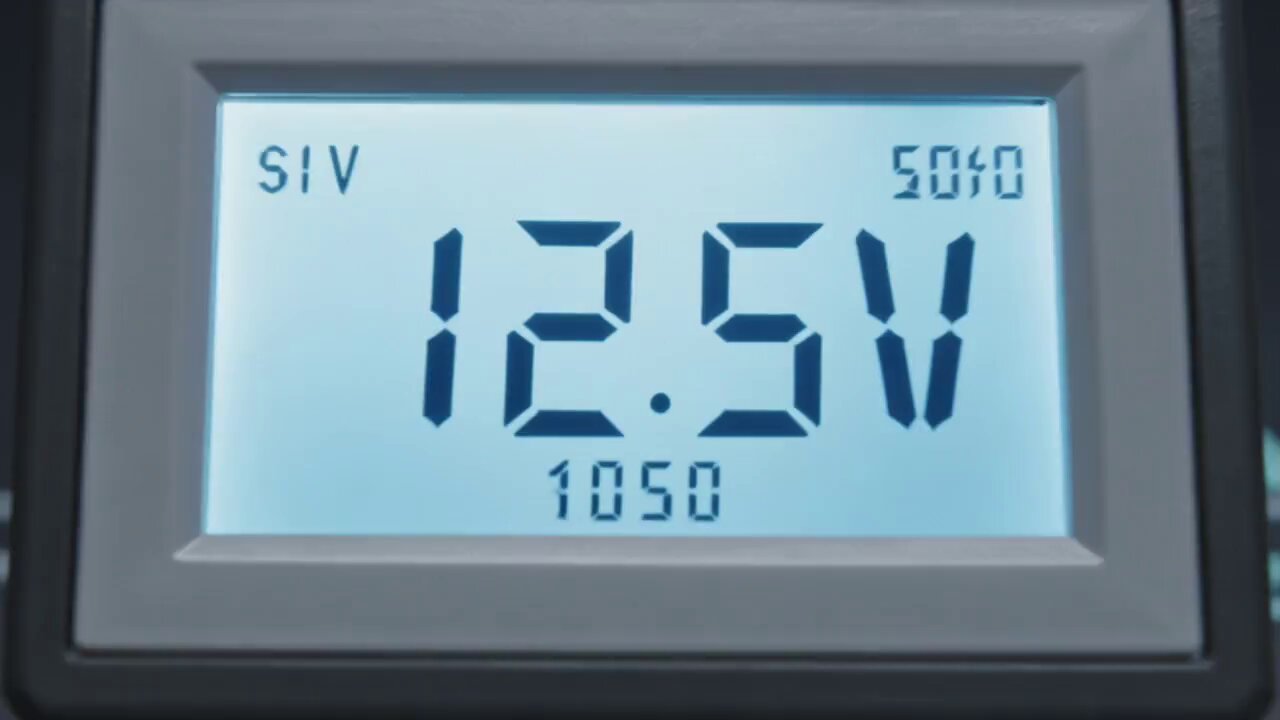
    The gap between data-rich and insight-poor is almost always a context problem, not a volume problem in energy operations.

    → View original post on X — @fogoros

  • Gary Marcus vindicated: Claude Code proves neurosymbolic AI superiority

    Yep … @GaryMarcus has been right for 25 years; some AI Godfathers, not so much at all! #SaturdayAISurvey @AnthropicAI Gary Marcus (@GaryMarcus) Claude Code is not AGI, but it is the single biggest advance in AI since the LLM. But the thing is, Claude Code is NOT a pure LLM. And it’s not pure deep learning. Not even close. And that changes everything. The source code leak proves it. Tucked away at its center is a 3,167 line kernel called print.ts. print.ts is a pattern matching. And pattern matching is supposed to be the *strength* of LLMs. But Anthropic figured out that if you really need to get your patterns right, you can’t trust a pure LLM. They are too probabilistic. And too erratic. Instead, the way Anthropic built that kernel is straight out of classical symbolic AI. For example, it is in large part a big IF-THEN conditional, with 486 branch points and 12 levels of nesting — all inside a deterministic, symbolic loop that the real godfathers of AI, people like John McCarthy and Marvin Minsky and Herb Simon, would have instantly recognized.* Putting things differently, Anthropic, when push came to shove, went exactly where I long said the field needed to go (and where @geoffreyhinton said we didn’t need to go): to Neurosymbolic AI. That’s right, the biggest advance since the LLM was neurosymbolic. AlphaFold, AlphaEvolve, AlphaProof, and AlphaGeometry are all neurosymbolic, too; so is Code Interpreter; when you are calling code, you are asking symbolic AI do an important part of the work. Claude Code isn’t better because of scaling. It’s better because Anthropic accepted the importance of using classical AI techniques alongside neural networks — precisely marriage I have long advocated. It’s *massive* vindication for me (go see my 2019 debate with Bengio for context, or to my 2001 book, The Algebraic Mind), but it still ain’t perfect, or even close. What we really need to do to get trustworthy AI rather than the current unpredictable “jagged” mess, is to go in the knowledge-, reasoning-, and world-model driven direction I laid out in 2020, in an article called the Next Decade in AI, in which neurosymbolic AI is just the *starting point* in a longer journey.* Read that article if you want to know what else we need to do next. The first part has already come to pass. In time, other three will, too. Meanwhile, the implications for the allocation of capital are pretty massive: smartly adding in bits of symbolic AI can do a lot more than scaling alone, and even Anthropic as now discovered (though they won’t say) scaling is no longer the essence of innovation. The paradigm has changed. — *Claude Code is plainly neurosymbolic but the code part is a mess; as Ernie Davis and I argued in Rebooting AI in 2019, we also need major advances in software engineering. But that’s a story for another day. — https://nitter.net/GaryMarcus/status/2042987819333738929#m

    → View original post on X — @garymarcus, 2026-04-11 19:46 UTC

  • Claude Code Quality Decline: AMD Director Reports Rising Laziness Issues
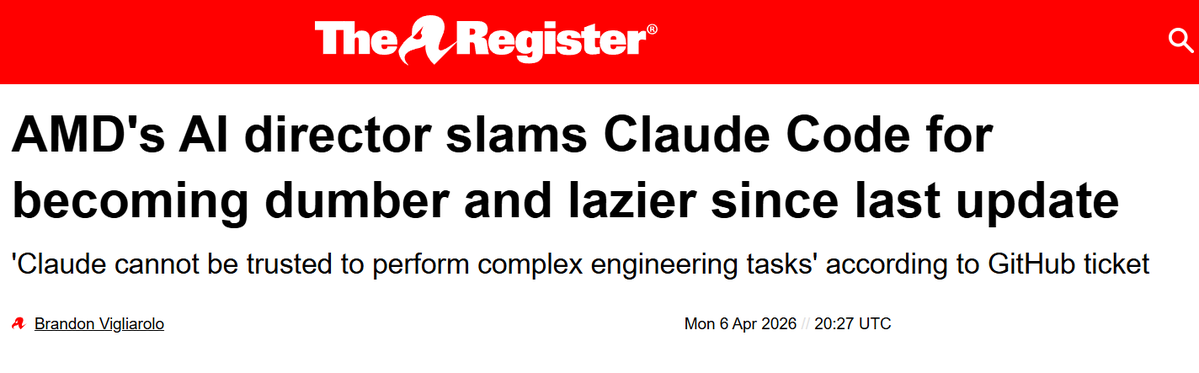
    Claude Code Quality Decline: AMD Director Reports Rising Laziness Issues

    AMD’s AI director Stella Laurenzo claims Anthropic’s Claude Code has significantly declined in quality since early March, citing analysis of 6,800+ sessions and 234k tool calls showing rising “laziness” behaviors like shallow reasoning, skipping code review, and incomplete tasks. Honestly, this is more impactful than expected, engineers report the model now favors quick, incorrect fixes over deep problem-solving, raising trust issues for complex workflows.

    → View original post on X — @kimmonismus, 2026-04-11 19:42 UTC

  • AI Models Need Contextual Baseline Data for Accurate Interpretation

    A voltage reading means very little to an AI model unless it knows what normal looks like for that specific location at that specific time.

    → View original post on X — @fogoros

  • RGPD bureaucracy delays rare cancer research data sharing

    I was at an official european cancer project hub i France and i'm agree with @sytses . 1/3 of the time was to talk about data and rgpd, not to talk about research doers. Not to talk about having a world sharing of data. As a parent of a child who had a rare bone cancer, we don't

    → View original post on X — @jessyseonoob

  • Semantic Tagging Enables AI Understanding of Industrial Sensor Data
    Semantic Tagging Enables AI Understanding of Industrial Sensor Data

    Semantic tagging provides the context AI models need to understand what a voltage reading actually means. Without knowing the asset, operating context, and grid topology position, models are processing numbers without meaning. Partner content with @IOTechSystems
    . #iotechsys_iiot

    → View original post on X — @fogoros

  • AI Empowers Rare Disease Patients With Data Insights

    hi @sytses
    , my son had a rare bone cancer too in 2024. We need more people like you. Because i'm not a scientist or in Medicine, no one want to listen to me. And I know that Patients know more about their disease and like you did, you already provide data. Now IA can do

    → View original post on X — @jessyseonoob