things are converging towards continual learning and self-evolving systems.
AGENTS
-
Unified Agent Definition Across Claude Code CrewAI OpenAI
By
–
Absolutely, same agent definition across Claude Code, CrewAI, and OpenAI is what makes it useful
-

GitAgent: Framework-Agnostic Standard for Portable AI Agents
By
–
If you found it useful, reshare it with your network Follow me → @Sumanth_077 for more insights and tutorials on AI Engineering! nitter.net/Sumanth_077/status/203… Sumanth (@Sumanth_077) Turn any git repo into an AI agent! GitAgent is a framework-agnostic standard that lets you define agents as git repositories. Every AI framework has its own structure. Claude Code, OpenAI, LangGraph, CrewAI, AutoGen all use different formats. You build an agent in one framework and it's locked there. No portability. No reuse. GitAgent fixes this. Your repository becomes your agent. Drop two files into a git repo (agent.yaml for the manifest, SOUL. md for identity) and it becomes a portable agent definition. Export it to any framework with adapters. You get git's workflow for free. Version control your prompts. Roll back broken changes with git revert. Fork public agents, customize them, and PR improvements back. Run gitagent validate in GitHub Actions to catch issues before deployment. The structure is flexible. Start with just agent.yaml and SOUL. md. Add skills, tools, workflows, memory, and compliance rules as you need them. Everything is optional except those two core files. It works across frameworks. Export to Claude Code, OpenAI Agents SDK, CrewAI, or as a raw system prompt. Same agent definition, different runtimes. Built for compliance. First-class support for FINRA, Federal Reserve, and SEC requirements. Segregation of duties built into the spec. Define roles, conflict matrices, and handoff workflows in agent.yaml. Link to the Github Repo in comments! — https://nitter.net/Sumanth_077/status/2038981420664959188#m
→ View original post on X — @sumanth_077, 2026-03-31 14:07 UTC
-
GitAgent Open Source Repository on GitHub
By
–
Github Repo: github.com/open-gitagent/git…
→ View original post on X — @sumanth_077, 2026-03-31 14:07 UTC
-
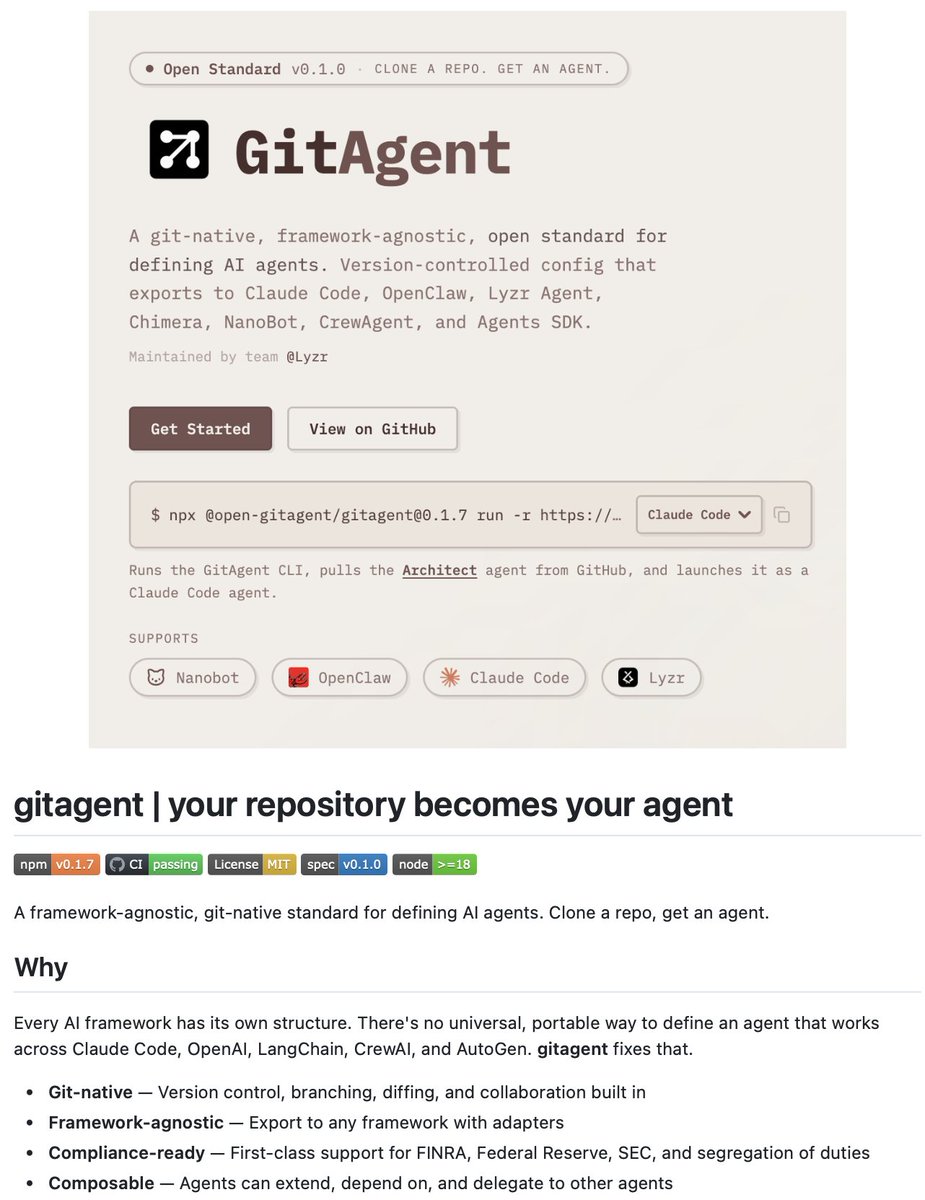
GitAgent: Framework-Agnostic AI Agent Definition Standard
By
–
Turn any git repo into an AI agent! GitAgent is a framework-agnostic standard that lets you define agents as git repositories. Every AI framework has its own structure. Claude Code, OpenAI, LangGraph, CrewAI, AutoGen all use different formats. You build an agent in one framework and it's locked there. No portability. No reuse. GitAgent fixes this. Your repository becomes your agent. Drop two files into a git repo (agent.yaml for the manifest, SOUL. md for identity) and it becomes a portable agent definition. Export it to any framework with adapters. You get git's workflow for free. Version control your prompts. Roll back broken changes with git revert. Fork public agents, customize them, and PR improvements back. Run gitagent validate in GitHub Actions to catch issues before deployment. The structure is flexible. Start with just agent.yaml and SOUL. md. Add skills, tools, workflows, memory, and compliance rules as you need them. Everything is optional except those two core files. It works across frameworks. Export to Claude Code, OpenAI Agents SDK, CrewAI, or as a raw system prompt. Same agent definition, different runtimes. Built for compliance. First-class support for FINRA, Federal Reserve, and SEC requirements. Segregation of duties built into the spec. Define roles, conflict matrices, and handoff workflows in agent.yaml. Link to the Github Repo in comments!
→ View original post on X — @sumanth_077, 2026-03-31 14:07 UTC
-
Top Smart Factory Technologies 2026: Agentic AI
By
–
And more insights here: https://
iiot-world.com/smart-manufact
uring/top-smart-factory-technologies-2026-agentic-ai-uns/
… #IIoT #EnergyEfficiency -
Molmo Point: AI Visual Grounding with Precise Spatial Pointing
By
–
Molmo Point: Teaching AI to Ground Language in Precise Visual Locations
— Satya Mallick (@LearnOpenCV) 31 mars 2026
In this episode of Artificial Intelligence: Papers and Concepts, we explore Molmo Point, an extension of multimodal AI that focuses on precise visual grounding enabling models to not just describe images,… pic.twitter.com/z1wpwyHwqUMolmo Point: Teaching AI to Ground Language in Precise Visual Locations In this episode of Artificial Intelligence: Papers and Concepts, we explore Molmo Point, an extension of multimodal AI that focuses on precise visual grounding enabling models to not just describe images, but accurately point to specific regions within them. Instead of treating images as whole scenes, Molmo Point trains models to connect language with exact spatial locations, bringing AI closer to how humans reference and interpret visual information. We break down why visual grounding has been a persistent challenge in vision–language models, how pointing mechanisms improve interaction and understanding, and what this means for applications like robotics, UI automation, and real-world task execution. If you’re interested in multimodal AI, spatial reasoning, or the future of AI systems that can both see and act, this episode explains why Molmo Point represents an important step toward more precise and actionable visual intelligence. Resources: Paper Link: allenai.org/papers/molmopoin… Interested in Computer Vision and AI consulting and product development services? Email us at contact@bigvision.ai or visit us at bigvision.ai
→ View original post on X — @learnopencv, 2026-03-31 13:30 UTC
-
Codex Agent Now Available as Open Source
By
–
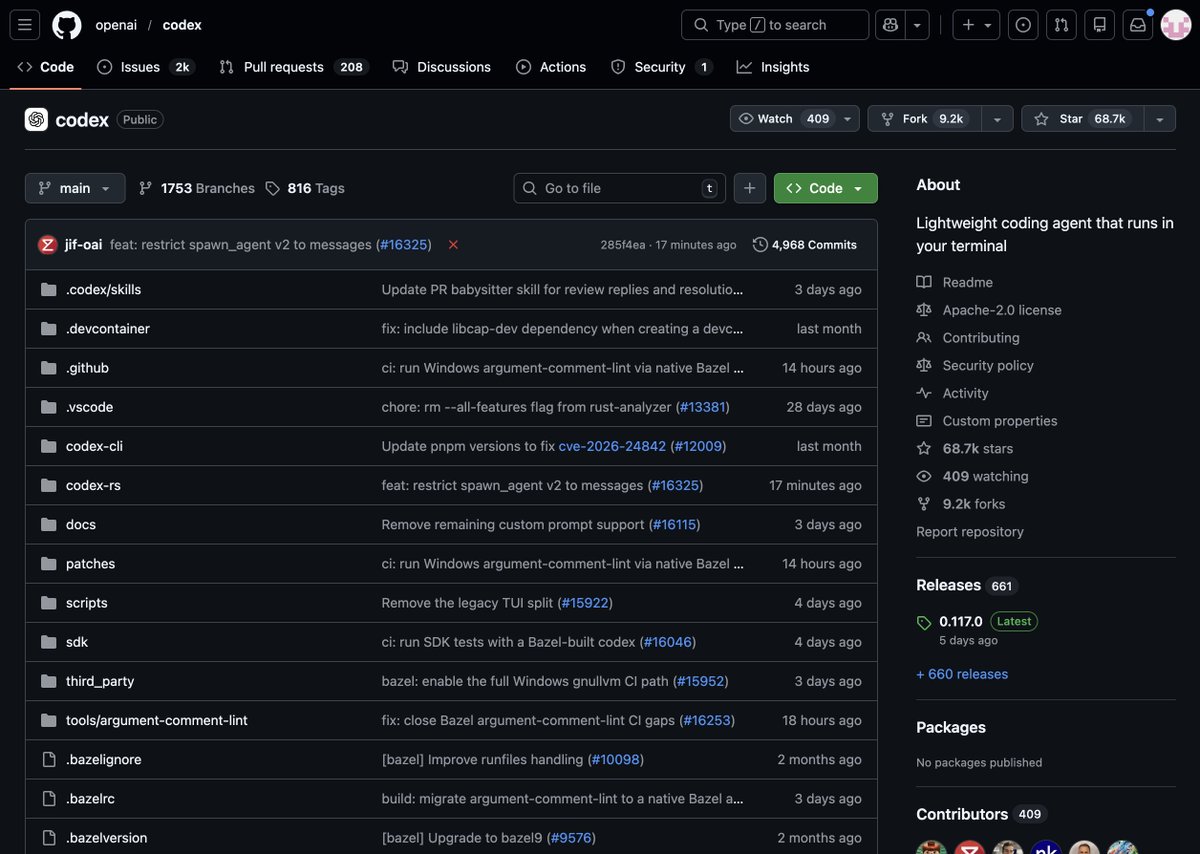
Reminder the Codex agent is open source 🤣
→ View original post on X — @arrakis_ai, 2026-03-31 13:22 UTC
-
Building AGI Agent Army for Pre-Market Wealth Singularities
By
–
Somehow gained α-AGI Insight internally → building an AGI agent army and deploying AGI Jobs to secure pre-market wealth singularities. #AGIALPHA
-

Natural-Language Agent Harnesses: Making AI Agent Control Portable and Inspectable
By
–
Agent harnesses are too restrictive. That's because they're still designed as code. What if the harness itself were written in natural language and interpreted by an LLM at runtime? This research explores the idea. The work introduces Natural-Language Agent Harnesses (NLAHs), a structured natural-language representation that externalizes harness logic as a portable, executable artifact. Instead of scattering control flow across controller code, framework defaults, and tool adapters, NLAHs make contracts, roles, stage structure, state semantics, and failure taxonomies explicit and editable. An Intelligent Harness Runtime (IHR) places an LLM inside the runtime loop to interpret and execute these harnesses directly. Why does it matter? Harness design is increasingly decisive for agent performance, but it's buried in code that's hard to transfer, compare, or ablate. NLAHs make the orchestration layer a first-class scientific object. The practical implication: harnesses become portable across runtimes, composable across tasks, and directly inspectable by humans and models alike. Paper: arxiv.org/abs/2603.25723 Learn to build effective AI agents in our academy: academy.dair.ai/