Funny how it's called 'Apple Intelligence,' yet it turns to OpenAI when the real brainpower is needed
@whats_ai
-
OpenAI Canvas: New Suggestion Feature for Collaborative Editing
By
–
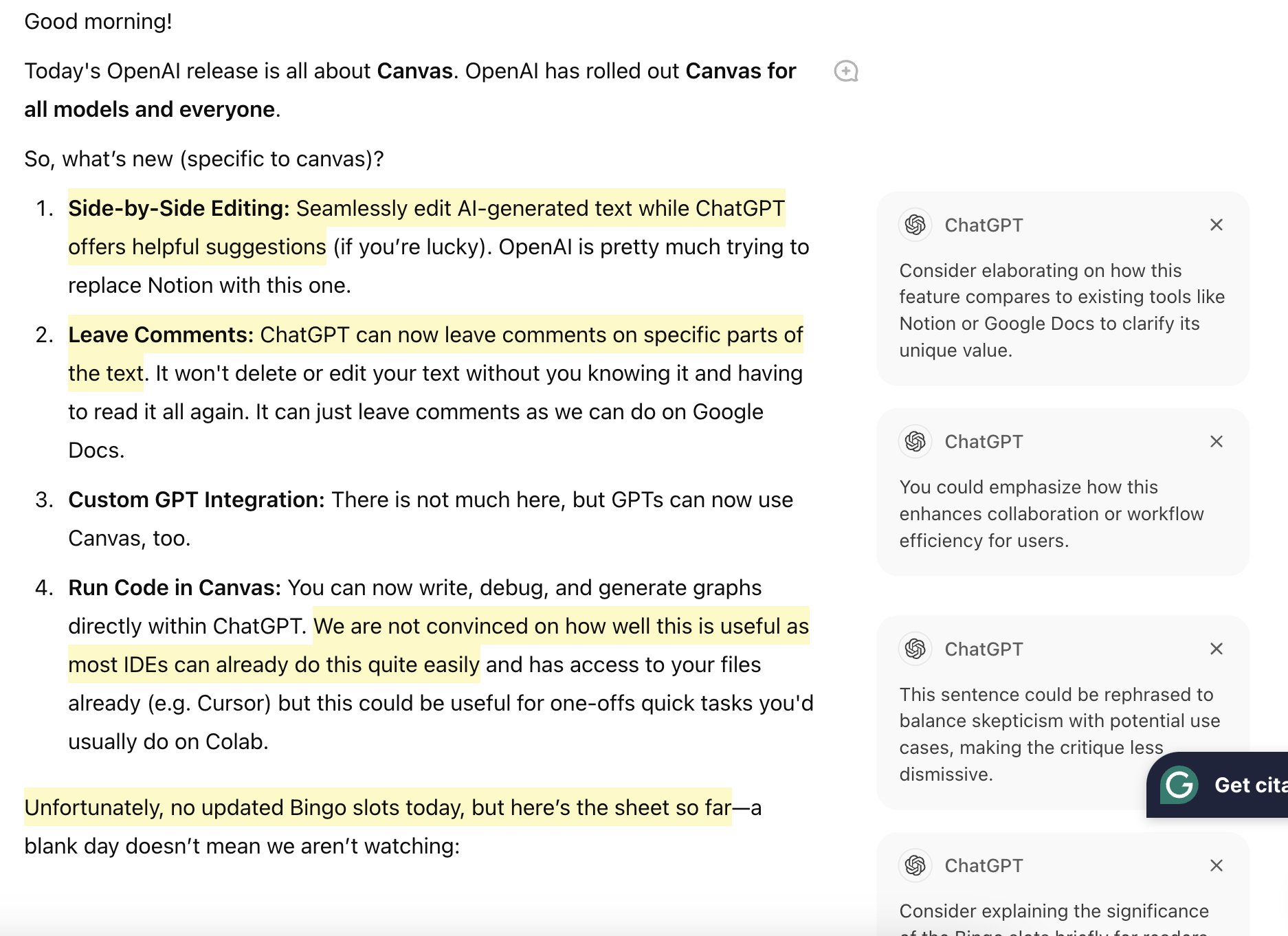
We just sent today's iteration, entirely made with OpenAI Canvas. I really love Canvas for editing and the new "Suggestion" feature, which allows ChatGPT to comment directly inside your draft (like Notion or Google Docs – see image). It allows for super easy edits and denial of
-
Prototyping AI Tools: Identify Problems, Test Solutions, Iterate
By
–
Prototyping a new tool? Don't overcomplicate it. There's no secret way to create something useful that succeeds: 1. Identify a real problem (you or someone you know has). It can be just a nice-to-have or something annoying.
2. Find a scrappy solution that exists and test it. If -
Rating Answers Easier Than Providing Perfect Ground Truths
By
–
Finally, it also has the benefit of being easier to do thanks to rating answers rather than having to provide perfect ground truths.
-
SFT and RL Fine-Tuning: Complementary Approaches for Model Optimization
By
–
I think that SFT will remain useful for fine-tuning a model to a new specific task, and RL fine-tuning becomes an interesting additional toolset further to push the model toward a desired kind of answer while also allowing it more flexibility in the way it “thinks” of the answer
-
OpenAI’s RLFT Boosts o1-mini Accuracy in Law, Finance, Engineering
By
–
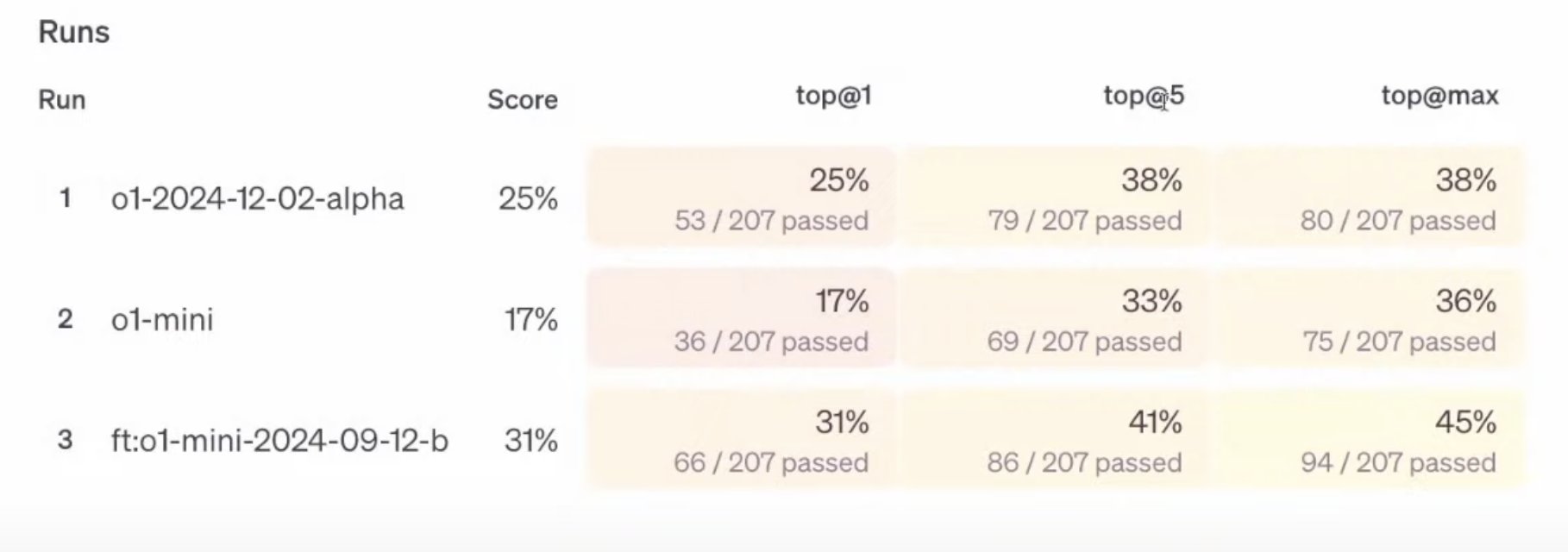
OpenAI sees huge potential in domains like Law, Finance, and Engineering, where “objectively correct” answers matter. Early results are promising: RLFT helped o1-mini boost accuracy in a gene example from 25% to 31%!
-
Question-Answer Pairs Training Without Perfect Ground Truth
By
–
Why is this interesting? It lets us use question-answer pairs without needing the full chain-of-thought input or even a perfect ground-truth output for SFT. Graders can assign nuanced scores (0–1), improving model outputs incrementally—even when answers are partially
-
RLFT Evaluates Complete Answers Instead of Individual Tokens
By
–
Instead of evaluating each token, one at a time, RLFT grades entire answers—perfect for scenarios like OpenAI’s o1, where we can’t access intermediate tokens before the “end_of_thought.”
-
OpenAI Releases Reinforcement Fine-Tuning for Flexible Model Training
By
–
Today, we got Reinforcement Fine-Tuning (RLFT)! (OpenAI releases day 2) Unlike Supervised Fine-Tuning (SFT) (already available on OpenAI for models like 4o), RLFT trains models with a flexible, non-fixed objective.
-
Reasoning Models Perform Better With Simple Prompts
By
–
As OpenAI writes in their documentation (https://platform.openai.com/docs/guides/reasoning#advice-on-prompting), these models perform best with simple prompts. "Advanced" techniques, like few-shot prompting or instructing the model to "think step by step," may not enhance performance and can sometimes hinder it.