
Now loop over each class. And from "X" subset the features corresponding to the current class "c". Using that calculate the probability of that class "c" occurring in the training data. This is calculated by: (Total No of times class "c" occurred)/Total No of classes
@sumanth_077
-

Defining the Naive Bayes Classifier Fit Method for Training
By
–
Define the fit method to train the Naive Bayes classifier. • Here "X" is the feature matrix that contains the data samples • "y" contains the class labels corresponding to each data sample. Also get the unique class labels and store them in "self.classes".
-
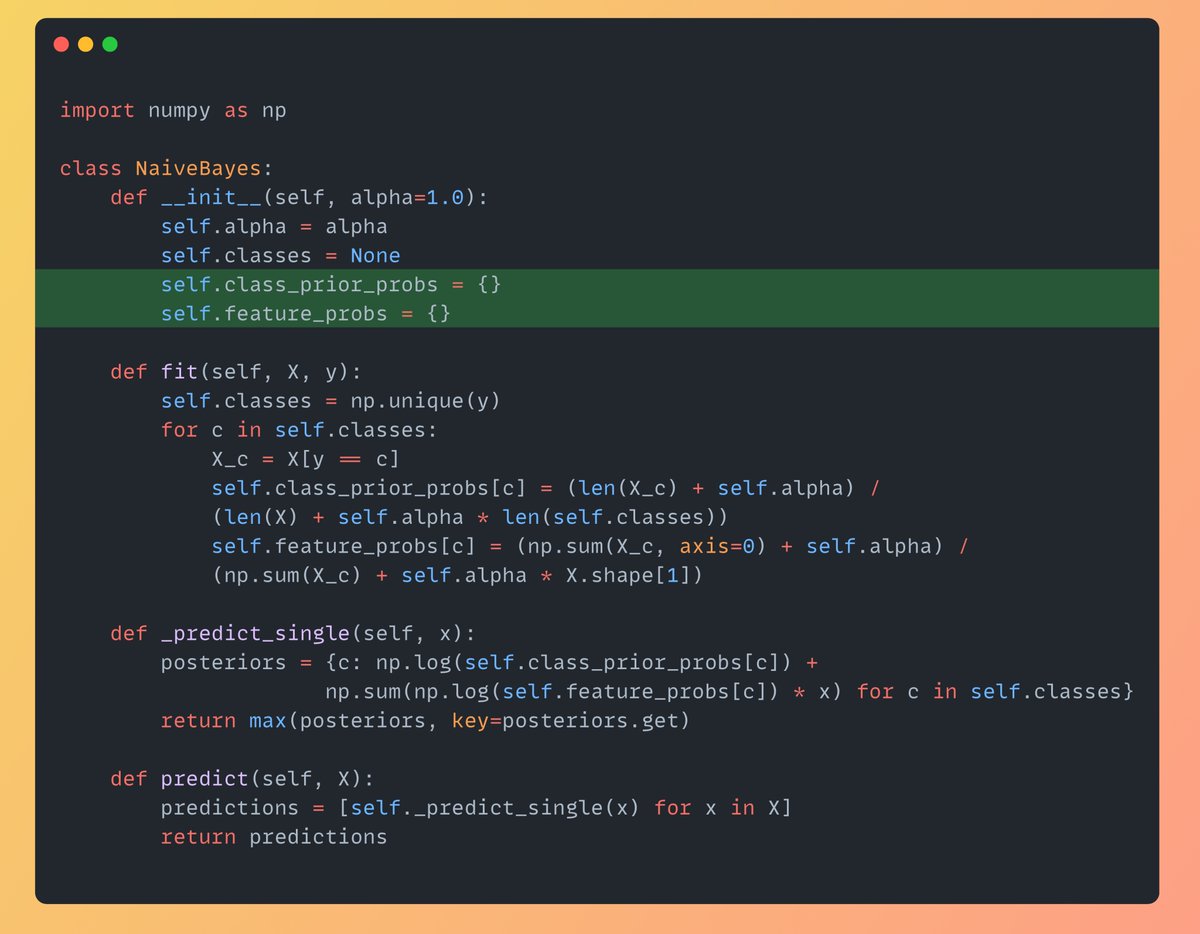
Initializing Class Prior Probabilities and Feature Probabilities Parameters
By
–
Similarly initialise: → class_prior_probs: This stores the probabilities of an individual classes → feature_probs: This stores the feature probabilities or conditional probability. More on these 2 parameters later:
-

Naive Bayes: Independence Assumption and Parameter Initialization
By
–
There reason why it called "naive" is it assumes the features are independent to each other. First, Let's initialise the parameters: → alpha: Just remember this as a smoothing parameter. Will explain it's importance later. → classes: To store the unique class labels.
-
Python ML MLOps CV NLP LLMs Daily Tutorials
By
–
If you are interested in: – Python – Machine Learning – MLOps – CV/NLP – LLMs Find me → @Sumanth_077 Everyday, I share tutorials on above topics! Like/RT the first tweet to help this reach more people!
-
Capstone Project: Build a Data Science Project from Scratch
By
–
6. Capstone Project Build a Data science project from scratch: After completing all the above courses take Harvard’s data science capstone project. Assess your skills in data visualization, statistics, data wrangling and machine learning.
-
Machine Learning Basics: Overfitting, Modeling, and Recommendations
By
–
5. Machine Learning This course will teach you the basics of machine learning, techniques to mitigate overfitting, supervised and unsupervised modelling approaches, and recommendation systems.
-
Data Pre-Processing: Preparing Data for Machine Learning Models
By
–
3. Data Pre-Processing This will teach you to prepare data and convert it into a format that is easily digestible by machine learning models.
-
Statistics Fundamentals for Data Science Learning
By
–
2. Statistics: Learn the fundamentals of statistics required for Data Science
-
Harvard Free Online Courses: Python, Data Science, Machine Learning
By
–
Harvard University is offering online courses on: – Python
– Data Science
– Machine Learning
– Data Preprocessing
– Data Visualization &
– Statistics No application required! Here are 5 FREE courses you don't want to miss: