Generative AI popularized the field of artificial intelligence, but it's so much more than language models and image generation. On Oct. 24, we’ll explore how this technology is transforming science, creativity, and society. Join us @Stanford
: https://
stanford.io/45yl8lJ
@stanfordhai
-
Generative AI Transforming Science, Creativity, and Society
By
–
-
AI Interpretability: Evaluating Data Visualization Tools for ML
By
–
To make AI systems more interpretable, researchers turned to data visualization tools to support human-in-the-loop ML. But an evaluation of these tools shows gaps between ambitions and evidence. #VIS4ML
-
Algorithmic Monoculture Creates Repeated Harms for User Groups
By
–
Algorithmic monoculture or reliance on the same datasets/algorithms may lead to repeated harms to individuals or groups. @StanfordCRFM tested this hypothesis and found an alarming trend: there are users who are always negatively impacted in the ecosystem.
-
Stanford AI Agents Self-Reflect to Improve Adaptation
By
–
Animals naturally excel at adapting to changing environments. How can AI successfully do the same? Stanford scholars designed a method that allows AI agents to “self-reflect” about their most interesting experiences, thereby improving performance.
-
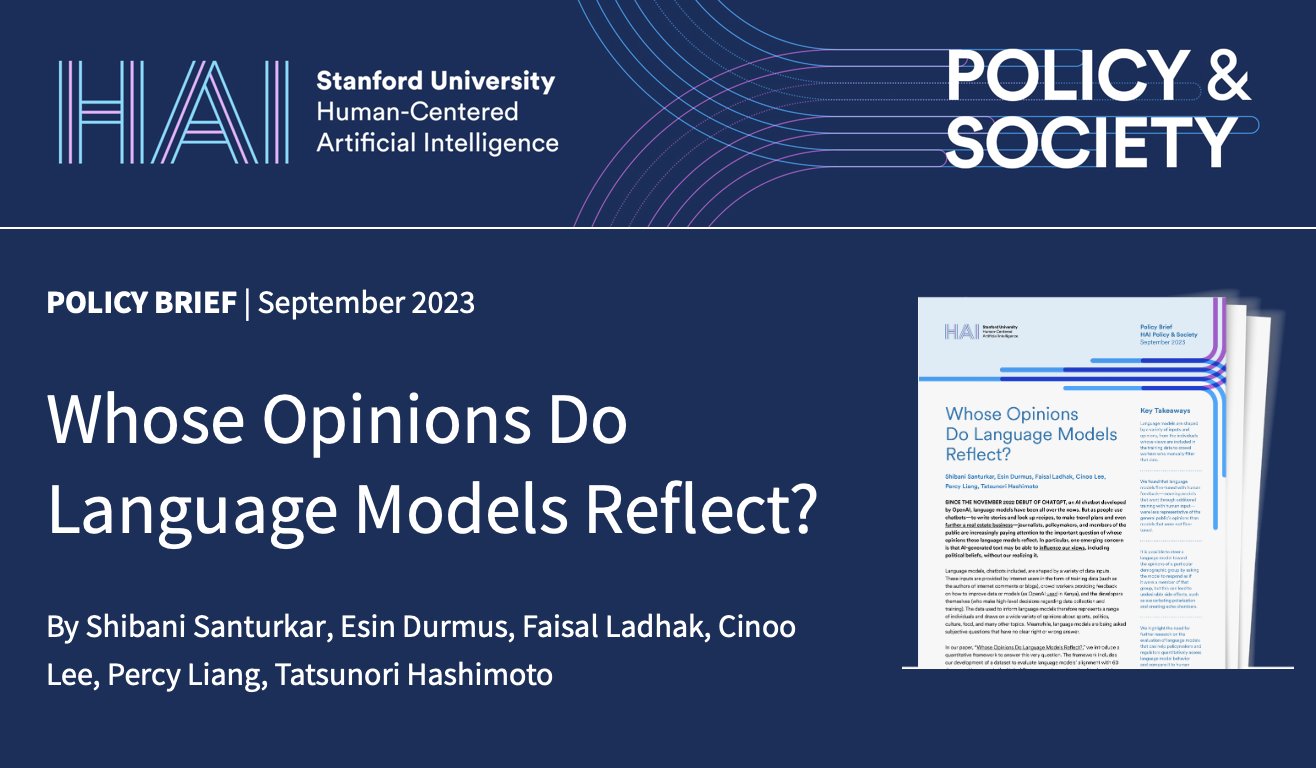
Language Models Fine-Tuned Feedback Show Less Public Opinion Bias
By
–
Our latest policy brief highlights a quantitative framework that evaluates bias in language models. One key takeaway? Language models fine-tuned with human feedback were less representative of public opinion than models that were not fine-tuned. Read more: https://
stanford.io/3LXLCWI -
AI Algorithms Detect Skin-Tone Bias in Medical Education
By
–
Finding disparity in existing educational materials in medicine is nothing new. But by using computer algorithms that are far more scalable than human-labeled data, people can now easily evaluate these educational materials for skin-tone bias. https://
stanford.io/3QbBVXg -
Stanford Develops Pediatric AI Framework for Safe Child Data
By
–
Stanford scholars introduced a new pediatrics AI framework to guide researchers, clinicians, regulators, and policymakers throughout each stage of the AI life cycle and ensure safe inclusion of children's data. https://
stanford.io/3ttZMIZ -
Shakey Robot: First AI-Powered Robot in 1972
By
–
On this day in 2004, Shakey the Robot earned its place in Carnegie Mellon University's Robot Hall of Fame. Created between 1966 and 1972 by Stanford Research Institute's Artificial Intelligence Center (now @SRI_Intl
), Shakey was the first robot to use AI: https://
bit.ly/3RXzUzg -
Generative Agents Simulate Complex Human Behavior for Research
By
–
Beyond gaming, researchers see potential in using AI agents to better understand ourselves. Dubbed as generative agents, they “could play a role in bringing a fresh perspective by enabling a more complex simulation of human behavior,” says @joon_s_pk
. -
Princeton Honors AI Researcher for Advancing Diversity Impact
By
–
Congrats to @drfeifei for receiving @Princeton
’s Woodrow Wilson Award, given to alumni whose careers embody Wilson’s call to duty. Her research has critically advanced AI, broadened diversity in the field, and focused on its human impact. Well deserved!