Academia's role in AI innovation is crucial, but resource constraints and the severe brain drain tilts the balance in favor of the private sector. @drfeifei @Rbaltman @kingjen and @RepAnnaEshoo champion NAIRR at the recent event by @StanfordHAI
.
@stanfordhai
-
Academia’s AI Innovation Role: Addressing Resource Constraints and Brain Drain
By
–
-
Natural Language Interface Enables Creative Coding for Digital Artists
By
–
A new interface for creative coding with natural language prompts helps digital artists translate imaginative ideas into code.
-
Stanford Emerging Tech Review Launched with Policy Focus
By
–
Join @StanfordEng and @HooverInst for today's launch of the Stanford Emerging Tech Review. We are pleased to have contributed to this university-wide effort to produce an annual report of key technological developments and their policy implications.
-

AI Education Rethinking in Stanford HAI Director’s New Memoir
By
–
HAI co-director @drfeifei urges a rethinking of AI education in her new memoir, “The Worlds I See.” Check out this book and more of our faculty publications here: https://
stanford.io/3FW737d -
GeoMatch: Machine Learning Tool Helps Place Refugees Optimally
By
–
Over 100 million people globally have been forcibly displaced from their homes, with about 35 million recognized as refugees. A machine learning tool called GeoMatch is designed to help place refugees where they’re most likely to thrive. @ImmigrationLab
-

Stanford HAI Director Launches Memoir on AI Ethics
By
–
Last week, our co-director @drfeifei celebrated the launch of her new memoir “The Worlds I See” with the Stanford community at an event hosted by the @StanfordCyber and @StanfordHAI
. An evening full of gratitude, togetherness, and inspiration: -
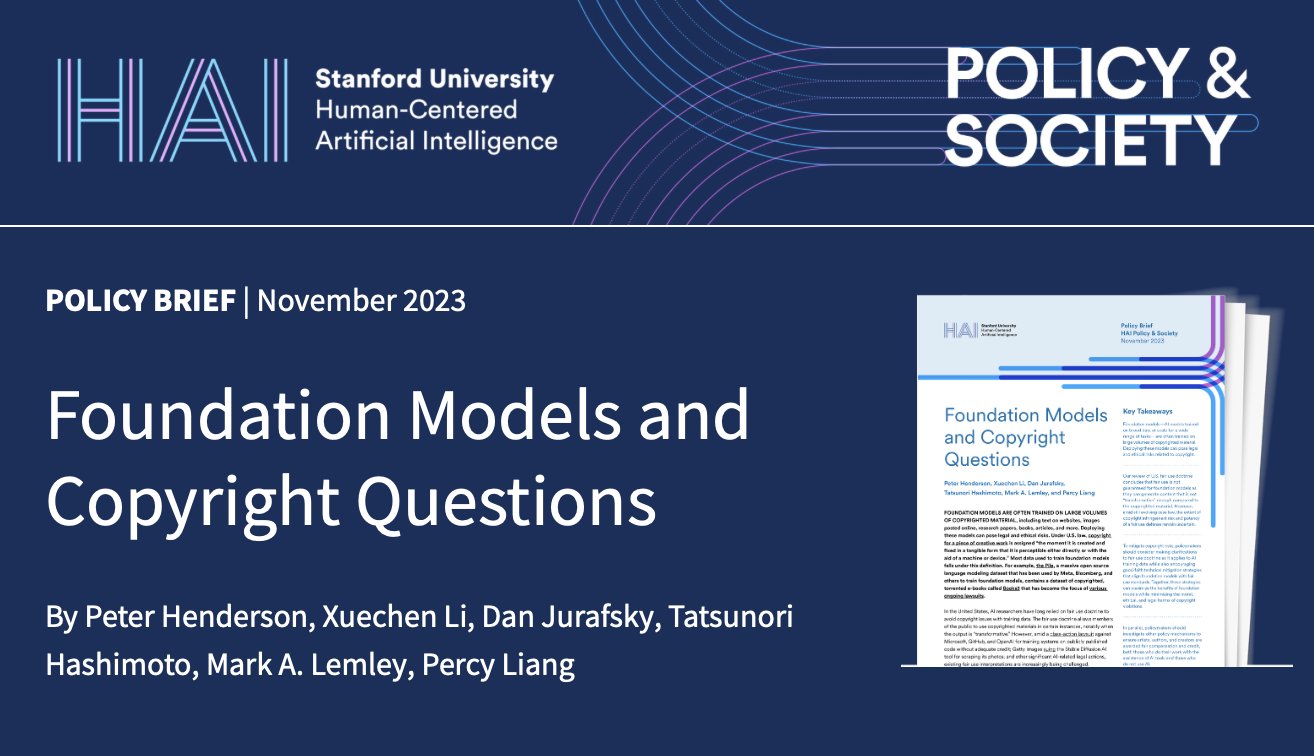
Stanford analyzes copyright risks in foundation models
By
–
Stanford scholars analyzed the U.S. case law to identify the potential risks of foundation models developed using copyrighted content and discussed legal and technical strategies to help reduce the risk of copyright violations. Read the policy brief: https://
stanford.io/3szn2oP -
Ecosystem-Level ML Model Analysis Reveals Systemic Failure Patterns
By
–
Ecosystem-level analysis of ML models reveals patterns of systemic failure that are invisible from a single-model perspective. @StanfordCRFM @RishiBommasani
-
Large Language Models Enable Human-Like Agents Breakthrough
By
–
Large language models make it possible to create human-like agents. A breakthrough by @joon_s_pk and colleagues has sparked interest among game developers and social scientists.
-
AI Responsibility Lies With People, Not Technology Itself
By
–
“AI is “promising” nothing. It is people who are promising – or not promising. AI is a piece of software. It is made by people, deployed by people and governed by people,” says HAI co-director @drfeifei in an interview with @guardian
: