
We’ve been using Sakana Fugu internally for our own research and coding. Instead of relying on a single model, it dynamically orchestrates the best combination of open and closed models for any task. The future of AI is collective intelligence. Excited to open the beta release:
@hardmaru
-
Sony’s Ace Robot Achieves Expert-Level Ping-Pong Play
By
–
Incredible work by Sony published in @Nature today! 🏓
— hardmaru (@hardmaru) 23 avril 2026
They’ve built “Ace”, an autonomous ping-pong robot that uses RL and Sony’s vision sensors to achieve expert-level play in ping pong. A huge leap forward for adaptive robotics.https://t.co/hJqnZzXV17pic.twitter.com/xQ5NThU6xJ https://t.co/hpep1aQsDBIncredible work by Sony published in @Nature today! They’ve built “Ace”, an autonomous ping-pong robot that uses RL and Sony’s vision sensors to achieve expert-level play in ping pong. A huge leap forward for adaptive robotics. https://
nature.com/articles/s4158
6-026-10338-5
… -

Principal Platform Engineer Role for Data Infrastructure in Tokyo
By
–
I am looking for a Principal Platform Engineer to join us in Tokyo and build the core data infrastructure for Japan’s most critical systems. Read the full mission and apply here: https://
sakana.ai/careers/#princ
ipal-platform-engineer
… -
String Seed of Thought: Prompting LLMs for Diverse Distribution-Faithful Generation
By
–
String Seed of Thought: Prompting LLMs for Distribution-Faithful and Diverse Generation https://
arxiv.org/abs/2510.21150 https://
pub.sakana.ai/ssot/ -
Simple Prompting Trick Improves LLM Randomness and Output Diversity
By
–
Getting LLMs to simulate “true” randomness or generate diverse outputs is surprisingly difficult. We found a simple prompting trick that solves this by having the model generate and manipulate a random string. To be presented at #ICLR2026 this week!
— hardmaru (@hardmaru) 20 avril 2026
Blog: https://t.co/CyevqqJ5ej https://t.co/dN0yZZ5MijGetting LLMs to simulate “true” randomness or generate diverse outputs is surprisingly difficult. We found a simple prompting trick that solves this by having the model generate and manipulate a random string. To be presented at #ICLR2026 this week! Blog: https://
pub.sakana.ai/ssot -
EDINET-Bench: Evaluating LLMs on Japanese Financial Statement Tasks
By
–
EDINET-Bench: Evaluating LLMs on Complex Financial Tasks using Japanese Financial Statements https://
arxiv.org/abs/2506.08762 https://
sakana.ai/edinet-bench/ -
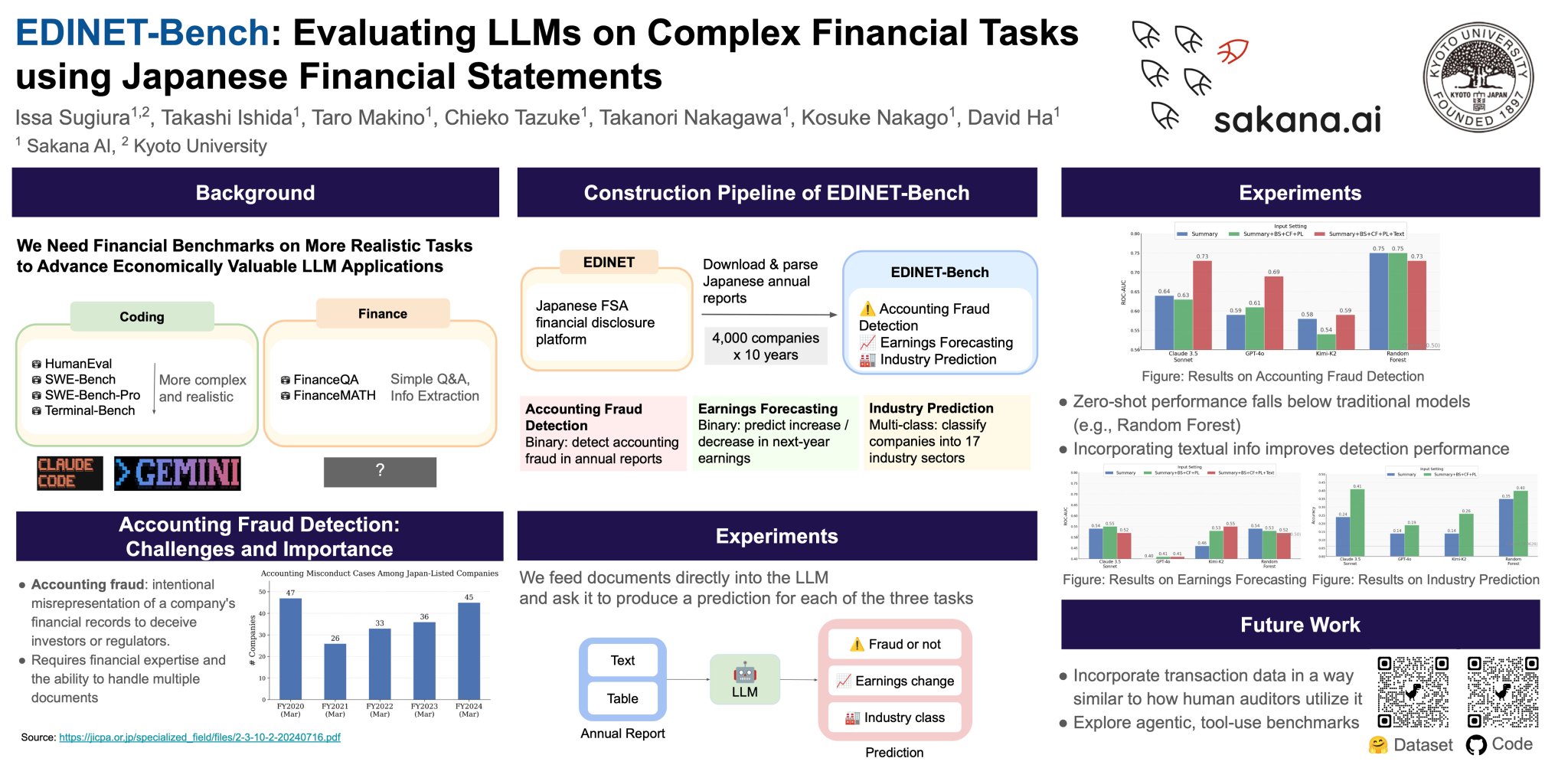
EDINET-Bench Japanese Financial Dataset Recognized at ICLR 2026
By
–

I am very proud of our team for releasing EDINET-Bench, and it is fantastic to see a Japanese financial dataset recognized at #ICLR2026 this week. We need more diverse, non-English datasets to evaluate models in the real world. https://
openreview.net/forum?id=Dxns0
cj15A
… -

Neural Network Cells Compete in Digital Petri Dish Browser
By
–
Make neural network cells inside a “Digital Petri Dish” fight for control and dominance in a web browser tab.https://t.co/t8N6CIhvze https://t.co/nPdtvRL473 pic.twitter.com/A5SSTvPJBu
— hardmaru (@hardmaru) 19 avril 2026Make neural network cells inside a “Digital Petri Dish” fight for control and dominance in a web browser tab. https://
pub.sakana.ai/digital-ecosys
tem/
… -
Software Engineer Research Development Role Opportunity
By
–
Software Engineer (Research and Development)
-

Sakana AI Hiring Software Engineers in Tokyo for R&D
By
–
We are hiring Software Engineers in Tokyo to help us scale Sakana AI’s R&D. If you’re interested in building the data pipelines and full stack infrastructure needed to push the boundaries of automated scientific discovery, we’d love to hear from you. https://
sakana.ai/careers/#softw
are-engineer-research-and-development
…