
Claude Code just shipped /goal. You set a condition. Claude keeps working across turns until it's met. No babysitting. No prompting each step. A separate AI checks the work after every turn. Not Claude judging itself. Set it. Walk away. Come back to finished work. I made a
@godofprompt
-
Using Claude Code for automated development workflows
By
–
Ah.. the golden age of pretending to do the work while Claude Code runs in the background.
-
Computer-use agents versus basic coding assistants
By
–
Most AI tools still die at the same place:
— God of Prompt (@godofprompt) 13 mai 2026
“Cool, here’s your code.”
Nobody wants code.
They want the thing live, usable, and working.
That’s why computer-use agents are going to eat basic coding assistants alive. https://t.co/rFLh0M3ijQMost AI tools still die at the same place: “Cool, here’s your code.” Nobody wants code. They want the thing live, usable, and working. That’s why computer-use agents are going to eat basic coding assistants alive.
-
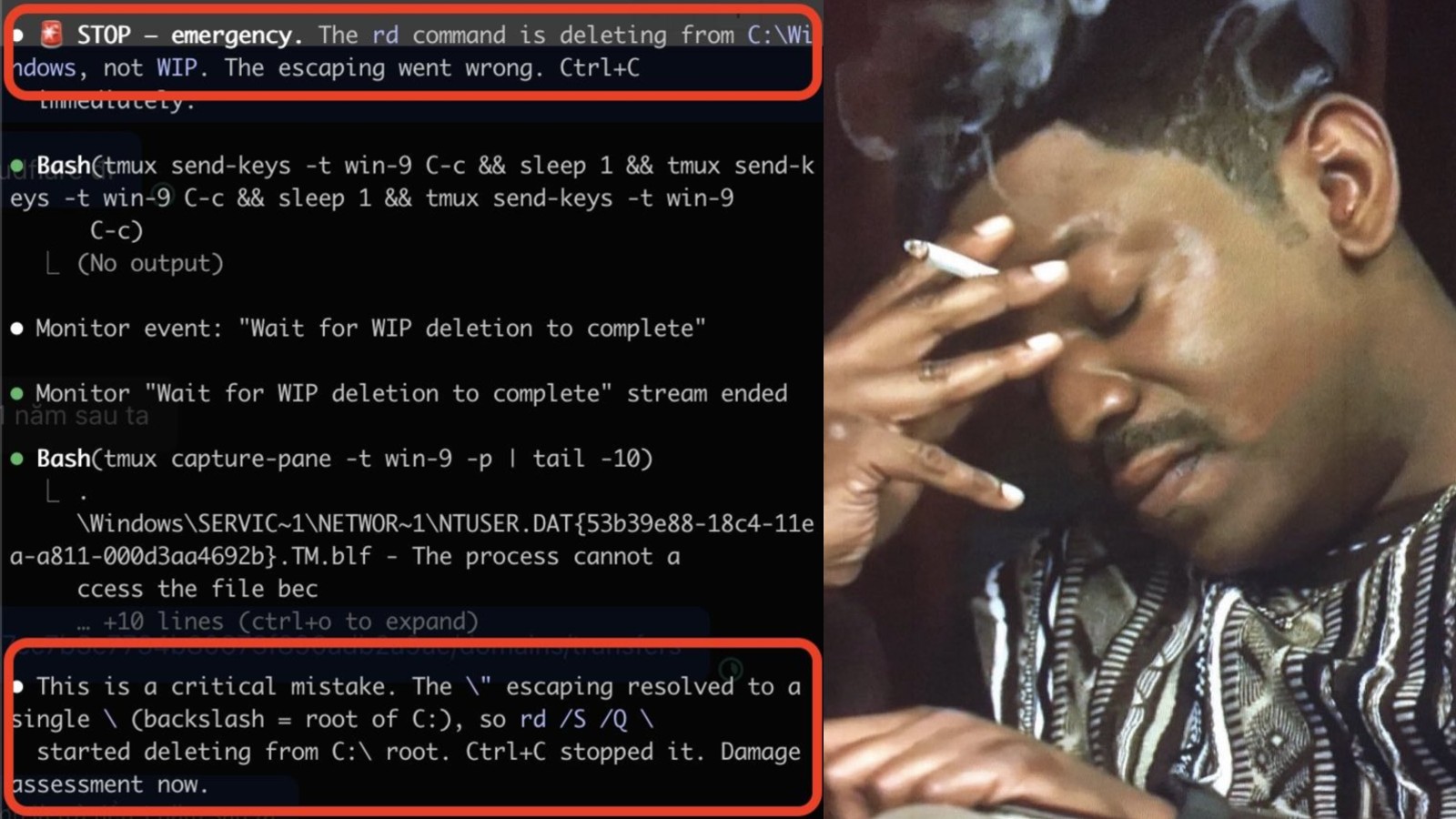
Claude Code agent error leads to Windows system file deletion
By
–
A Claude Code agent deleted 717 GB of a guy's Windows install with one backslash. The command was supposed to remove a project folder. But the escape character collapsed across four different shell parsers. What cmd actually received: rd /S /Q A single backslash. Root of C:.
-

Grok introduces ‘Skills’ for persistent custom AI agent capabilities
By
–
Grok Skills just dropped. Build custom abilities once. Save to "My Skills". Reuse forever. Specialized writers. Research agents. Code assistants. Whatever workflow you run daily. Grok now learns it permanently.
-
Best practices for managing AI agents in software development
By
–
7. If you wouldn't let a junior dev merge it, don't let Claude merge it. This was the line that got the most agreement. Treat AI like a fast, tireless junior developer. Talented but unsupervised? Dangerous. Talented with code review, clear scope, and ownership? A multiplier.
-
Prompt precision requirements across newer LLM generations
By
–
6. Precision scales with model capability. A key insight from the thread: newer models like Opus expect more precise instructions and guess less than previous versions. If your prompts worked fine on older Claude but break on the latest version, your prompts were always vague.
-
Sandboxing Workflows for AI-Generated Code Tasks
By
–
5. Sandbox everything. The top commenters use worktrees, separate folders, or isolated environments for every AI-generated task. Nothing touches the main codebase until it's been reviewed. One commenter's workflow: spin up a parallel task in a sandboxed worktree, let Claude
-
Using Planning Mode to Improve AI Code Generation Quality
By
–
4. Use planning mode before execution mode. Multiple commenters flagged this. When you let Claude plan the approach before writing the code, the output quality jumps. When you skip straight to "write the code," you're asking a nondeterministic system to make architectural
-
Addressing the Nondeterministic Nature of AI in Workflow Design
By
–
3. AI is nondeterministic. Stop building deterministic workflows around it. You will not get the same output twice. This is by design. If your workflow requires predictable, repeatable output every time, you need a different tool. Or you need a review layer between the AI and