Everyone on earth will get really good chatbots for free, so thats good for democratization of AI, but really good agents that can do complex work burn thousands of times more tokens, and will be reserved for places that can afford to pay, which is bad for democratization.
@emollick
-
Compute limits will favor agentic AI over chatbots
By
–
We are quite short of compute, and that is going to result in compute becoming very expensive for complex agentic workflows even as single-turn chatbots get cheaper. So the richest companies & most pressing use cases will use AI agents & everyone else will be stuck with chatbots?
-
Using AI for Peer Review Alongside Humans
By
–
The implication is that you should be using AI for peer review, but combine it with humans, though AI reviewers keep getting better and humans don't. Paper:
-
GPT-5.2 Competitive with Expert Peer Reviewers
By
–
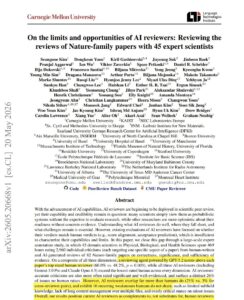
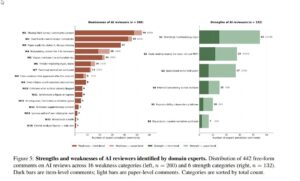
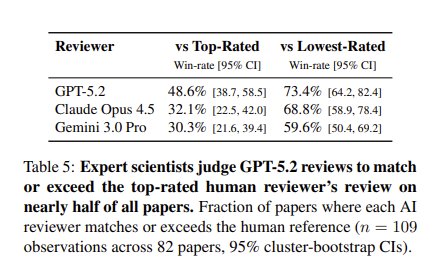
Seems GPT-5.2 reaches expert level in peer review: 45 scientists took 469 hours evaluating human & AI reviews on 82 papers. "Surprisingly, current AI reviewers are competitive even with the top-rated reviewers in Nature’s official peer review…" though not without weaknesses.
-
GenAI drives enterprise ROI as coding agents gain traction
By
–
Enterprise adoption will take awhile, but we have moved past no success – 75% of companies had positive ROI from GenAI in November, and coding agents are now starting to have a real impact at many firms. I think normal adoption does not mean that model abilities aren't growing.
-
AI struggles to generate novel research questions
By
–
In science, AI still does a poor job at finding interesting questions to solve in fields that don't have lists of known issues This has always been the hardest thing to teach PhDs: otherwise you find small problems or problems that don't advance the field or don't generalize etc
-
AI’s potential electricity and water footprint by 2030
By
–
Individual use is small, but at aggregate scale, resource usage is higher. By 2030, AI may use as much electricity as Japan. Water use will remain less than 1% of total US water use in 2030, but that can still strain local utilities. (and this problem alone took many runs)
-
Estimates of AI data center power and water usage
By
–
Estimates of power usage here: https://
arxiv.org/pdf/2509.20241 (these numbers also match independent assessments) Estimates of water usage here: https://
eta-publications.lbl.gov/sites/default/
files/2024-12/lbnl-2024-united-states-data-center-energy-usage-report_1.pdf
… (note it only includes direct cooling, not water for electricity generation) -
Estimated energy and water for an LLM solving an Erdös problem
By
–
If this is true, using the best public estimates we have of LLM resource use, solving this Erdos problem took 0.6–6.3 kWh of electricity and about 3–31 liters of water. So that is less than three almonds worth of water and the electricity equivalent of 2-20 miles of EV driving.
-
Which AI labs will prioritize social science research?
By
–
Math is easy* because it has verifiable outputs and few messy judgement choices to make. Which AI labs have the guts to make advancing social science a priority? It may actually do more for human flourishing to unlock sociology, econ & psych reseach. * For AIs, not for humans