AI Dynamics

Global AI News Aggregator

About

@elliotchen100

  • WaytoAGI Tokyo Event Dinner Invitation
    WaytoAGI Tokyo Event Dinner Invitation

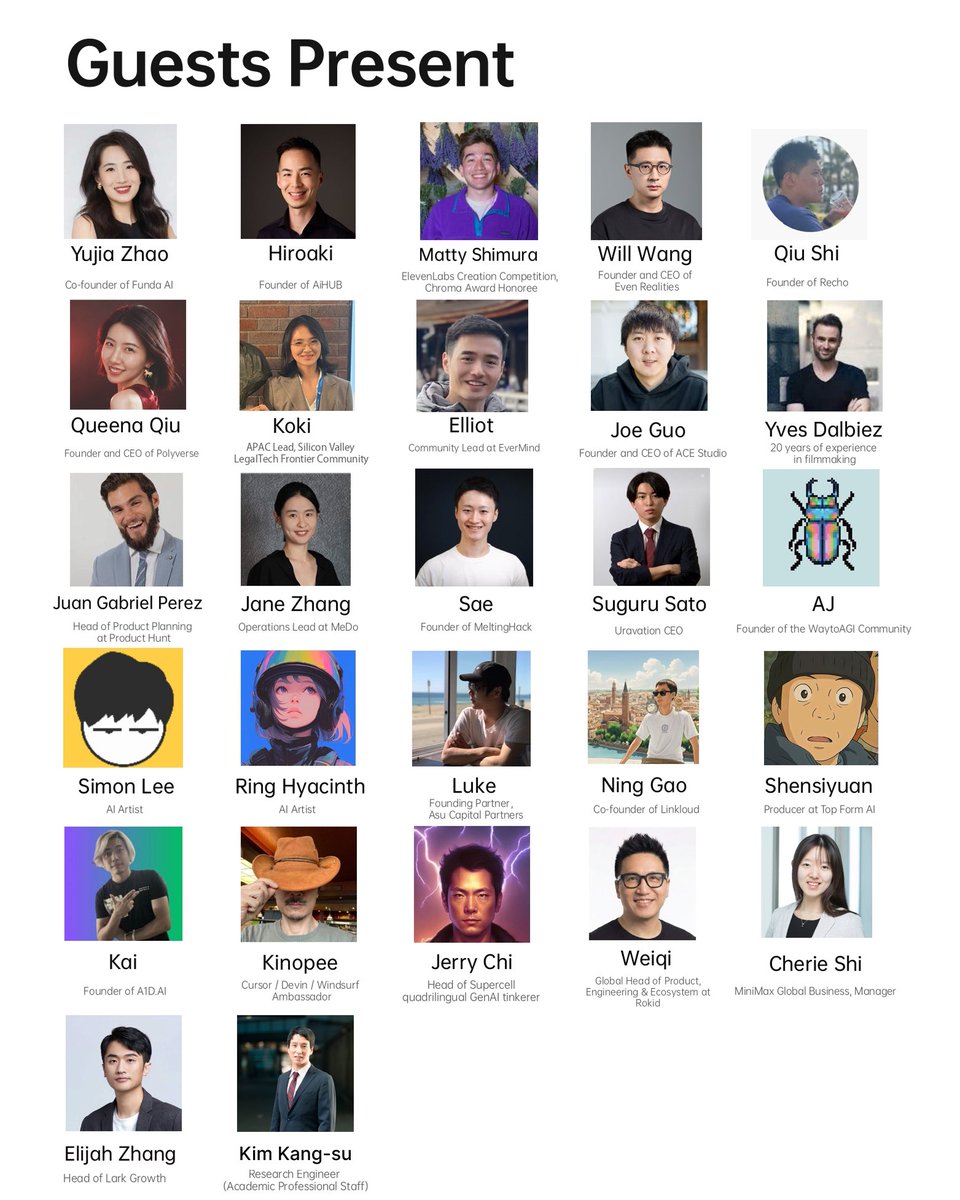
    Attending WaytoAGI event in Tokyo next week. @EverMind as one of the sponsors has two dinner invitation slots available. April 8th at 6 PM. Come meet in person and have dinner together. Interested? DM me. — WaytoAGI | Path to AGI (@WaytoAGI) YOUR ALL-STAR LINEUP IS HERE! 🤩🤩 Meet the dream team powering AGI Horizon Tokyo 2026! We've gathered global AI titans, visionary founders, top creators, and elite investors – all in one room.
    Apr 8 @ Happo-en Tokyo
    Don't miss your chance to connect with the minds shaping the future of AI. 👇
    luma.com/3iwspjhl #AGIHorizonAllStars #AIGuests2026 #agi2026 #waytoagi #ai #tokyo #AGIhorizon #東京AI [Translated from EN to English]

    → View original post on X — @elliotchen100, 2026-04-03 07:51 UTC

  • MSA Inference Code Officially Open-Sourced, Supporting Million-Level Long Text Memory

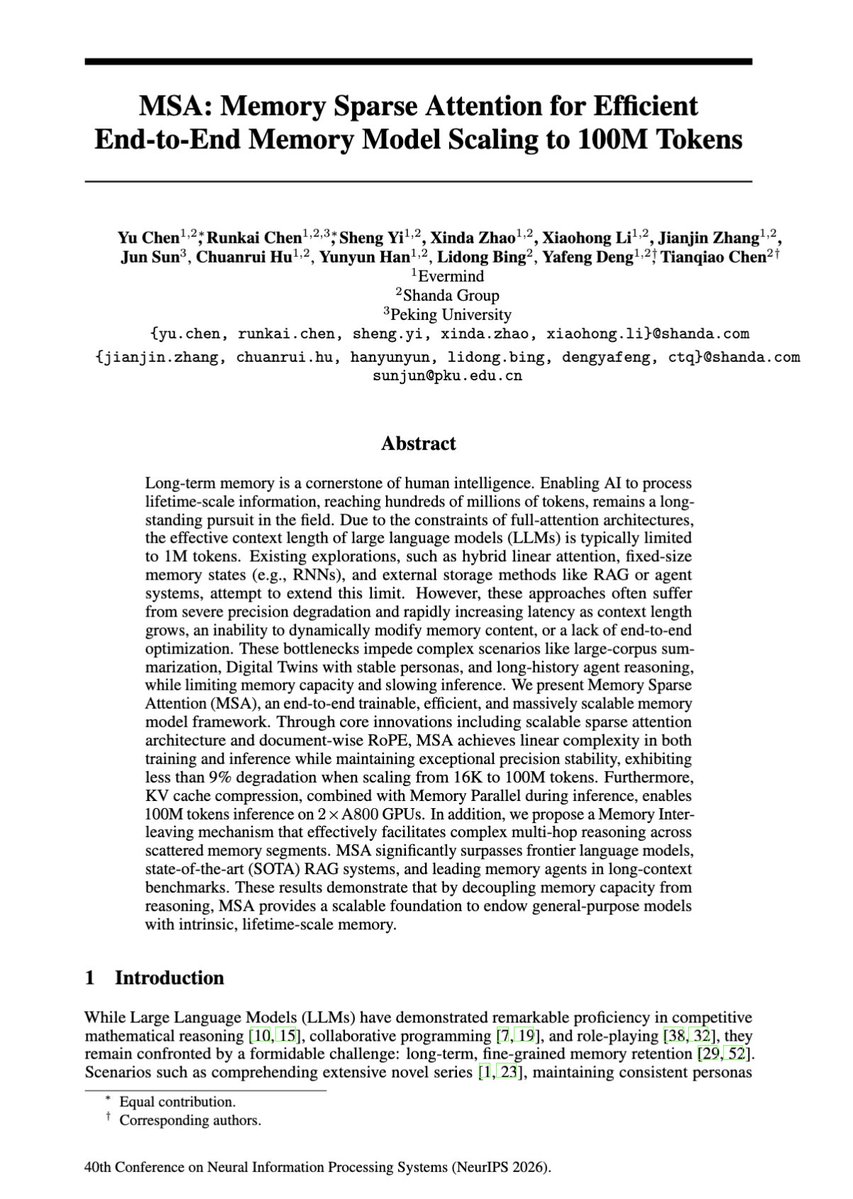
    MSA's Inference code is officially open-sourced on time 🫡 EverMind (@evermind) A few weeks ago we published our Memory Sparse Attention paper, a new way to give AI models long-term memory that actually works. Today's LLMs/Agents forget. They can only hold so much context before things start falling apart. We built a system that lets a model remember up to 100 million tokens, the length of about a thousand books, and still find the right answer with less than 9% performance loss. On several benchmarks, our 4-billion parameter model even beats RAG systems built on models 58× its size. The idea? Instead of searching a separate database and hoping the right info comes back (that's how RAG works), we built the memory directly into how the model thinks. It learns what to remember and what to ignore, end to end, no separate retrieval pipeline needed. The response to the paper blew us away. Researchers and engineers everywhere asking the same thing: "When can we see the code?" So we got to work, cleaned up the inference code, documented it, and made it ready for the community to dig in. You asked for it. We open-sourced it. github.com/EverMind-AI/MSA [Translated from EN to English]

    → View original post on X — @elliotchen100, 2026-04-03 03:55 UTC

  • MSA Inference Open Sourced, Ultra Long Memory Attention Mechanism
    MSA Inference Open Sourced, Ultra Long Memory Attention Mechanism

    MSA's Inference part will be open sourced tomorrow, have a great Friday! Elliot (@elliotchen100) The paper is here. It's called MSA, Memory Sparse Attention. In one sentence, here's what it is: Give large models native ultra-long memory. Not an external retrieval plugin, not brute force context window expansion, but "memory" directly grown into the attention mechanism, trained end-to-end. Why don't past solutions work? RAG's essence is "open book exam". The model doesn't remember anything itself, just flips through notes on the fly. Whether it finds the right info depends on retrieval quality, and speed depends on data volume. Once information is scattered across dozens of documents and requires cross-document reasoning, it falls apart. Linear attention and KV cache's essence is "compressed memory". It remembers, but gets blurrier the more you compress, and gets lost over time. MSA's approach is completely different: → No compression, no external plugins. Instead, teach the model to "focus on what matters" The core is a scalable sparse attention architecture with linear complexity. 10x more memory means computational costs don't explode exponentially. → The model knows "which document this memory comes from and when" Uses document-wise RoPE positional encoding, letting the model naturally understand document boundaries and temporal order. → Can reason across fragmented information Memory Interleaving mechanism enables the model to perform multi-hop reasoning across scattered memory fragments. Not just finding one relevant record, but chaining clues together. The results? · Scales from 16K to 100M tokens with less than 9% accuracy degradation · 4B parameter MSA model outperforms 235B-level top RAG systems on long context benchmarks · Can run 100M token inference on just 2 A800s. This isn't lab-exclusive, it's startup-affordable. Simply put, past large models were geniuses with goldfish memory. What MSA does is let them truly "remember". We put it on GitHub. Algorithm researchers, give it a star if you like it. 🌟👀🙏 github.com/EverMind-AI/MSA — https://nitter.net/elliotchen100/status/2034479369855590660#m [Translated from EN to English]

    → View original post on X — @elliotchen100, 2026-04-02 07:24 UTC

  • AI Memory Research Meetup Event Bay Area Invitation
    AI Memory Research Meetup Event Bay Area Invitation

    https://
    x.com/evermind/statu
    s/2037674277219242311

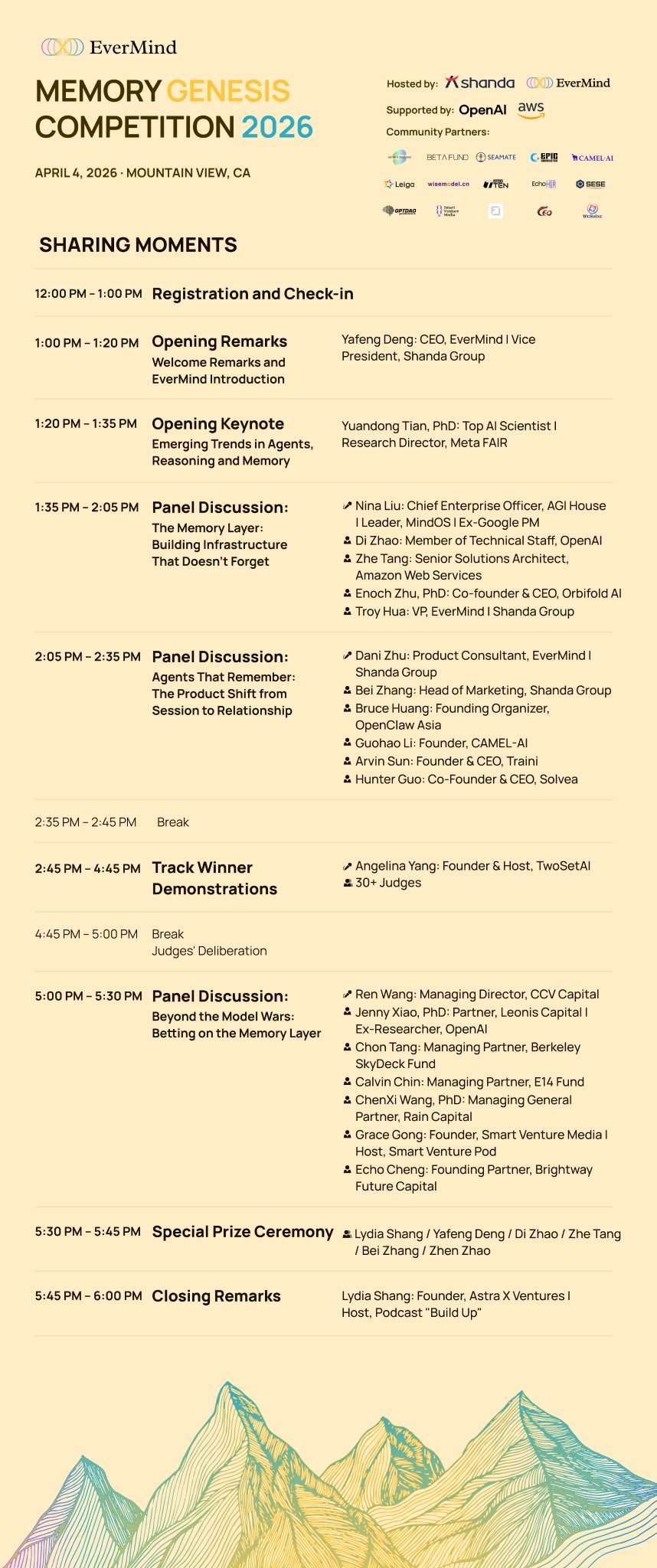
    bro 在湾区吗?欢迎来活动面基呀,现场都是研究 memory 的大佬们

    → View original post on X — @elliotchen100

  • Submit Your Resume to Evermind Career Opportunity

    Yes, you can send your resume directly to evermind@shanda.com

    → View original post on X — @elliotchen100

  • AI Agent Mastering Dual Identity Gaming Strategy

    bro is good at his game, agent + real person, dual identities.

    → View original post on X — @elliotchen100

  • EverMind MSA: From Application Layer Patches to Native Attention Memory

    It seems everyone is interested in memory, which reinforces our determination to do EverMind well. First, let me correct a misconception: it's not that Claude's engineering is poor. Anthropic's engineering capabilities are beyond question—the fact that 200 lines of MEMORY.md can achieve this effect actually proves that Opus has a solid foundation. But "the model is strong so the solution is adequate" doesn't mean "the solution itself is sufficiently good." @bigthing123456 hit the nail on the head—the bottleneck isn't retrieval, it's determining what the model should remember and when. Claude's current approach lets AutoDream use rules to scan, merge, and trim, essentially outsourcing "memory management" to an offline process. The problem is: rules are static, but contextual importance is dynamic. A detail you deemed unimportant last week might be the exact key to debugging today. Once trimmed, it's gone. @boyuan_chen mentioned using daily files + semantic search for three-layer separation, which is already much better than the native solution. But fundamentally, it's still patching at the application layer—you must design what goes into MEMORY.md, what into daily files, and what through search. These decisions themselves require "understanding context." Using LLM to manage LLM memory is recursive. Our approach with EverMind MSA is completely different:
    Instead of adding a memory module at the application layer, we modify the attention mechanism itself. We let models learn content-aware sparse routing of historical information within Transformer—which tokens should be preserved long-term and which should decay—this is learned through training by the model itself, not decided by external scripts. This doesn't mean our solution is perfect; MSA currently faces its own challenges, like training costs and generalization in long-tail scenarios. But directionally, memory should be a native capability of the model, not a 200-line markdown file. MSA is open-sourcing Inference this week. If you like it, please star it. github.com/EverMind-AI/MSA — Elliott (@elliotchen100) I looked at Claude's Memory mechanism, and it's nothing special. The entire memory system's core is just one MEMORY.md file, no more than 200 lines, injected into context at each session start. What if there's too much memory? A background subprocess called AutoDream periodically scans, merges, and trims to ensure it fits. Basically: the model can't remember on its own, so it uses the file system + LLM self-management to simulate memory. This solution is engineeringly solid, but has several fundamental limitations: 1. Storage and retrieval depend entirely on file system + Markdown, cannot scale to cross-project, cross-Agent scenarios—memory is siloed
    2. No true semantic indexing, no dynamic recall based on relevance, 200 lines is the hard limit
    3. AutoDream's consolidation is rule-driven (scan, merge, trim), not cognitively driven—it can deduplicate and compress, but cannot extract new insights from experience
    4. No forgetting curve, no memory reinforcement mechanism—memory either exists or is deleted, no middle ground After doing Memory for a while, you realize the ceiling of such solutions isn't engineering, it's architecture. As long as the model's attention mechanism doesn't natively support efficient retrieval over large historical context, the application layer will forever be patching. This is why we chose a different path at EverMind. The MSA (Memory Sparse Attention) we released recently implements content-aware sparse routing directly at the Transformer attention layer, letting the model itself learn "what to remember and what to ignore," rather than relying on external scripts to decide for it. Anthropric's engineering capability is undoubtedly top-tier. But this leak happens to demonstrate… [Translated from EN to English]

    → View original post on X — @elliotchen100, 2026-04-02 00:19 UTC
  • First Open-Source Inference Model Released

    First open-source inference ha, take it step by step.

    → View original post on X — @elliotchen100

  • MSA Paper Published, Inference Code Open Sourced This Week
    MSA Paper Published, Inference Code Open Sourced This Week

    A little spoiler: 1. @EverMind's MSA paper has been selected for publication by AlphaXiv, and it's getting great traffic 2. MSA's Inference code will be open sourced this week github.com/EverMind-AI/MSA — alphaXiv (@askalphaxiv) Scaling Attention to 100M context!? Memory Sparse Attention introduces an idea where instead of rereading an entire 100M-token entry, it learns to jump straight into the relevant memories and reason from them end-to-end. More specifically, it first encodes documents into compressed memory slots, then for each question it uses a learned router to score which chunks are actually relevant, pulls only the top few, and runs normal attention over that tiny assembled context. So the model's compute grows with "how much it needs to look at" not "how much memory exists". This retrieval step is trained jointly with answer generation, so memory lookup is part of the model itself, and can decouple memory capacity from reasoning cost. [Translated from EN to English]

    → View original post on X — @elliotchen100, 2026-04-01 03:05 UTC

  • Claude Code 7-Layer Memory Architecture Explained with Remotion Video Examples

    A comprehensive interpretation of Claude Code's 7-layer memory architecture. Here's a great Remotion video example included, highly recommended to check out. Troy Hua (@troyhua) x.com/i/article/203904059263… — https://nitter.net/troyhua/status/2039052328070734102#m [Translated from EN to English]

    → View original post on X — @elliotchen100, 2026-03-31 23:24 UTC