
Curious about the capabilities of PaLM 2? In our new paper explainer, we summarize the main contributions of PaLM 2, a model that excels in various tasks like multilingual question answering and arithmetic reasoning. PaLM 2 mathematical reasoning performance surpasses SoTA (at
@dair_ai
-
MentalLlaMa: Open-Source LLM for Mental Health Analysis
By
–
9/ MentalLlaMa – an open-source LLM series for interpretable mental health analysis with instruction-following capability; proposes a multi-task and multi-source interpretable mental health instruction dataset on social media with 105K data samples.
-

Logical Chain-of-Thought Framework Improves LLM Reasoning
By
–
10/ Logical Chain-of-Thought in LLMs – a new neurosymbolic framework to improve zero-shot chain-of-thought reasoning in LLMs; leverages principles from symbolic logic to verify and revise reasoning processes to improve the reasoning capabilities of LLMs.
-

LLM Alignment Survey: Comprehensive Review of Safety and Interpretability
By
–
7/ LLM Alignment Survey – a comprehensive survey paper on LLM alignment; topics include Outer Alignment, Inner Alignment, Mechanistic Interpretability, Attacks on Aligned LLMs, Alignment Evaluation, Future Directions, and Discussions.
-

Qwen LLM Demonstrates RLHF Strength in Tool Use and Planning
By
–
8/ Qwen LLM – proposes a series of LLMs demonstrating the strength of RLHF on tasks involving tool use and planning capabilities for creating language agents.
-

LlaVA-RLHF Achieves GPT-4 Level Performance on Multimodal Tasks
By
–
6/ LlaVA-RLHF – adapts factually augmented RLHF to aligning large multimodal models; this approach alleviates the reward hacking in RLHF and improves performance on the LlaVA-Bench dataset with the 94% performance level of the text-only GPT-4.
-
Boolformer: Transformer Architecture for Boolean Function Symbolic Regression
By
–
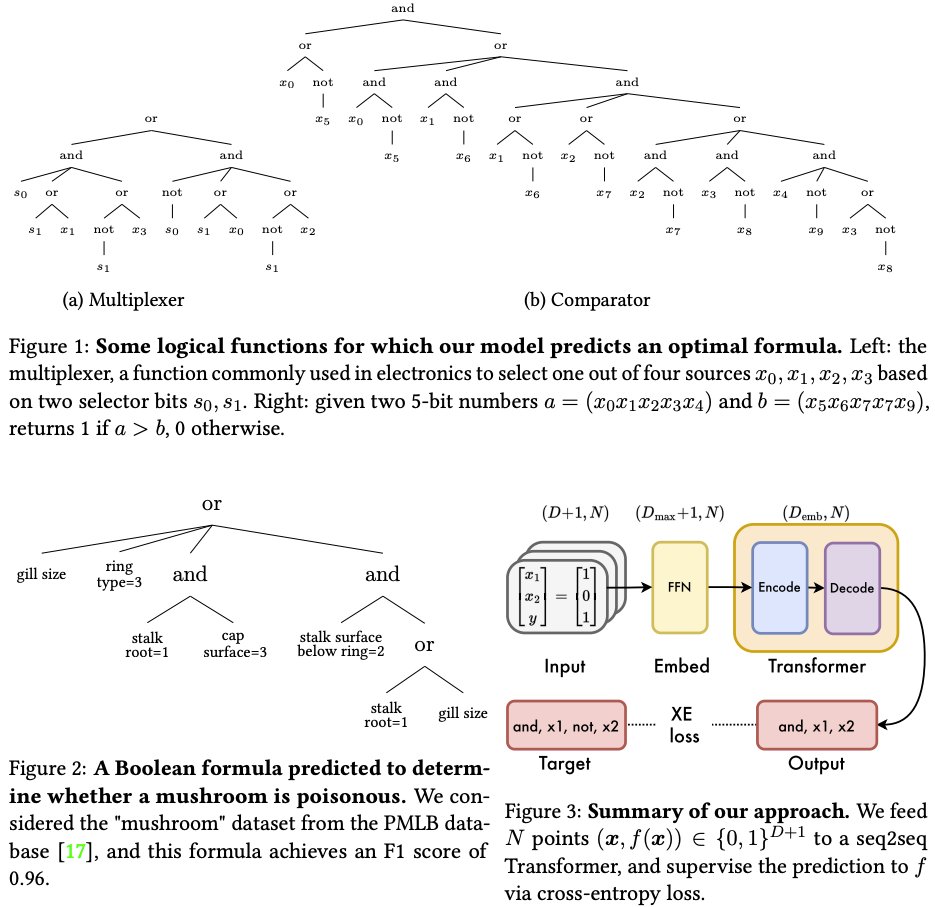
5/ Boolformer – presents the first Transformer architecture trained to perform end-to-end symbolic regression of Boolean functions; it can predict compact formulas for complex functions and be applied to modeling the dynamics of gene regulatory networks.
-

Graph Neural Prompting Enhances LLMs Knowledge Learning
By
–
3/ Graph Neural Prompting with LLMs – proposes a plug-and-play method to assist pre-trained LLMs in learning beneficial knowledge from knowledge graphs (KGs).
-

Vision Transformers Need Registers for Internal Computations
By
–
4/ Vision Transformers Need Registers – identifies artifacts in feature maps of vision transformer networks that are repurposed for internal computations; the proposed solutions provide additional tokens to the input sequence to fill that role.
-

The Reversal Curse: LLMs fail bidirectional generalization
By
–
1/ The Reversal Curse – finds that LLMs trained on sentences of the form “A is B” will not automatically generalize to the reverse direction “B is A”; shows the effect across model sizes and model families.