Here are the top AI Papers of The Week (June 9-15): – V-JEPA 2
– Magistral
– TableRAG
– Text-to-LoRA – Reinforcement Pre-Training
– Self-Adapting Language Models Read on for more:
@dair_ai
-
Top AI Papers of The Week: V-JEPA, TableRAG, and More
By
–
-
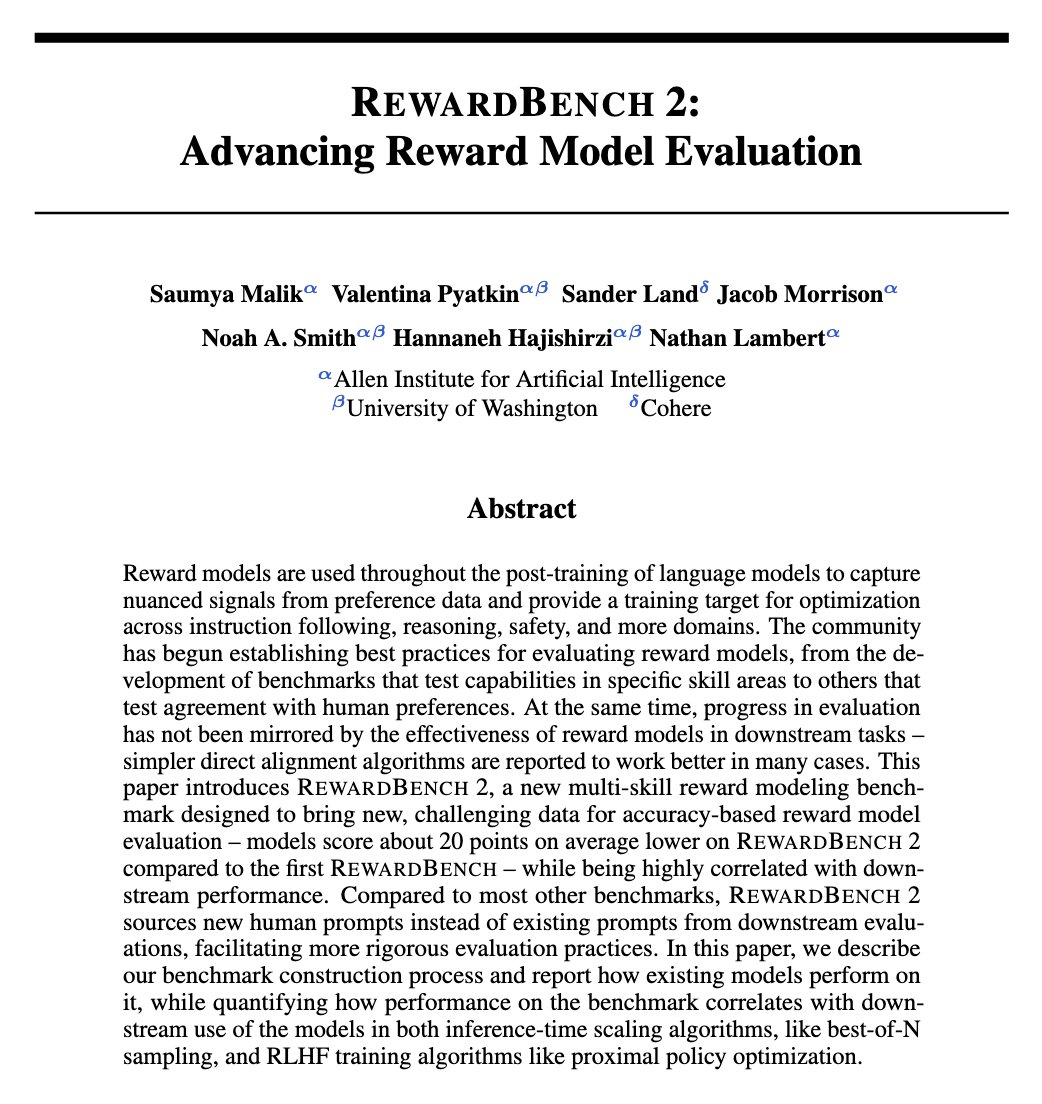
RewardBench 2: New Multi-Skill Reward Model Evaluation Benchmark
By
–
9. RewardBench 2 RewardBench 2 is a new multi-skill benchmark for evaluating reward models with more challenging human prompts and stronger correlation to downstream performance.
-
LLM Memorization Capacity: Quantifying 3.6 Bits per Parameter
By
–
10. Memorization in LLMs This study introduces a method to quantify how much a model memorizes versus generalizes, estimating GPT models have a capacity of ~3.6 bits per parameter.
-
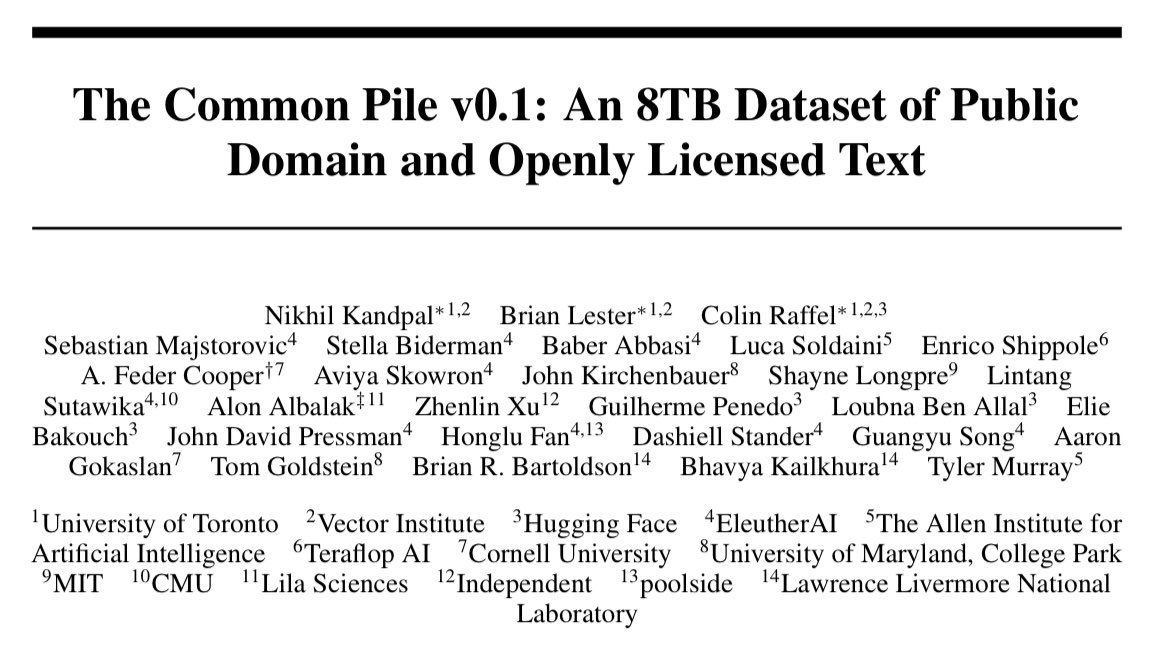
Common Pile v0.1: 8TB Open Licensed Text Dataset for LLM Training
By
–
8. Common Pile v0.1 The Common Pile v0.1 is an 8TB dataset of openly licensed text designed for LLM pretraining, addressing legal and ethical concerns of unlicensed data use.
-
AlphaOne: Universal Framework for Controlling LRM Reasoning
By
–
7. AlphaOne Introduces a universal framework, α1, for modulating the reasoning progress of large reasoning models (LRMs) during inference. Rather than relying on rigid or automatic schedules, α1 explicitly controls when and how models engage in “slow thinking” using a tunable
-
Self-Challenging Language Model Agents for Multi-Turn Tool Use
By
–
6. Self-Challenging Language Model Agents Proposes a novel self-improvement method for multi-turn tool-use LLM agents, called the Self-Challenging Agent (SCA). It trains LLMs entirely from tasks they generate themselves, avoiding the need for human-annotated tasks or
-
OpenHands-Versa: Unified Coding Agent with Multimodal Browsing
By
–
5. Coding Agents with Multimodal Browsing Introduces OpenHands-Versa, a unified agent designed to perform strongly across diverse domains, coding, web browsing, and multimodal information access, by equipping a single agent with three general capabilities…
-
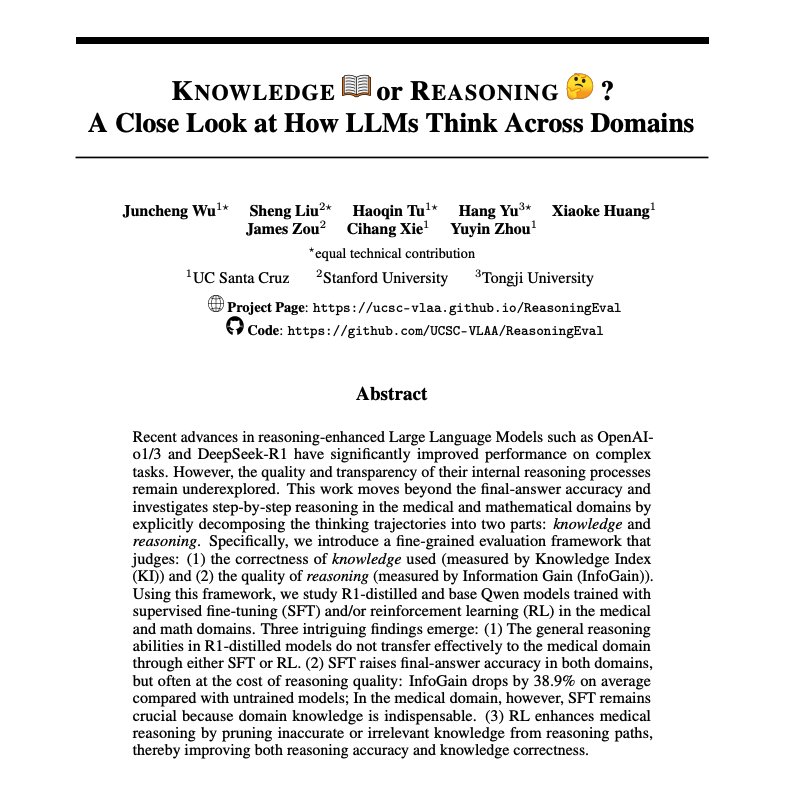
Evaluating LLM Knowledge and Reasoning with KI InfoGain
By
–
3. Knowledge or Reasoning Introduces a fine-grained evaluation framework to dissect LLM thinking into two components: knowledge correctness and reasoning informativeness, measured via Knowledge Index (KI) and Information Gain (InfoGain), respectively.
-

OpenThoughts3: SFT Data Curation for Open-Source Reasoning
By
–
4. Open Thoughts This paper presents OpenThoughts3, a systematic recipe for curating supervised fine-tuning (SFT) data that advances the performance of open-source reasoning models.
-
Information-Theoretic Framework for LLM Semantic Knowledge Organization
By
–
2. From Tokens to Thoughts This paper introduces an information-theoretic framework to examine whether LLMs organize semantic knowledge like humans, balancing compression and meaning.