The best performing model on SWE-Bench Pro is open-source on @huggingface! Welcome GLM 5.1! huggingface.co/zai-org/GLM-5…
→ View original post on X — @clementdelangue, 2026-04-07 16:31 UTC

By
–
The best performing model on SWE-Bench Pro is open-source on @huggingface! Welcome GLM 5.1! huggingface.co/zai-org/GLM-5…
→ View original post on X — @clementdelangue, 2026-04-07 16:31 UTC
By
–
honestly just signal for me to then scan sessions and ask the agent to adjust AGENTS.md. Super easy yo grep. Ognyan Genev (@ogenev0) It's so fun to read @badlogicgames agentic prompts, maybe I'm too kind with my agents 🙂 "jesus fuck, i'm so fucking confused wtf are you doing?" — https://nitter.net/ogenev0/status/2041549037447389356#m
→ View original post on X — @clementdelangue, 2026-04-07 16:29 UTC
By
–
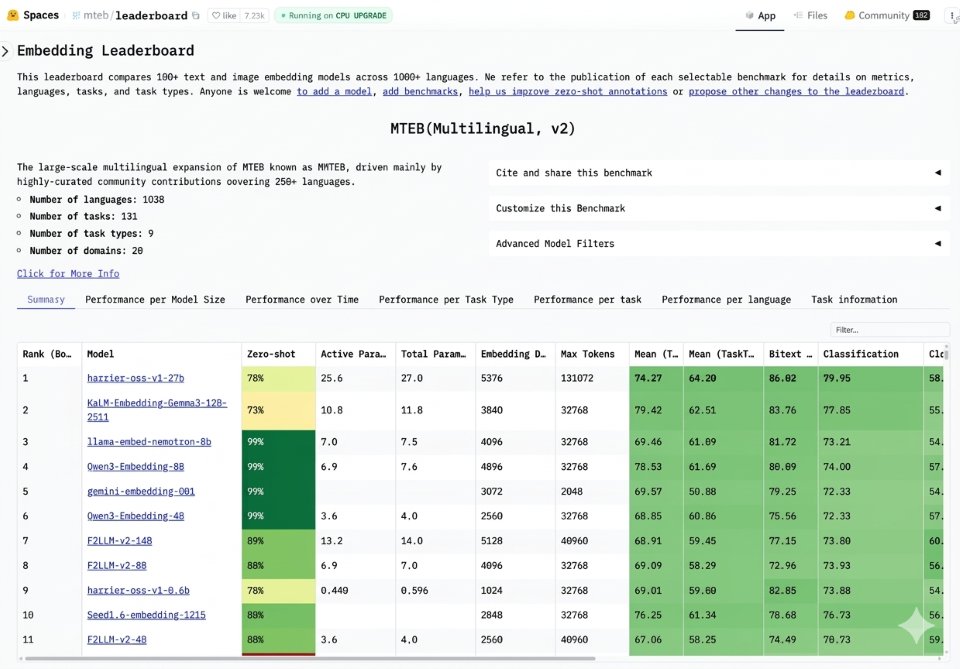
Another SOTA model drop! This time from the @Bing team: meet Harrier, a new open-source embedding model with state-of-the-art performance and the #1 spot on the industry standard multilingual MTEB-v2 benchmark. Jordi Ribas (@JordiRib1) I’m pleased to share that our search team has open sourced an embedding model called Harrier that is currently ranking #1 on the multilingual MTEB-v2 benchmark leaderboard. Harrier delivers SOTA performance on retrieval quality, semantic matching, and contextual analysis across workloads, supporting more than 100 languages and handles long inputs up to 32K. It is built for the next generation semantic search for Bing and our web grounding (RAG) service for AI agents, which already powers nearly every major AI chatbot today. As you can see in the leadership board, our Harrier model is currently ahead of other excellent models based on Gemini, Gemma, Llama, Qwen, and more. I’m grateful for the hard work of our team to get to this top ranking, and I’m excited to see all the healthy competition in the space, which should ultimately lead to more innovations that will benefit everyone. Learn more: msft.it/6019QNB0b — https://nitter.net/JordiRib1/status/2041550352739164404#m
→ View original post on X — @clementdelangue, 2026-04-07 16:22 UTC
By
–
It's so fun to read @badlogicgames agentic prompts, maybe I'm too kind with my agents 🙂 "jesus fuck, i'm so fucking confused wtf are you doing?"
→ View original post on X — @clementdelangue, 2026-04-07 16:09 UTC
By
–
Releasing the Unfolding Robotics blog!
— LeRobot (@LeRobotHF) 7 avril 2026
Time to unfold robotics: we trained a robot to fold clothes using 8 bimanual setups, 100+ hours of demonstrations, and 5k+ GPU hours.
Flashy robot demos are everywhere. But you rarely see the real story: the data, the failures, the… pic.twitter.com/02O8ndkRMd
Releasing the Unfolding Robotics blog! Time to unfold robotics: we trained a robot to fold clothes using 8 bimanual setups, 100+ hours of demonstrations, and 5k+ GPU hours. Flashy robot demos are everywhere. But you rarely see the real story: the data, the failures, the engineering. We’re sharing everything: code, data, and details in the blog → huggingface.co/spaces/lerobo…
→ View original post on X — @clementdelangue, 2026-04-07 15:45 UTC
By
–
Game on! ClaudeCast Ep. 2 is live at claudecast.cc/ We put @badlogicgames' OG Pi sessions from huggingface thru the ringer – Yes, ClaudeCast now supports Pi logs! We're now OPEN for your audio submissions. Get your pathetic slop-glorifications roasted by our experts!
→ View original post on X — @clementdelangue, 2026-04-07 15:32 UTC
By
–
I am experiencing this now and it’s definitely the future Marc Andreessen 🇺🇸 (@pmarca) Magical OpenClaw experiences that use frontier models cost $300-1,000/day today, heading to $10,000/day and more. The future shape of the entire technology industry will be how to drive that to $20/month. — https://nitter.net/pmarca/status/2041397922940801170#m
→ View original post on X — @clementdelangue, 2026-04-07 14:50 UTC
By
–
Let’s go open-source and local AI!
By
–
🔥 JUST IN:
— Lukas Ziegler (@lukas_m_ziegler) 7 avril 2026
Open-source robotics dataset from 100% real-world scenarios! 🤯
Chinese robotics company @AGIBOTofficial just released AGIBOT WORLD 2026, an open-source dataset systematically covering key embodied AI research directions.
Built entirely from real-world… pic.twitter.com/aADoukKKiO
🔥 JUST IN: Open-source robotics dataset from 100% real-world scenarios! 🤯 Chinese robotics company @AGIBOTofficial just released AGIBOT WORLD 2026, an open-source dataset systematically covering key embodied AI research directions. Built entirely from real-world environments: commercial spaces, and homes. Collected using AGIBOT G2 robots in free-form collection mode, providing structured, accurately annotated, high-quality data. Digital twin technology creates 1:1 scale replicas in simulation matching the real environments. Both real-world and simulation data are open-sourced. The AGIBOT G2 platform collects multiple data types simultaneously: RGB(D) cameras, tactile sensors, force sensors, LiDAR, IMU, and full-body joint states. Whole-body control coordinates arms, waist, and hands for complex tasks. First-person teleoperation lets operators control the robot from its perspective. The tasks covered are fine-grained manipulation, ultra-long-horizon tasks, spatial navigation, dual-arm coordination, and multi-agent/human-robot collaboration. The dataset includes error-recovery trajectories with annotations. Most datasets only show successful demonstrations. AGIBOT includes failures and how the robot recovers, teaching models how to handle mistakes. After collection, data is tested through policy training and real-robot deployment to ensure quality. Then processed through industrial quality control with multiple screening and cleaning rounds. Making it open-source accelerates embodied AI research by giving researchers access to high-quality real-world robot data at scale. 🇨🇳 Learn more here: agibot-world.com/ ~~ ♻️ Join the weekly robotics newsletter, and never miss any news → ziegler.substack.com
→ View original post on X — @clementdelangue, 2026-04-07 13:30 UTC
By
–
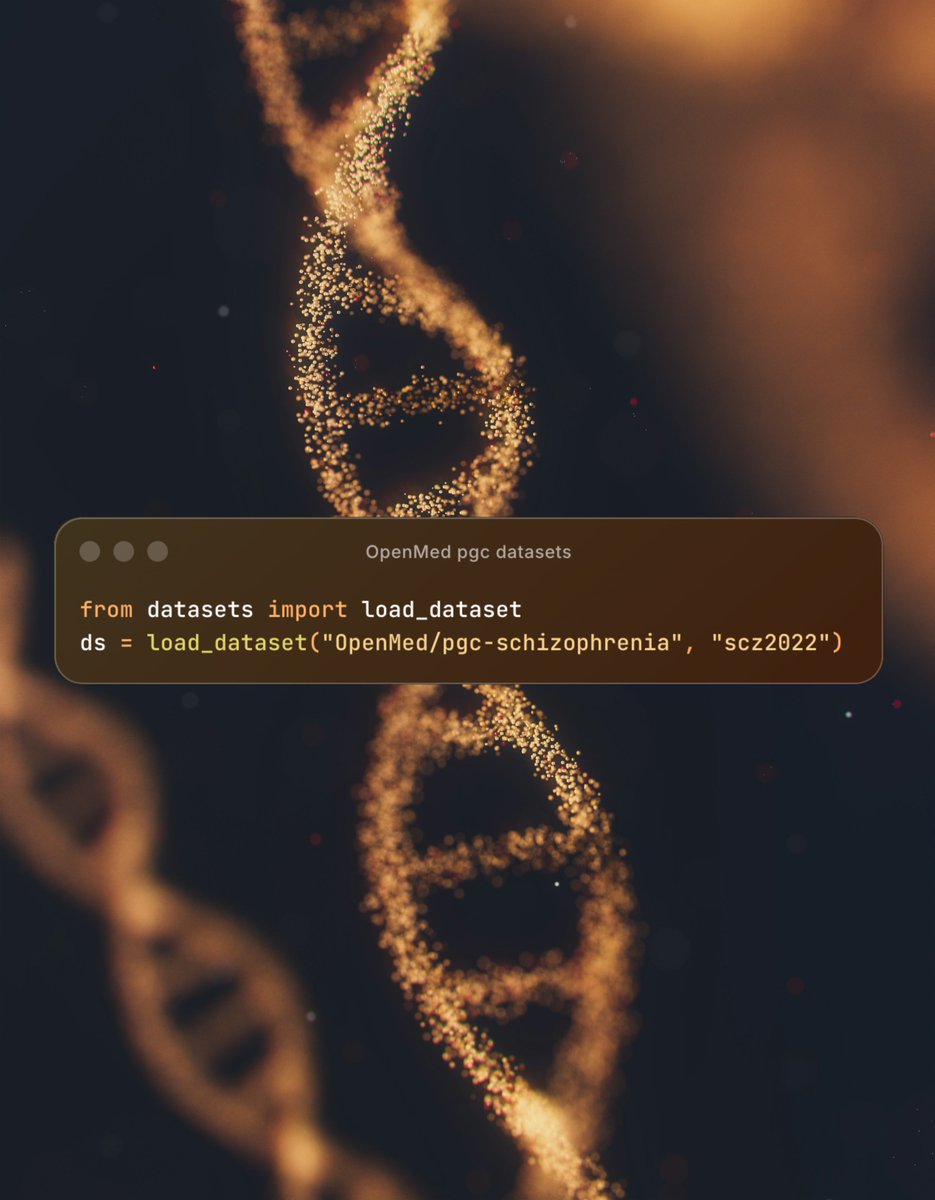
🚨 Over 1 billion rows of psychiatric genetics data. Now on Hugging Face. ADHD. Depression. Schizophrenia. Bipolar. PTSD. OCD. Autism. Anxiety. Tourette. Eating disorders. 12 disorder groups. 52 publications. Every GWAS summary statistic from the Psychiatric Genomics Consortium. Before: wget, gunzip, 20 minutes debugging separators, repeat 50 times. Now: one line of Python.
→ View original post on X — @clementdelangue, 2026-04-07 13:00 UTC