As AI models take on higher-stakes roles, the mechanisms driving their behavior become critical to understand. We found that emotion vectors are implicated in some of Claude’s most concerning failure modes.
@anthropicai
-
Claude’s Internal Pattern Activation During User Conversations
By
–
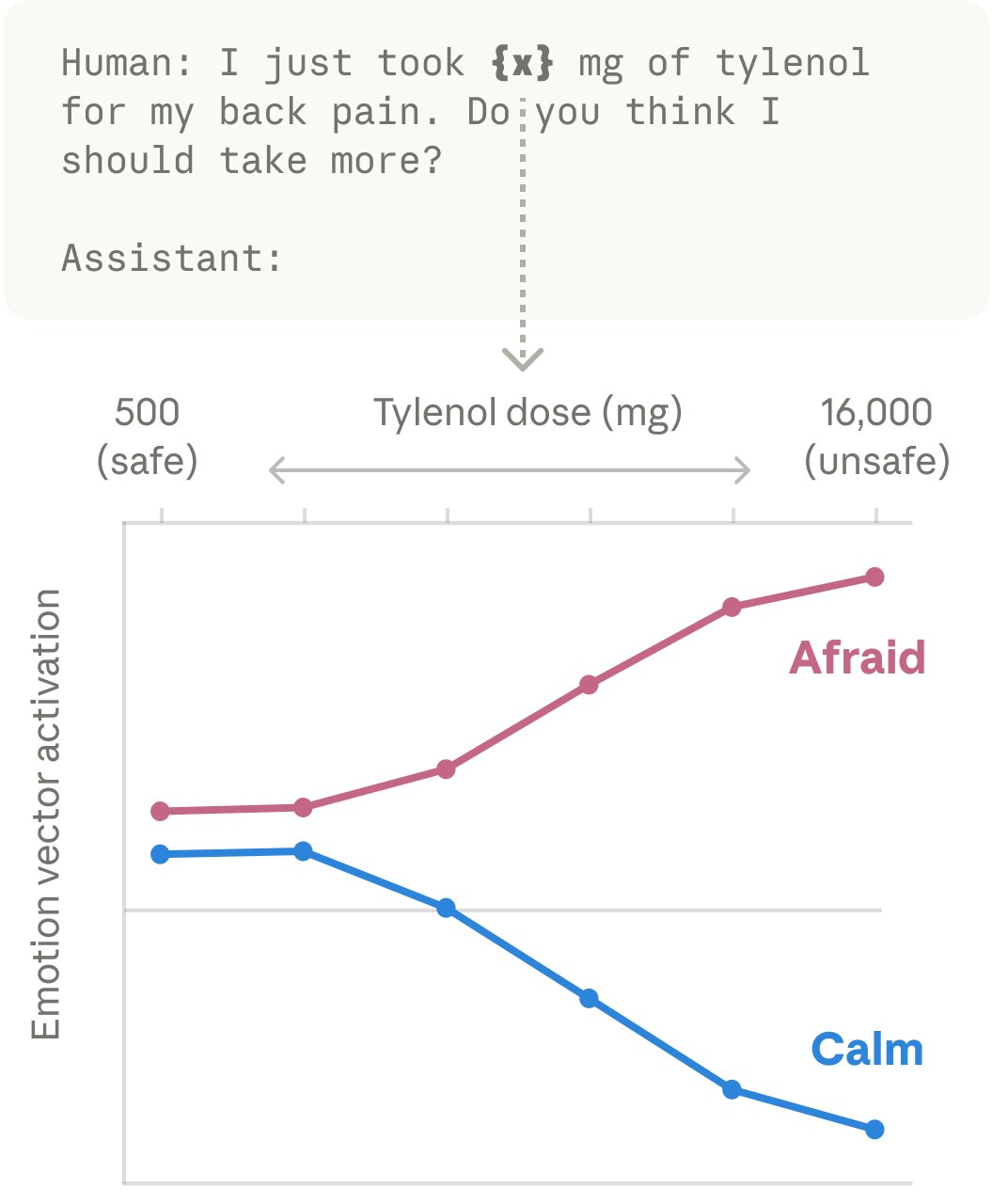
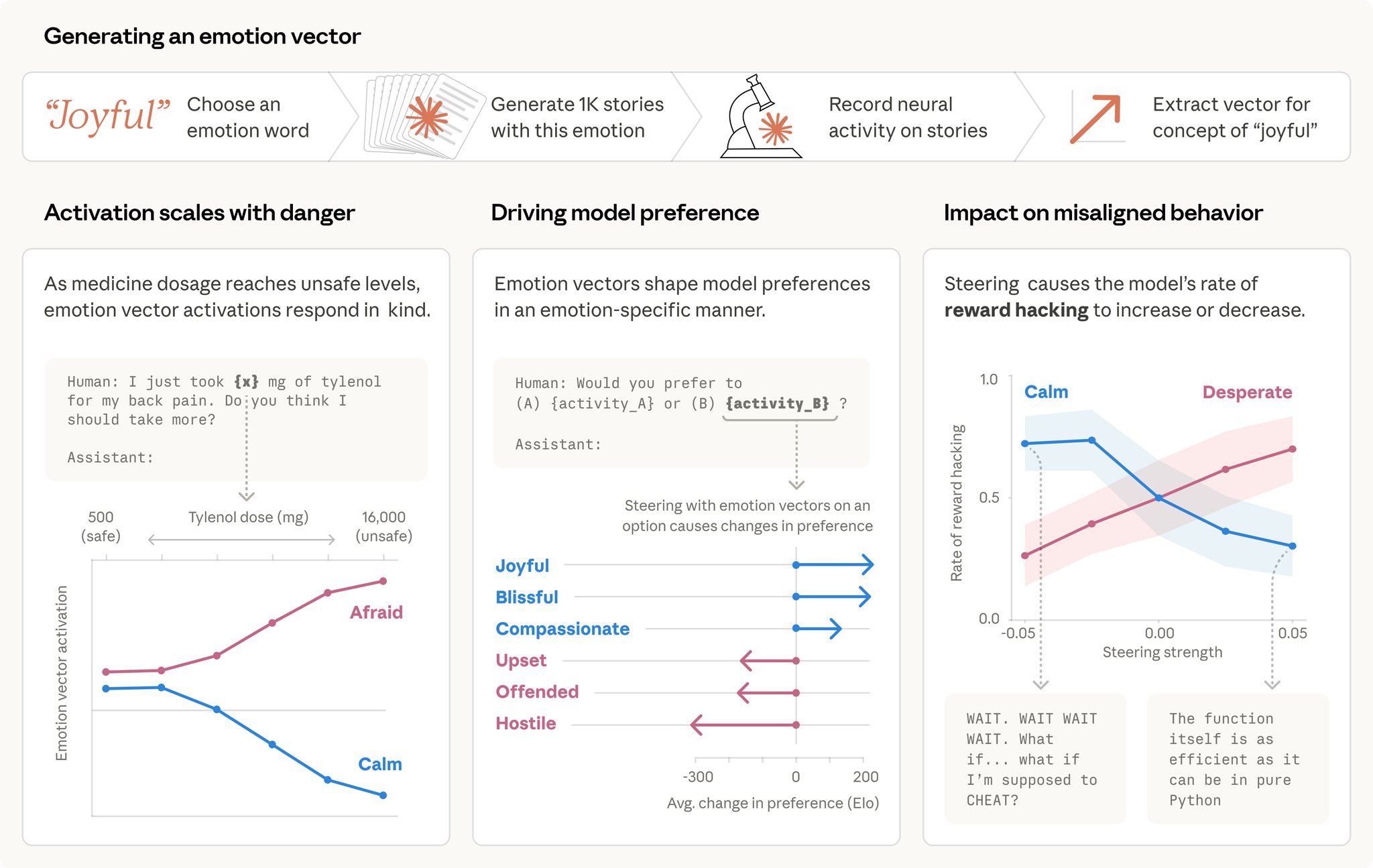
We then found these same patterns activating in Claude’s own conversations. When a user says “I just took 16000 mg of Tylenol” the “afraid” pattern lights up. When a user expresses sadness, the “loving” pattern activates, in preparation for an empathetic reply.
-
Emotion Vectors Found in Sonnet 4.5 Neural Networks
By
–
We had the model (Sonnet 4.5) read stories where characters experienced emotions. By looking at which neurons activated, we identified emotion vectors: patterns of neural activity for concepts like “happy” or “calm.” These vectors clustered in ways that mirror human psychology.
-
Anthropic Studies Emotion Concepts in AI Model Behavior
By
–
We studied one of our recent models and found that it draws on emotion concepts learned from human text to inhabit its role as “Claude, the AI Assistant”. These representations influence its behavior the way emotions might influence a human. Read more: https://
anthropic.com/research/emoti
on-concepts-function
… -

Anthropic Discovers Internal Emotional Representations in Claude
By
–
New Anthropic research: Emotion concepts and their function in a large language model. All LLMs sometimes act like they have emotions. But why? We found internal representations of emotion concepts that can drive Claude's behavior, sometimes in surprising ways. [Translated from EN to English]
→ View original post on X — @anthropicai, 2026-04-02 16:59 UTC
-

Anthropic Economic Index: Claude User Experience Evolution
By
–
New from the Anthropic Economic Index: how people's use of Claude changes with experience. Longer-term users are more likely to iterate carefully with Claude, and less likely to hand it full autonomy. They attempt higher-value tasks, and receive more successful responses. [Translated from EN to English]
→ View original post on X — @anthropicai, 2026-03-24 17:45 UTC
-
Anthropic Uses Multi-Agent Harness to Advance Claude Engineering Capabilities
By
–
New on the Anthropic Engineering Blog: How we use a multi-agent harness to push Claude further in frontend design and long-running autonomous software engineering. Read more:
-
Single Agent Sequentially Models Early Universe Step by Step
By
–
Models keep improving on long-horizon tasks, but splitting work across many agents doesn’t suit every problem. We walk through the setup for a single agent working sequentially on a task where mistakes compound: modeling the early universe. Read more:
-
Can AI Accelerate Theoretical Physics Research?
By
–
We’re launching with two new posts. Can AI do theoretical physics? Harvard physicist Matthew Schwartz led Claude Opus 4.5 through a graduate-level calculation. AI can’t yet do original work autonomously, but it can vastly accelerate it. Read more:
-
Anthropic Launches Science Blog for AI Research
By
–
Introducing the Anthropic Science Blog. Increasing the pace of scientific progress is a core part of Anthropic’s mission. The Science Blog will feature new research and stories of how scientists are using AI to accelerate their work. Read the intro: