AI Dynamics

Global AI News Aggregator

About

@animaanandkumar

  • Neural Operators: Running Million Simulations in Seconds
    Neural Operators: Running Million Simulations in Seconds

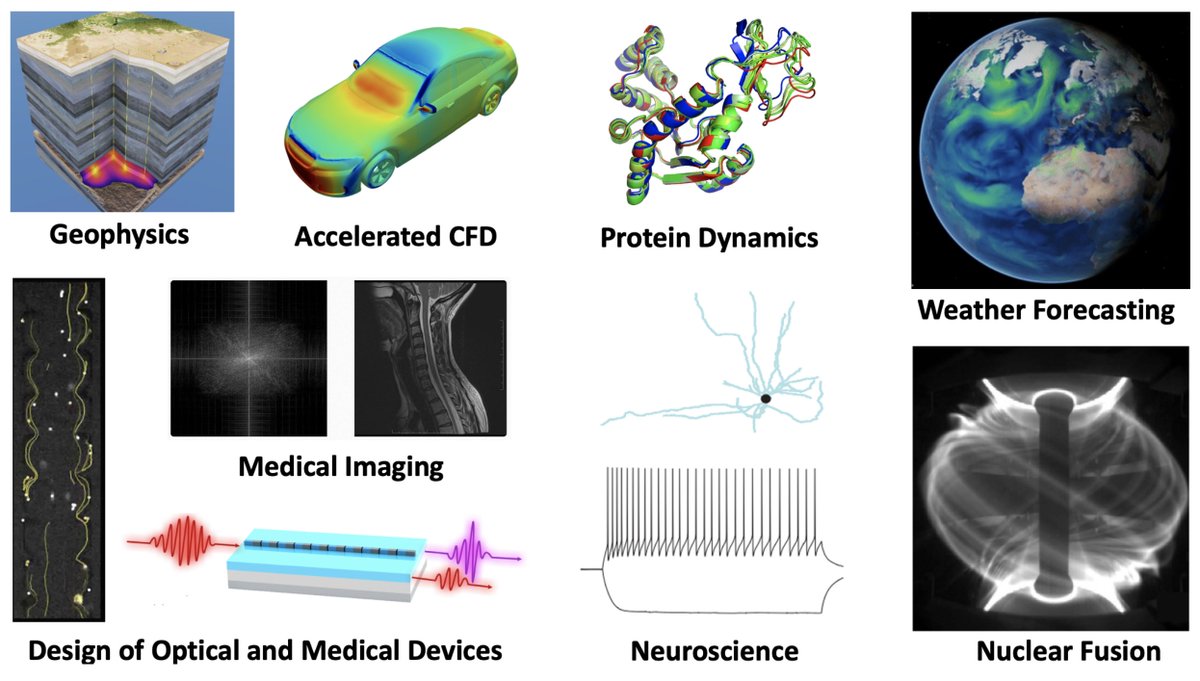
    What if you could run a million simulations in the time it takes to run one? Neural operators are making this a reality. These neural networks learn to approximate the physics behind conventional simulations and then produce new solutions almost instantly. The result? Better-performing chips, smarter fusion reactors, faster drug discovery. A new neural operator is trained for each design problem. The design process unfolds as follows: 1. The problem is defined. For example, optimizing the layout of a computer chip to minimize hot spots that arise during operation and can lead to device failure. 2. The parameter space is defined. In the above example, this could be the range of possible layouts and connections between chip components. 3. Hundreds or thousands of conventional simulations are run to sample the parameter space. These simulations can be very computationally intensive, requiring a supercomputer in some cases. 4. The neural operator is trained on those simulations. Crucially, while the training simulations use discrete grids, neural operators learn continuous solutions. This means they can be trained on lower-resolution simulations and still produce accurate results at higher resolutions, saving even more compute. 5. The trained network evaluates candidate designs almost instantly, enabling rapid optimization across the parameter space. 6. The solution is verified with a conventional simulation. In practice, these checks are run periodically throughout the process to keep the neural operator honest. By replacing the bulk of expensive simulations with near-instant neural operator evaluations, engineers can explore vast design spaces that were previously out of reach. Yet another example of how neural networks beyond LLMs are quietly transforming science and engineering.

    → View original post on X — @animaanandkumar, 2026-02-23 19:00 UTC

  • AAAS 2026 Highlights: Science, Policy, and Research Innovation
    AAAS 2026 Highlights: Science, Policy, and Research Innovation

    ✨ New Article: #AAASmtg Highlights! ✨ @aaas is where science and policy meet, and this year’s Science @ Scale theme brought big ideas from across the research landscape. From climate and public health to biomedical innovation, it was inspiring to step outside our usual orbit—and even convert a few particle physicists into organ‑on‑chip fans. This year, we saw real momentum for non‑animal, human‑relevant science. SAO’s Gabby Vidaurre, PhD delivered a standout Postdoc Talk on our Research Modernization NOW #SciPol roadmap, and AI‑driven innovations took center stage—from lung‑ultrasound interpretation to exposome analytics. The SNAP Coalition made AAAS history with the first‑ever graduate student–led plenary, and science‑integrity icon @MicrobiomDigest reminded us why integrity is essential to all of what we do. ⬇️ Read the full recap, also featuring @AnimaAnandkumar of @CaltechEAS, @ThomasHartung19 of @jhucaat, and researchers from @ASU, @asuhealth, and @tue_mech: linkedin.com/pulse/sao-actio…

    → View original post on X — @animaanandkumar, 2026-02-20 15:20 UTC

  • CO₂ Storage Subsurface Modeling for Carbon Capture Scaling

    RT @jiacheny7: Accurate modeling of CO₂ storage in the subsurface is a critical challenge for scaling Carbon Capture and Storage (CCS). 🌎 B…

    → View original post on X — @animaanandkumar, 2026-02-19 20:08 UTC

  • Fun-DDPS: Decoupled Diffusion for CO₂ Storage Inverse Modeling

    Accurate modeling of CO₂ storage in the subsurface is a critical challenge for scaling Carbon Capture and Storage (CCS). 🌎 But here’s the catch: the inverse problem (recovering geological properties from sparse field observations) is severely ill-posed. 🤒 Traditional approaches either struggle with the scarcity of measured data or are too computationally expensive. 💸 In our new work, we introduce Fun-DDPS (Function-space Decoupled Diffusion Posterior Sampling), a generative framework that decouples the problem into two parts: a function-space diffusion model that learns a prior over geological parameters, and a differentiable Local Neural Operator surrogate for physics modeling and conditioning. ✨ Why does the decoupling matter? The diffusion prior handles the heavy lifting of recovering missing geological information, while the neural operator surrogate makes data assimilation fast and physically grounded — no expensive full-physics simulations in the loop. Key results on synthetic CCS datasets: ⏩ 11x improvement in forward modeling with only 25% observations ✅ Robust inverse modeling for data assimilation under sparse, noisy conditions 🔥 First rigorous validation of diffusion-based inverse solvers against asymptotically exact Rejection Sampling (RS) posteriors This points toward a scalable, practical path for uncertainty-aware subsurface characterization — something the CCS community needs as projects move from pilots to full-scale deployment. 📷 arxiv.org/abs/2602.12274 Huge kudos to my amazing collaborators — this work wouldn’t have been possible without them: @IsaacJu13 @AnimaAnandkumar Sally M Benson @ggg_www_ #CarbonCapture #CO2Sequestration #MachineLearning #DiffusionModels #NeuralOperators #AI4Science #CCS #Sustainability

    → View original post on X — @animaanandkumar, 2026-02-19 20:06 UTC

  • Anima Anand Kumar Cancels India AI Summit Trip Due to Commitments

    Unfortunately I have had to cancel my trip for India AI summit due to other commitments. I hope the Indian leadership continues to grow the AI ecosystem and invest in education and research. Data centers and GPU access needs to be democratized broadly. #IndiaAISummit2026

    → View original post on X — @animaanandkumar, 2026-02-17 05:26 UTC

  • Decoupled Diffusion Solver for Inverse PDE Problems

    Solving Inverse PDEs with 1% Paired Data: Introducing Decoupled Diffusion Inverse Solver We propose a data-efficient and physics-aware diffusion framework for solving inverse problems on function spaces. In scientific machine learning, solving inverse problems requires costly

    → View original post on X — @animaanandkumar

  • FourcastNet: NVIDIA’s AI Weather Forecasting Innovation Advances

    In 2021 at @nvidia I led the release of FourcastNet the first fully AI based high resolution weather model. More than a year later @GoogleDeepMind released graphcast following our work. Proud to see further progress including FourCastNet 3

    → View original post on X — @animaanandkumar

  • GenSLM Designs Functional Enzymes with Frances Arnold
    GenSLM Designs Functional Enzymes with Frances Arnold

    Wonderful collaboration with @francesarnold We employed genSLM the first genome scale language model to design functional and versatile enzymes.

    → View original post on X — @animaanandkumar

  • AI and Science: 2025 Seminal Contributions and Progress

    2025 was a whirlwind of activity in AI+science. Our team’s seminal contributions to the field were well recognized and we deepened those foundations. You can read the year end summary here

    → View original post on X — @animaanandkumar

  • Neural Operators Impact Across Science and Engineering

    My talk on AI+Science hosted by the @ChenInstitute is now online https://
    youtube.com/watch?v=Jyymk4
    hptKk
    … I go into details of neural operators and how they are impacting broadly across science and engineering

    → View original post on X — @animaanandkumar