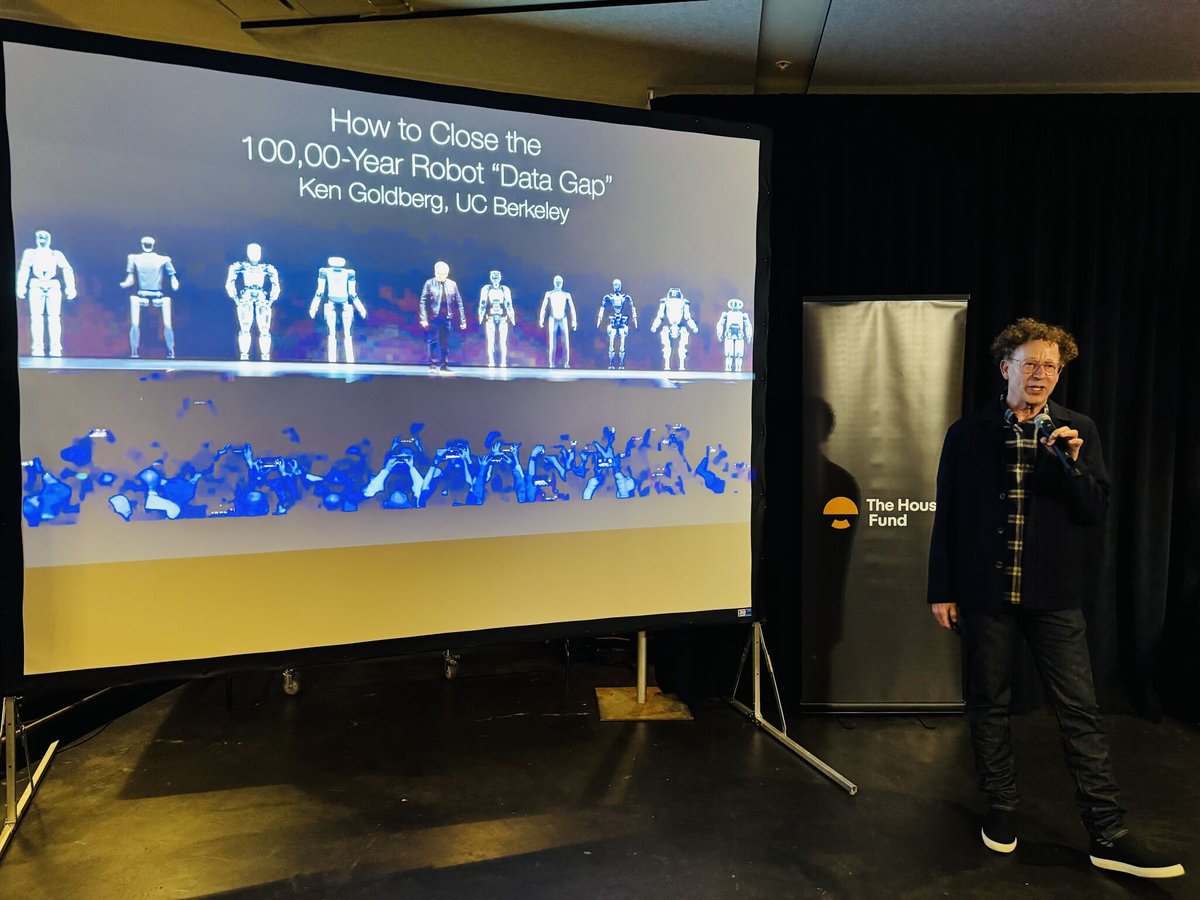


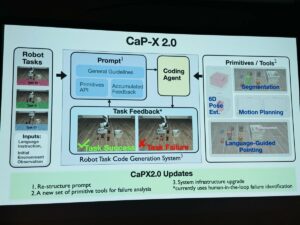
Thank your for this excellent summary Junfan! Junfan Zhu 朱俊帆 (@junfanzhu98) How to Close the 100,000-Year Robot “Data Gap” — @Ken_Goldberg (@UCBerkeley) Goldberg’s core claim: end-to-end Vision-Language-Action (VLA) models aren’t delivering. They’re opaque, hard to debug, and fragile under distribution shift. On LIBERO / LIBERO-PRO, models reach ~100% in-distribution, but tiny pose perturbations collapse success to ~17% or 0% (even π₀). This is systematic overfitting, not generalization. Code-as-Policy (CaP) reframes control: LLMs generate executable programs that call structured primitives (perception, 6D pose, motion planning, grasping). Generalization shifts from weights → code. Benefits: interpretable, verifiable, training-free at inference, debuggable. Open question: reliability. CaP-X (arXiv 2603.22435) introduces a full evaluation stack: 🔷 CaP-Gym: unified REPL over RoboSuite + LIBERO-PRO + BEHAVIOR (tabletop → mobile/bimanual, sim→real) 🔷 CaP-Bench: multi-level abstraction tests 🔷 CaP-Agent0: training-free agent (visual differencing, skill library, parallel queries) 🔷 CaP-RL: verifiable reward RL in Python sandbox Results: under perturbations that break VLAs, CaP-X hits ~96% success with strong pose invariance (extreme corners, lighting, object swaps). LIBERO-PRO (50 trials/task): many 100%, lowest ~76–78%. Failures are mostly semantic (label ambiguity), not control. Grasping/planning ≈ solved. CaP-X 2.0 pushes agentic coding: prompt restructuring, failure-analysis primitives, human-in-loop, reusable cloud skill cache. Test-time loop (no retraining): generate → compile → execute → perturb → diagnose → patch. Extensions include Rust backends (reliability) and Graph-as-Policy (GaP) for node-level verification. Core thesis (GOFE + CaP hybrid): pure VLA scaling cannot close the 100,000-year data gap (robot ≈10K hrs vs LLM ≈1.2B hrs). Robotics needs a Good Old-Fashioned Engineering (GOFE) skeleton: modular pipelines, PID (kp, kv), feedforward (e.g., virtual gravity) — inherently pose-invariant. → Build GOFE backbone + CaP brain. Deploy now, collect real data, spin a flywheel to improve modules and future VLAs. Hot 🔥 takes: 🔷 “Robot generalists should get off their high horse.” VLA-only is dogmatic. 🔷 VLAs may win eventually, but near-term progress requires hybrids. 🔷 Reliability (→99.9%) is the real bottleneck, not demos. Comparison 🔷 GOFE: no generality, but available, interpretable, reliable 🔷 VLA: promised generality, but opaque, brittle, not ready 🔷 CaP: generality + available + interpretable; reliability improves via hybrid + iteration Timeline: near-term: structured tasks (declutter, laundry, delivery). ~5 years: major home logistics gains. Full humanoid generalists: far off. Strategy: specialists first + reliability to 99.9%. Bottom line: don’t wait for end-to-end intelligence. Turn LLMs into super-programmers over a GOFE substrate, deploy hybrids, iterate with real data, and asymptotically approach VLA—without burning out the field. 👉🏻More pics: linkedin.com/posts/junfan-zh… — https://nitter.net/junfanzhu98/status/2039953079706247169#m
→ View original post on X — @ken_goldberg, 2026-04-03 23:15 UTC