This! I’ve had so much fun building small utility apps for tracking expenses, keeping track of investments and chores Codex makes it significantly easy to build apps and interacts quite well with xcodebuild CLI to automate & screenshots skill to help close the loop
TOOLS
-

Book: XGBoost for Regression and Time Series Predictive Modeling
By
–
XGBoost for Regression, Predictive Modeling, and Time Series Analysis — Learn how to build, evaluate, & deploy predictive models: http://
amzn.to/4l2YcU9 v/ @PacktDataML —
My review: XGBoost is definitely the focal point and central contribution of this book, along with all -
Technical troubleshooting of ChatGPT API and model availability
By
–
The error makes sense since 5.3-Codex is not available via API (yet) Though if you're on API Key it shouldn't show you the 5.3 Codex option in the first place or is this happening when you "Sign in w/ ChatGPT".
-
SWE-Bench Verified Deprecation: End of Major AI Benchmark
By
–
The End of SWE-Bench Verified (2024-2026) https://
latent.space/p/swe-bench-de
ad
… Today @OpenAIDevs is announcing the voluntary deprecation of SWE-Bench Verified! We're releasing a podcast + analysis in today's post. Saturation of SWE-Bench has been a community hot topic for over a year – -
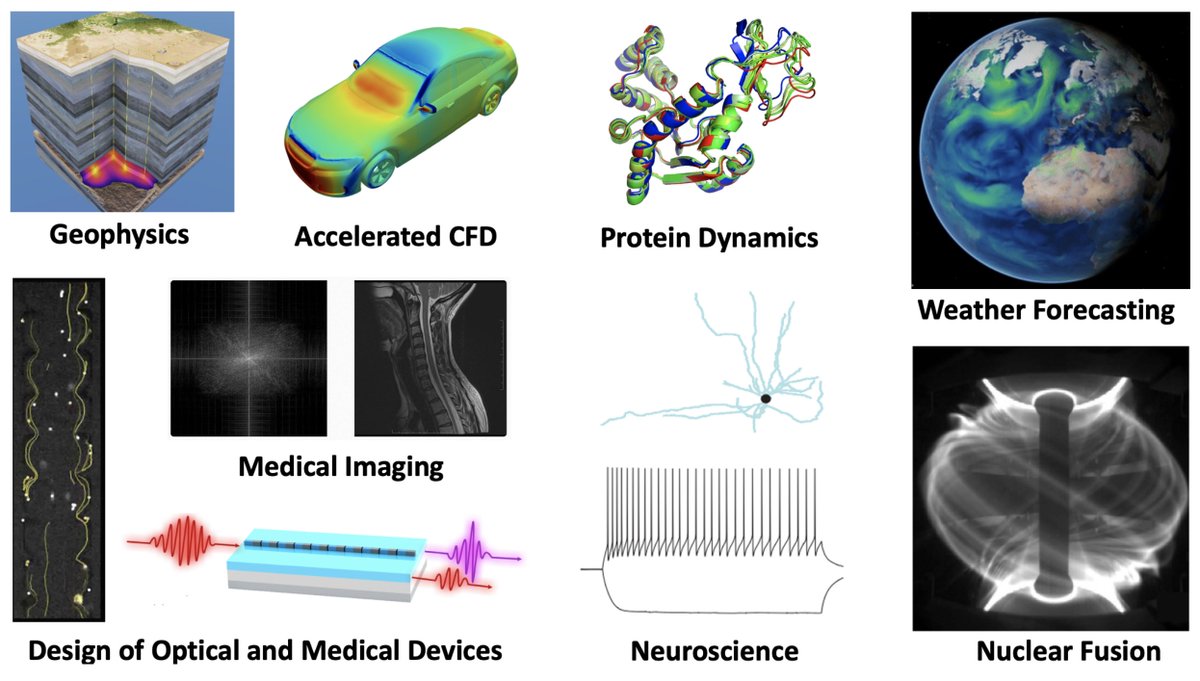
Neural Operators: Running Million Simulations in Seconds
By
–
What if you could run a million simulations in the time it takes to run one? Neural operators are making this a reality. These neural networks learn to approximate the physics behind conventional simulations and then produce new solutions almost instantly. The result? Better-performing chips, smarter fusion reactors, faster drug discovery. A new neural operator is trained for each design problem. The design process unfolds as follows: 1. The problem is defined. For example, optimizing the layout of a computer chip to minimize hot spots that arise during operation and can lead to device failure. 2. The parameter space is defined. In the above example, this could be the range of possible layouts and connections between chip components. 3. Hundreds or thousands of conventional simulations are run to sample the parameter space. These simulations can be very computationally intensive, requiring a supercomputer in some cases. 4. The neural operator is trained on those simulations. Crucially, while the training simulations use discrete grids, neural operators learn continuous solutions. This means they can be trained on lower-resolution simulations and still produce accurate results at higher resolutions, saving even more compute. 5. The trained network evaluates candidate designs almost instantly, enabling rapid optimization across the parameter space. 6. The solution is verified with a conventional simulation. In practice, these checks are run periodically throughout the process to keep the neural operator honest. By replacing the bulk of expensive simulations with near-instant neural operator evaluations, engineers can explore vast design spaces that were previously out of reach. Yet another example of how neural networks beyond LLMs are quietly transforming science and engineering.
→ View original post on X — @animaanandkumar, 2026-02-23 19:00 UTC
-
Boosting Prompt Efficiency with Voice
By
–
Here's what it looks like in real time:
— God of Prompt (@godofprompt) 23 février 2026
→ Switching between Claude and ChatGPT
→ Complex prompts spoken naturally
→ Building on previous outputs by voice
→ Iterating 10x faster
This is how I went from 5 prompts a day to 50. pic.twitter.com/HddBPkFZneHere's what it looks like in real time: → Switching between Claude and ChatGPT
→ Complex prompts spoken naturally
→ Building on previous outputs by voice
→ Iterating 10x faster This is how I went from 5 prompts a day to 50. -
Seamless AI Conversation with Natural Language
By
–
So I started just… talking to Claude and ChatGPT.
— God of Prompt (@godofprompt) 23 février 2026
Like I'm explaining my idea to a smart colleague.
→ Open ChatGPT
→ Hit Wispr Flow
→ Just describe what I want in natural language
→ All the context, all the nuance, everything
Zero friction between thought and prompt. pic.twitter.com/bh7uiCMR6lSo I started just… talking to Claude and ChatGPT. Like I'm explaining my idea to a smart colleague. → Open ChatGPT
→ Hit Wispr Flow
→ Just describe what I want in natural language
→ All the context, all the nuance, everything Zero friction between thought and prompt. -
GeoSpy AI finds your home address from a single photo
By
–
This is unreal… A video of your kid can now expose your exact home address
— Linus ✦ Ekenstam (@LinusEkenstam) 23 février 2026
I bet you that most people don’t know this at all
But GeoSpy AI can find your exact location from a single photo.
No metadata. No EXIF data. Just pixels. This is bonkers
pic.twitter.com/ZpCZxJktL2This is unreal… A video of your kid can now expose your exact home address I bet you that most people don’t know this at all But GeoSpy AI can find your exact location from a single photo. No metadata. No EXIF data. Just pixels. This is bonkers
-
Using Claude for Excel formula generation
By
–
Prompt 1 : La Formule Magique Le problème qu'on a tous eu : Tu passes 30 min à chercher une formule sur Google. Tu trouves rien. Tu abandonnes. Colle ça dans Claude : "Tu es un expert Excel. J'ai besoin d'une formule qui [DÉCRIS TON PROBLÈME]. Donne-moi la formule exacte à
-

Unifying IT Tools for Resilient Enterprise Infrastructure
By
–
The future of resilient IT isn’t about adding more tools – it’s about unifying what matters. So while IT isn’t getting easier – it can get smarter See: https://
linkedin.com/pulse/merging-
strengths-how-corsica-technologies-redefining-sally-eaves-h2z9c/
… I’ve been diving deep into the @corsicatech + @AccountabilIT partnership, and it’s one of the