AI Dynamics

Global AI News Aggregator

About

TOOLS

  • RL Model Transferability: Personalizing Across Rapidly Evolving Base Models
    RL Model Transferability: Personalizing Across Rapidly Evolving Base Models

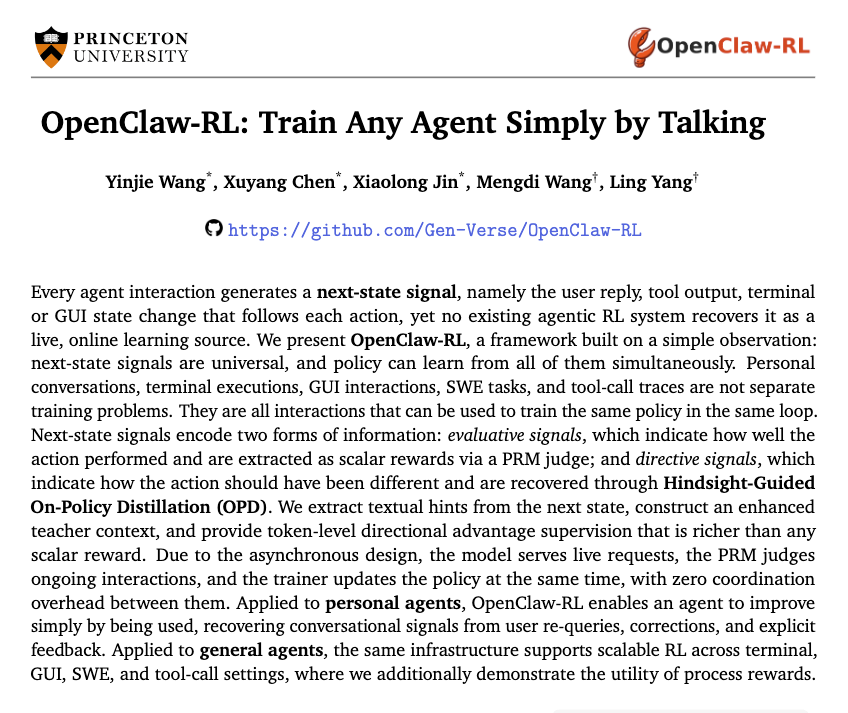
    This is really cool. It got me thinking more deeply about personalized RL: what’s the real point of personalizing a model in a world where base models can become obsolete so quickly? The reality in AI is that new models ship every few weeks, each better than the last. And the pace is only accelerating, as we see on the Hugging Face Hub. We are not far away from better base models dropping daily. There’s a research gap in RL here that almost no one is working on. Most LLM personalization research assumes a fixed base model, but very few ask what happens to that personalization when you swap the base model. Think about going from Llama 3 to Llama 4. All the tuned preferences, reward signals, and LoRAs are suddenly tied to yesterday’s model. As a user or a team, you don’t want to reteach every new model your preferences. But you also don’t want to be stuck on an older one just because it knows you. We could call this "RL model transferability": how can an RL trace, a reward signal, or a preference representation trained on model N be distilled, stored, and automatically reapplied to model N+1 without too much user involvement? We solved that in SFT where a training dataset can be stored and reused to train a future model. We also tackled a version of that in RLHF phases somehow but it remain unclear more generally when using RL deployed in the real world. There are some related threads (RLTR for transferable reasoning traces, P-RLHF and PREMIUM for model-agnostic user representations, HCP for portable preference protocols) but the full loop seems under-studied to me. Some of these questions are about off-policy but other are about capabilities versus personalization: which of the old customizations/fixes does the new model already handle out of the box, and which ones are actually user/team-specific to ever be solved by default? That you would store in a skill for now but that RL allow to extend beyond the written guidance level. I have surely missed some work so please post any good work you’ve seen on this topic in the comments. Ronak Malde (@rronak_) This paper is almost too good that I didn't want to share it Ignore the OpenClaw clickbait, OPD + RL on real agentic tasks with significant results is very exciting, and moves us away from needing verifiable rewards Authors: @YinjieW2024 Xuyang Chen, Xialong Jin, @MengdiWang10 @LingYang_PU — https://nitter.net/rronak_/status/2034158978733904160#m

    → View original post on X — @thom_wolf, 2026-03-19 15:01 UTC

  • Node Agent: AI-Powered Creative Workflow Builder
    Node Agent: AI-Powered Creative Workflow Builder

    introducing Node Agent. describe what you want, and watch our agent build and refine creative workflows to make it happen. completely free for Pro, Max, and Business in krea . ai / nodes

    → View original post on X — @krea_ai

  • DataRobot Open Source Projects and AI Toolchain Insights

    Full writeup coming soon on the @DataRobot blog. Our toolchain, what's compounding, what we'd do differently and what we're looking forward to. In the meantime, check out some of our open-sourced projects! https://
    github.com/datarobot-oss

    → View original post on X — @datarobot

  • AI tooling feedback loops accelerate product development cycles

    We're doing something meta here too – building AI tooling with AI tooling creates a tight feedback loop. When engineers hit friction with our own platform, they're also the ones who can fix it. We can ship product improvement in days, not quarters. We're not building this in

    → View original post on X — @datarobot

  • AI-Powered Development: Claude and Cursor in Production Engineering

    Day-to-day: @claudeai Code for the heavy lifting, @cursor_ai IDE are popular, and yes — we dogfood. Not just using AI to write. Using it to ship improvements to our SDK, review PRs, build our own skills and help new engineers find their footing in a large codebase.

    → View original post on X — @datarobot

  • DGX Spark vs RTX PRO 6000 Memory Bandwidth: Why Tool Choice Matters

    DGX Spark uses unified memory > 273 GB/s RTX PRO 6000 delivers > 1.8 TB/s (1792 GB/s) If someone told you they’re comparable, they’re wrong And this is exactly why llama.cpp isn’t the right tool here Try vLLM or SGLang on a GPU and you’ll see very different results

    → View original post on X — @theahmadosman

  • Google testing new ‘Build with Gemini’ and Skills features
    Google testing new ‘Build with Gemini’ and Skills features

    BREAKING : Google is working on a new "Build with Gemini" feature for Gemini Business, as well as on Skills support. Skills implementation has been spotted in the consumer version as well. "Architect, prototype, and refine enterprise-grade applications in minutes."

    → View original post on X — @testingcatalog

  • Create Matrix-Style Animations with Replit’s Video Stack Tutorial

    What if you could create an animation straight out of the Matrix? In this tutorial, I build a galloping ASCII horse with digital rain using Replit’s Stack. Try it yourself and start creating animations directly in your Replit project.

    → View original post on X — @replit

  • TDK SensEI Automates Industrial Problem Detection and Resolution

    Detecting a problem is step one. Knowing how to fix it without waiting for a technician to research it is step two. Bob Roth at AWS re: Invent explained how TDK SensEI automates both. Partner Content with TDK SensEI. #tdk_iiot

    → View original post on X — @fogoros

  • Qwen3-TTS powers open-source Voicebox clone

    With Voicebox, @ElevenLabs just lost its moat. → Powered by Alibaba's Qwen3-TTS for near-perfect cloning
    → Ships with a DAW-like "Stories Editor"
    → No cloud, runs locally on your machine 100% Open Source. 100% Local. Link to repo in ↓

    → View original post on X — @datachaz