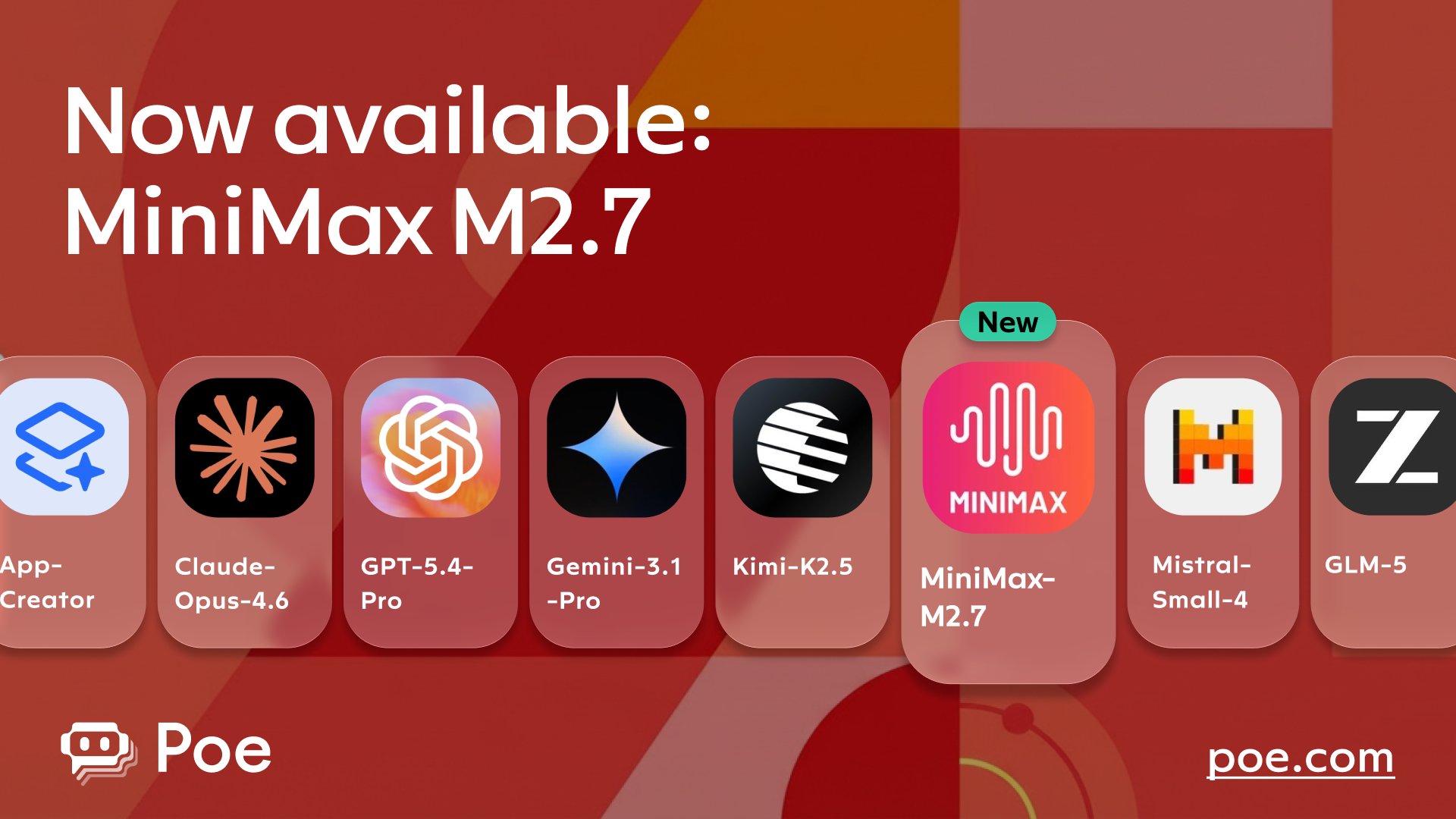
MiniMax-M2.7 is live on Poe! A next‑gen self‑evolving model built for autonomous software engineering and agent workflows. M2.7 can iteratively improve its own agent scaffolds, optimize task performance over repeated runs, and deliver major gains on real-world coding benchmarks
TOOLS
-
MSBuild 2026 Speakers Announced for June in San Francisco
By
–
We have some sweeet speakers at #MSBuild in SF this year, June 2-3: @chipro: author of my fav AI eng book @simonw: author of my fav blog @swyx: creator of AI engineer confs @steipete: creator of OpenClaw michael chiang: co-founder at @ollama + even more aka.ms/build26
-
Introducing GLM 5 Turbo for Research Paper Analysis
By
–
Introducing GLM 5 Turbo for understanding research papers 🚀
— alphaXiv (@askalphaxiv) 19 mars 2026
Highlight any section of a paper to ask questions and “@” other papers for quick context, comparisons, and benchmark references pic.twitter.com/WKPGQP3ExMIntroducing GLM 5 Turbo for understanding research papers Highlight any section of a paper to ask questions and “@” other papers for quick context, comparisons, and benchmark references
-
Share Files via Tailscale Directly from macOS Finder
By
–
if you use tailscale, right click file in finder, share, tailscale, pick the device
-
Self-Orchestrating AI Agents: The Next Major Breakthrough in LLM Performance
By
–
It’s happening: nitter.net/nousresearch/status/20… Matt Shumer (@mattshumer_) Agents that natively self-orchestrate, managing their own context, tools, and sub-agents, are the next big unlock in LLM performance. Right now, a skilled engineer building an optimized harness, with thoughtful data flow, separation of concerns, sub-agent management, etc., can make dramatic improvements over baseline for specific tasks. If a model could do this itself, that’d be a major step forward. You give it an objective and a set of tools, and it figures out the optimal way to orchestrate itself to do the task. For example, I’m building a very primitive AI scientist that I’ll open-source soon. Most of the work isn’t in the prompt, it’s in the harness… what the orchestrator sees, what sub‑agents see, what gets shared between them and when, where we summarize vs. pass raw data, and which tools each agent controls. Doing this allows me to dramatically improve what the model can do on its own. If a model can effectively design its own harness for a given problem, it’d be a huge step forward. My bet: self-orchestrating models… ones that manage their own context, tools, and sub-agents, will move the frontier almost as much as the jump from chatbot → reasoning did. Maybe more. — https://nitter.net/mattshumer_/status/1991942387145322715#m
→ View original post on X — @mattshumer_, 2026-03-19 21:48 UTC
-
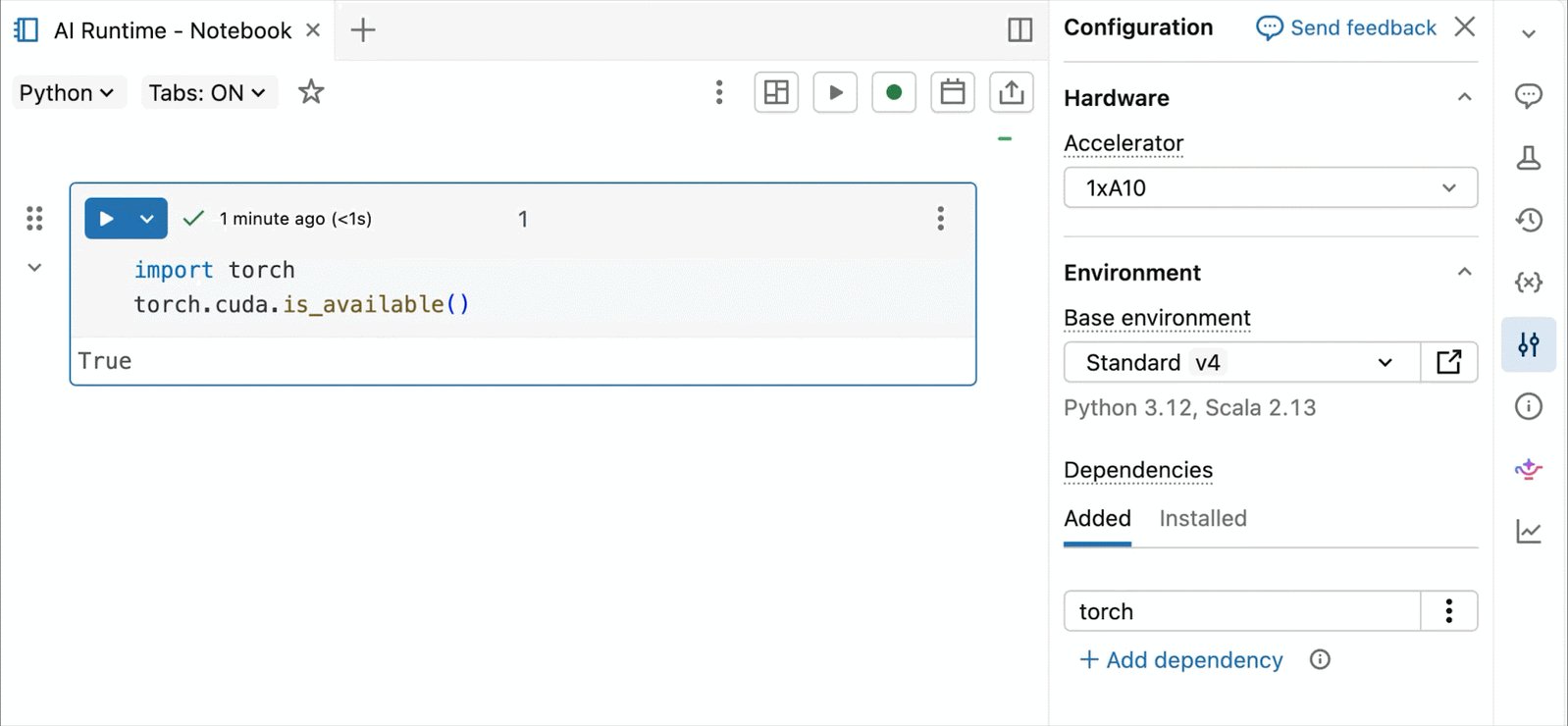
NVIDIA Launches AI Runtime with A10 H100 GPUs on Databricks
By
–
Today at #NVIDIAGTC, we’re introducing AI Runtime, with serverless NVIDIA A10 and H100 GPUs now available on Databricks for training and fine-tuning.
— Databricks (@databricks) 19 mars 2026
GPU infrastructure has been one of the biggest blockers for teams building advanced AI, from long procurement cycles to complex… pic.twitter.com/dWouC8G76vToday at #NVIDIAGTC, we’re introducing AI Runtime, with serverless NVIDIA A10 and H100 GPUs now available on Databricks for training and fine-tuning. GPU infrastructure has been one of the biggest blockers for teams building advanced AI, from long procurement cycles to complex
-
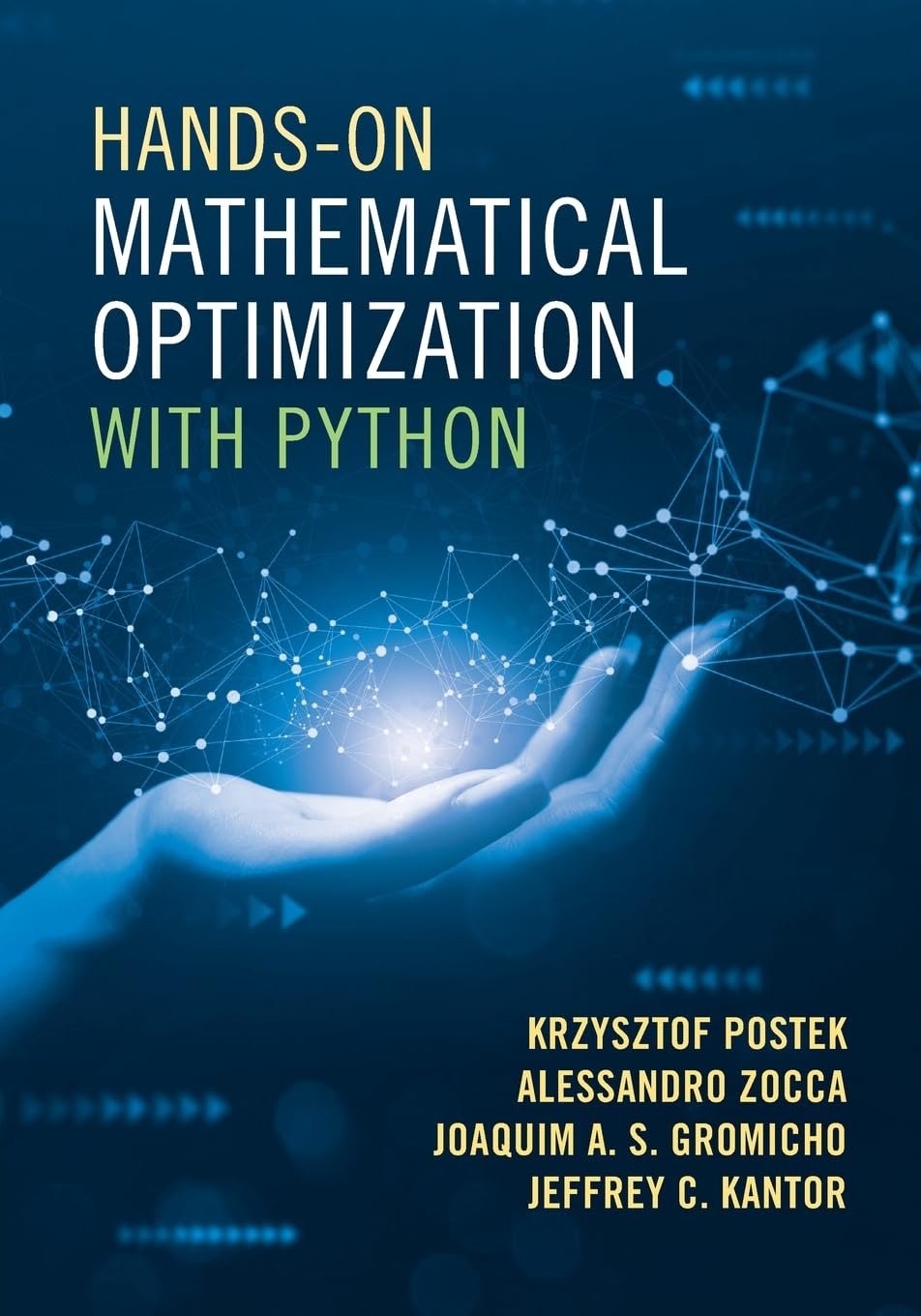
Hands-On Mathematical Optimization with Python: Key Ingredients and Modeling Choices
By
–
Hands-On Mathematical Optimization with Python: https://
amzn.to/4b3VADe “…presents the key ingredients of an optimization problem and the choices one needs to make when modeling a real-life problem mathematically. Topics covered range from linear and network optimization to -
Async vibe-coding with AI agents builds apps
By
–
Now I can literally stack prompts in @Anything, step outside to touch grass, and come back to a fully built app ☕
— Charly Wargnier (@DataChaz) 19 mars 2026
Shall we coin it async vibe-coding? 👀pic.twitter.com/EcLpC3CLWs https://t.co/KwoEEI9qi5Now I can literally stack prompts in @Anything
, step outside to touch grass, and come back to a fully built app Shall we coin it async vibe-coding? -
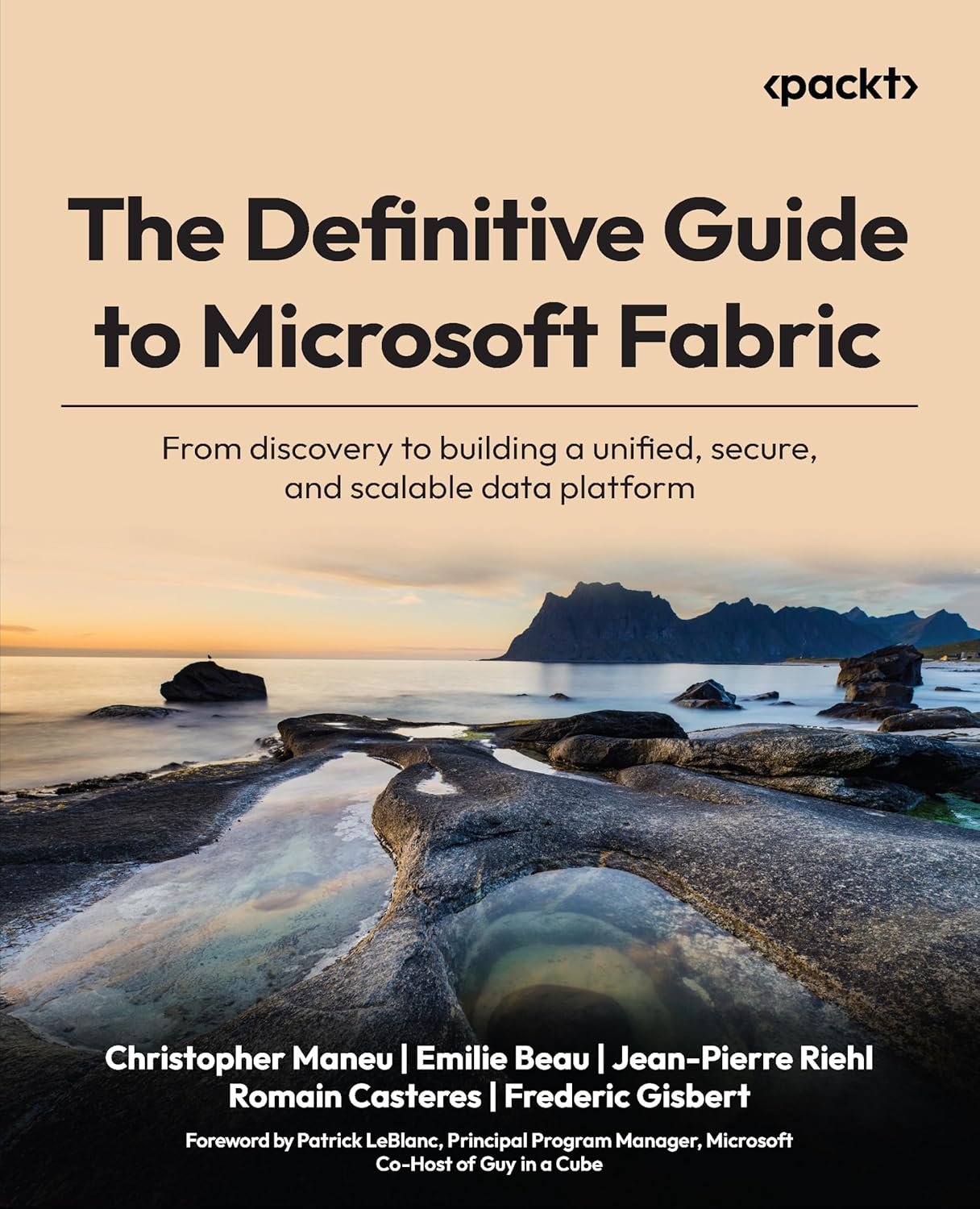
Microsoft Fabric Guide: Discovery to Unified Data Platform
By
–
The Definitive Guide to Microsoft Fabric — From discovery to building a unified, secure, and scalable data platform: http://
amzn.to/3MdE1Xk v/ @PacktDataML Table of Contents: Getting started with Fabric From Lakehouse to First Analysis Unifying Data in OneLake