AI Dynamics

Global AI News Aggregator

About

TOOLS

  • Computer-Aided Engineering: Simulating Product Performance

    What Is computer-aided engineering? 🤔 Computer-aided engineering (CAE) is the use of software to simulate and analyze how products will perform in real-world conditions Read how this helps engineers test, optimize, and validate designs before building them. 👉 nvda.ws/4td8zbK

    → View original post on X — @nvidiaai, 2026-03-30 22:40 UTC

  • Development of AI Tooling and MCP Server Integrations

    good question, I started by contributing tooling around http://
    developers.openai.com with llms.txt support and then added the Docs MCP server Supported myriad of model launches from OpenResponses, GPT 5.3 Codex, Spark, GPT 5.4 Along with Codex App and features like Skills, Sub

    → View original post on X — @reach_vb

  • Agent 4 rethinks building experience with improved canvas and real-time collaboration

    Agent 4 didn't replace what worked. It rethought it. The building experience is fundamentally better.
    The Design Canvas now works across every artifact type.
    Collaboration happens in real time—no forking required.
    And planning no longer pauses your build.

    → View original post on X — @replit

  • AI Coding Capabilities Improving: Developer Skepticism Addressed
    AI Coding Capabilities Improving: Developer Skepticism Addressed

    This is an insane Anthropic tweet. And it’s a *buried reply* to one of their other tweets. I am reminded of a talk I gave ~2-3 months ago where a senior developer at a Fortune 500 company asked me “why would I use AI to code if I can just code myself.” I answered. He said, “But sometimes it messes up.” I told him this was coming. Even if it’s not perfect today (it makes weird product features decisions sometimes, not gonna lie), the scaling laws seem to be holding up this year and the next iteration will be even more capable. I wish I could send him this tweet.

    → View original post on X — @alliekmiller, 2026-03-30 21:26 UTC

  • Natural Language Agent Harnesses: From Code to AI-Defined Control Logic
    Natural Language Agent Harnesses: From Code to AI-Defined Control Logic

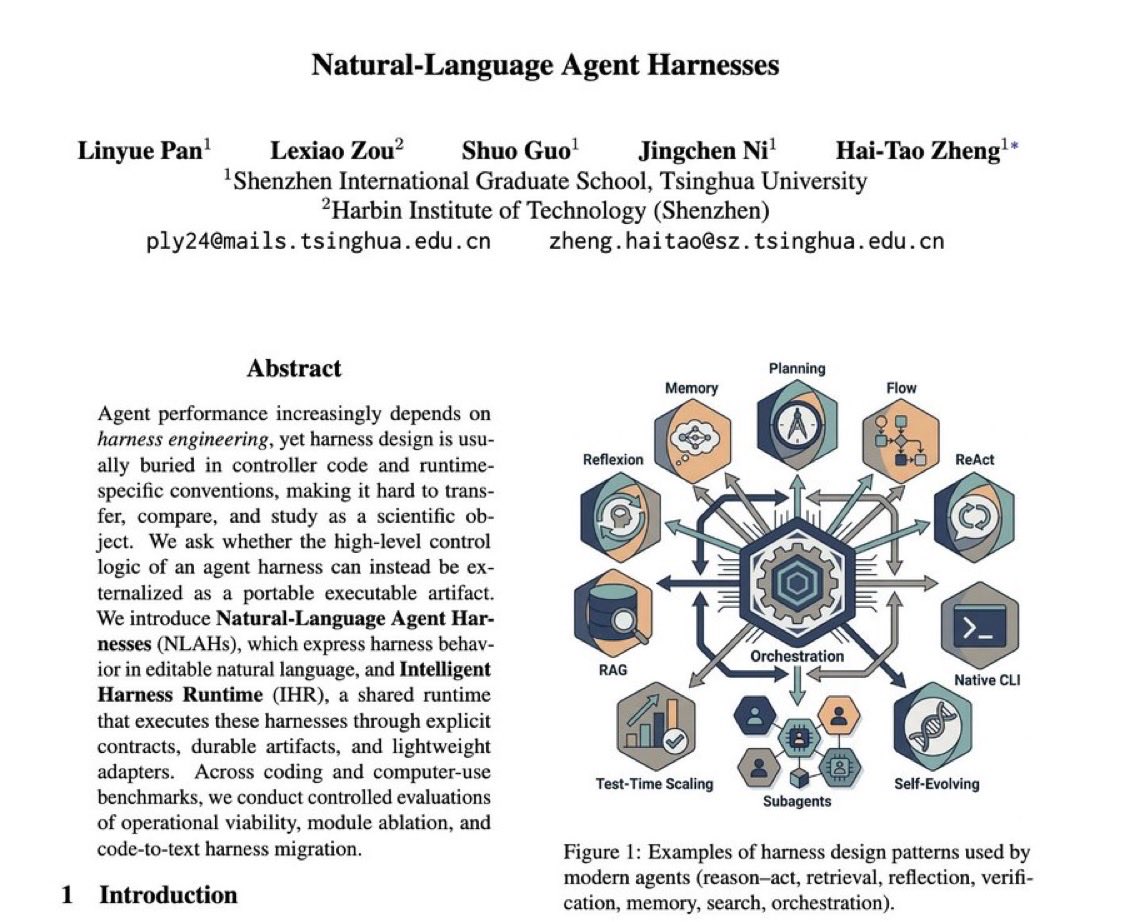
    We’re trying to build intelligent systems… using control frameworks designed by humans. That’s the core limitation of today’s agent harnesses. A new paper from Tsinghua University and Shenzhen proposes something radically different: 👉 What if the harness itself is not code—but natural language? Instead of hardcoding orchestration logic, they introduce Natural-Language Agent Harnesses (NLAH): – The control logic is written as an editable natural language SOP – The LLM interprets and executes that SOP dynamically – A shared runtime enforces structure via contracts, artifacts, and adapters Even more interesting: ➡️ The SOP itself can be generated and adapted by AI depending on the task So instead of: > Humans define → Agents execute We get: > AI defines → AI executes → AI evolves 🧠 Technical takeaway This shifts agent design from: – Static orchestration graphs – Hardcoded tool pipelines – Rigid planner-executor loops To: – Executable natural language control logic – Runtime-interpreted orchestration – Portable, composable harness artifacts The harness is no longer buried in code—it becomes a first-class abstraction. 🏗️ Architecture implications – Decouple control logic from implementation – Treat orchestration as data, not code – Use LLMs as meta-execution engines – Design systems that scale with tokens, not constraints 💡 Bigger question If agents can define and execute their own control logic… What else in AI system design should stop being code—and start being language? 📄 Paper: arxiv.org/abs/2603.25723 🔗 Follow my communities and personal initiatives: • Amazing AI, Data, Quantum Computing & Emerging Technologies — drdebashisdutta.com/ • Research & Innovation – Quantum, AI & Advanced Systems — researchedge.org

    → View original post on X — @debashis_dutta, 2026-03-30 21:25 UTC

  • OpenClaw: The Next AI Breakthrough Beyond ChatGPT?

    🦞👀👏🏾 Could OpenClaw be the next ChatGPT? In an interview with Jim Cramer, Jensen Huang says OpenClaw could unlock a whole new wave of AI. ➡️ Not just chat. ➡️ AI that acts. We’ve moved from: Search ➝ Generate ➝ Execute It’s a big shift and I am here for it. 💬 What’s your take, real breakthrough or overhyped? 📊 source: madmoneyoncbc | IG 📌 Tags: #AI #NVIDIA #ChatGPT #Tech #OpenClaw #TechNews #Innovation #GenAI #FutureOfWork #ArtificialIntelligence #Technology #MachineLearning #Startups

    → View original post on X — @catherineadenle, 2026-03-30 21:19 UTC

  • Abacus CoWork Launches Multi-Model AI for Laptops

    🚨 BREAKING NEWS – Abacus CoWork brings Claude, GPT 5.4 And Gemini To Your Laptop! Super excited to announce our MULTI-MODEL CoWork product! – combine the coding power of Opus with the reasoning prowess of GPT 5.4 – optimized for efficiency using "low effort" mode – computer use to tes – packaged for FREE with ChatLLM and Abacus AI's Deep Agent Get complex tasks done right on your laptop

    → View original post on X — @abacusai, 2026-03-30 20:58 UTC

  • GRASP: New Gradient-Based World Model Planner Released
    GRASP: New Gradient-Based World Model Planner Released

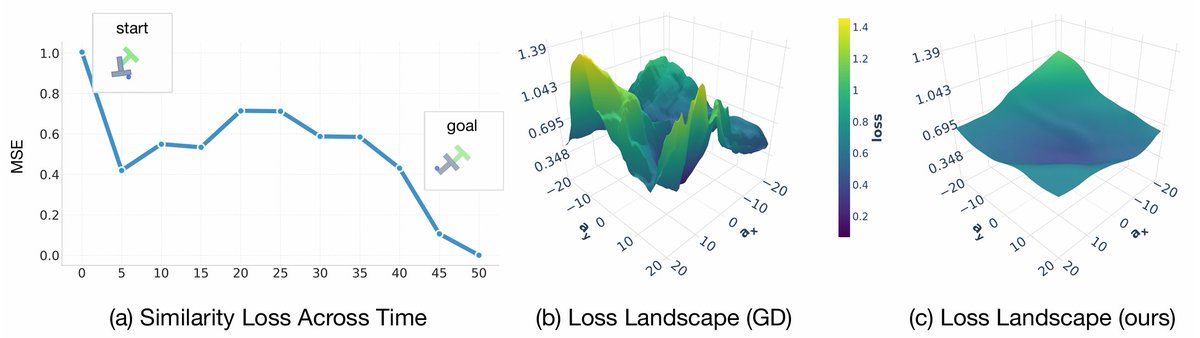
    Code for our new world model planner is live! github.com/michael-psenka/gr… Includes our implementation on dino-wm, as well as implementations on jepa-wm and le-wm, and minimal pseudocode for anyone to re-implement themselves. Michael Psenka (@michaelpsenka) tl;dr New planner for world models! GRASP: gradient-based, stochastic, parallelized. Long range planning for world models has always been an issue. 0th order methods like CEM/MPPI dominate, but have degrading performance at longer contexts or higher-dimensional actions. We wanted to address this from the ground up. w/ Michael Rabbat, @ask1729 , @ylecun*, @_amirbar* (equally advised) — https://nitter.net/michaelpsenka/status/2019870377032503595#m

    → View original post on X — @berkeley_ai, 2026-03-30 20:44 UTC

  • The rise of vibe coding in AI-driven development

    and all is vibe coded, it's incredible… and computers can't do the coffee for dev

    → View original post on X — @jessyseonoob

  • Experimenting with local models and AI coding agents

    This sounds right to me – I've tinkered with running local models against Claude Code and Codex and been disappointed, but I've not put the work in yet to try and find the right harness+model combination given how many tiny details might produce disappointing results

    → View original post on X — @simonw