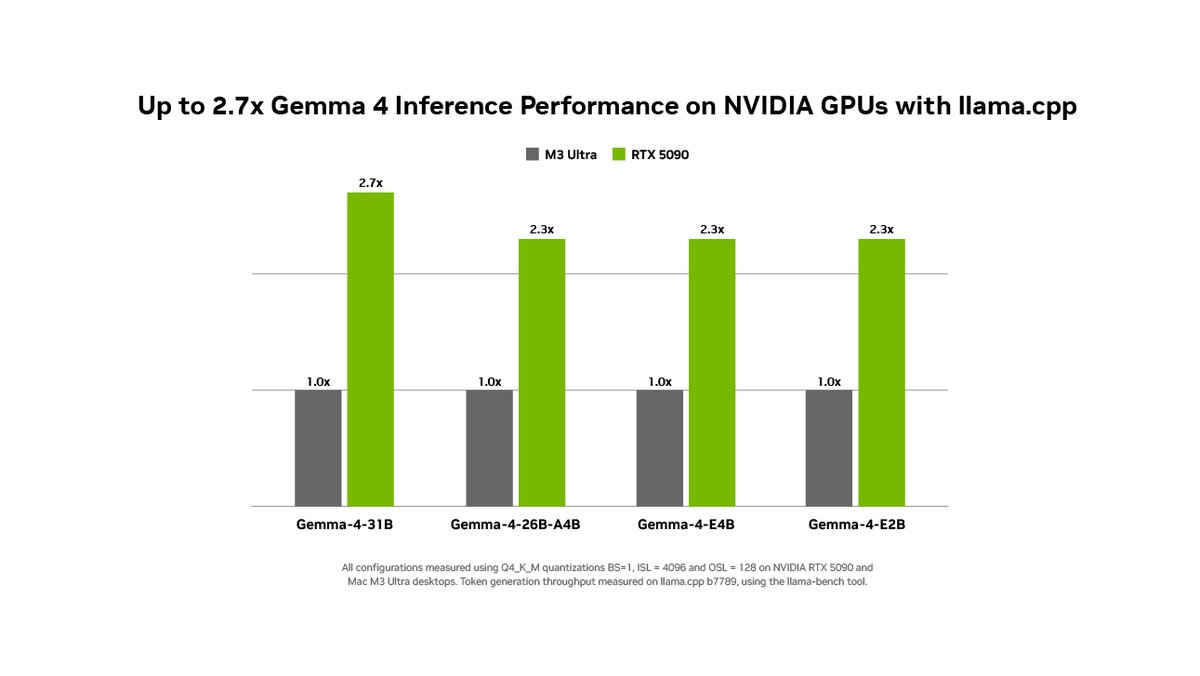
.@GoogleGemma 4 31B is up to 2.7X faster on RTX using llama.cpp. Thanks to @ggerganov for working with us to make this model fast.
→ View original post on X — @huggingface, 2026-04-02 19:30 UTC
By
–
.@GoogleGemma 4 31B is up to 2.7X faster on RTX using llama.cpp. Thanks to @ggerganov for working with us to make this model fast.
→ View original post on X — @huggingface, 2026-04-02 19:30 UTC
By
–
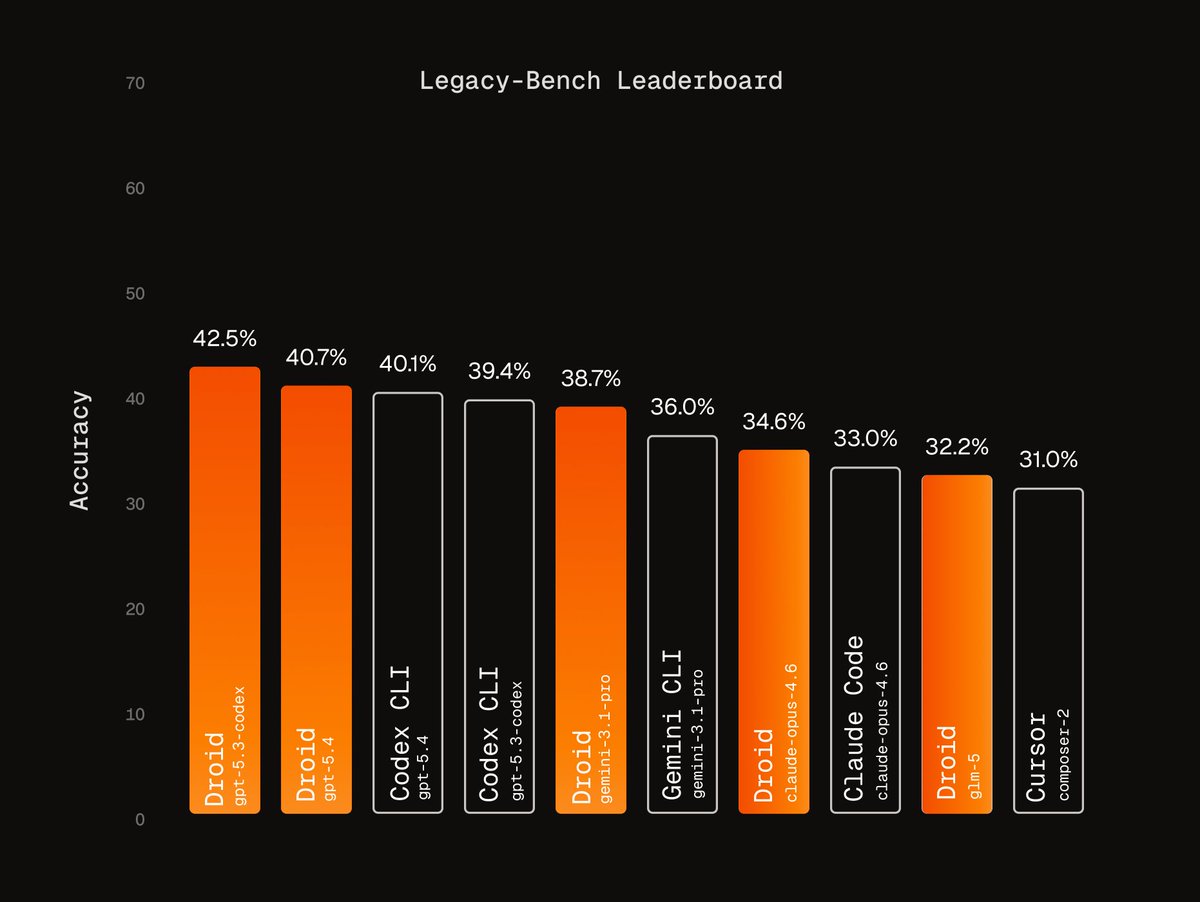
No major benchmark is designed for COBOL, Fortran, or Assembly – the languages powering trillions in transactions and infrastructure that must be modernized or risk catastrophic failure. We built Legacy-Bench to measure frontier agents on the code the world actually runs on.
→ View original post on X — @nathanlands, 2026-04-02 19:18 UTC
By
–
Cool use of llms.txt to provide an author-created AI-assisted reading experience for a book: spoileralert.wtf/llms.txt (LLMs can be *fantastic* for close reading.) Andrew Maynard (@2020science) I've been experimenting with translating my 2018 book Films from the Future into a website designed primarily for AIs. Here's how it went: futureofbeinghuman.com/p/spo… — https://nitter.net/2020science/status/2039711655706444192#m
→ View original post on X — @jeremyphoward, 2026-04-02 19:16 UTC
By
–
Actually I don't mind ollama (they'll probably have gemma 4 in a few days because the architecture is so similar to gemma 3 that it should be an easy port). I know I should consider other options, but somehow the performance is the same or better compared to custom compiled

By
–
You can run Gemma 4 100% locally in your browser thanks to HF transformers.js. That means 100% private and 100% free! @xenovacom created a demo for it here: https://
huggingface.co/spaces/webml-c
ommunity/Gemma-4-WebGPU
…
By
–
Really excited for this launch of Gemma 4 from @demishassabis and the DeepMind team. Open source models are a key front for the west to have a lead on and this is a very key addition to the effort. Excited to see what developers in SV and around the world can build using this. Demis Hassabis (@demishassabis) Excited to launch Gemma 4: the best open models in the world for their respective sizes. Available in 4 sizes that can be fine-tuned for your specific task: 31B dense for great raw performance, 26B MoE for low latency, and effective 2B & 4B for edge device use – happy building! — https://nitter.net/demishassabis/status/2039736628659269901#m
→ View original post on X — @demishassabis, 2026-04-02 19:07 UTC
By
–
Thank you to our season's sponsors: @WorkOS — Modern identity platform for B2B SaaS, free up to 1 million MAUs: https://
workos.com/lenny @TrustVanta — automate compliance, manage risk, and accelerate trust with AI: https://
vanta.com/lenny Also available on:
• Spotify:
By
–
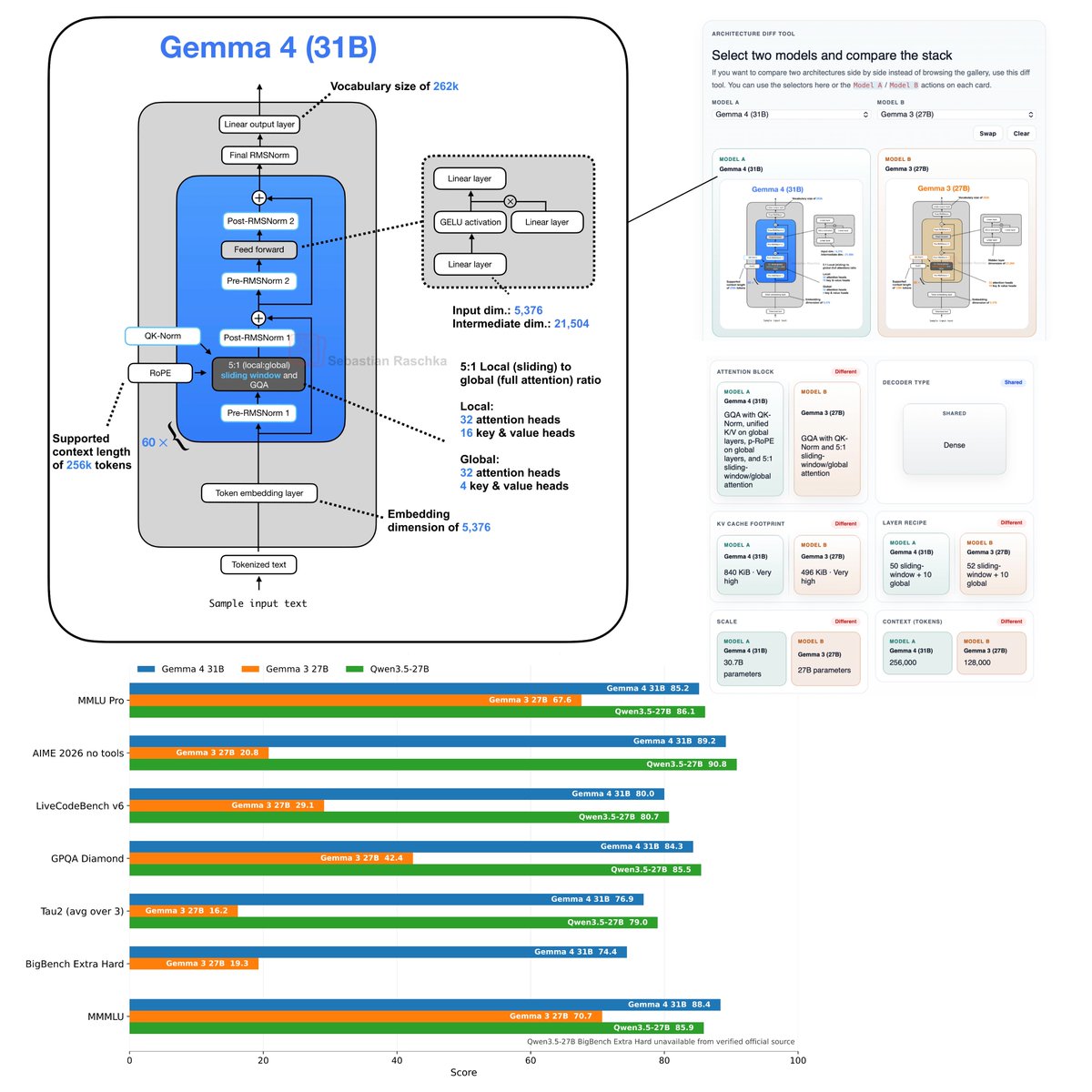
And the link to the gallery entry for more details, links, comparisons, etc: sebastianraschka.com/llm-arc…
By
–
Flagship open-weight release days are always exciting. Was just reading through the Gemma 4 reports, configs, and code, and here are my takeaways: Architecture-wise, besides multi-model support, Gemma 4 (31B) looks pretty much unchanged compared to Gemma 3 (27B). Gemma 4 maintains a relatively unique Pre- and Post-norm setup and remains relatively classic, with a 5:1 hybrid attention mechanism combining a sliding-window (local) layer and a full-attention (global) layer. The attention mechanism itself is also classic Grouped Query Attention (GQA). But let’s not be fooled by the lack of architectural changes. Looking at the benchmarks, Gemma 4 is a huge leap from Gemma 3. This is likely due to the training set and recipe. Interestingly, on the AI Arena Leaderboard, Gemma 4 (31B) ranks similarly to the much larger Qwen3.5-397B-A17B model. But as I discussed in my model evaluation article, arena scores are a bit problematic as they can be gamed and are biased towards human (style) preference. If we look at some other common benchmarks, which I plotted below, we can see that it’s indeed a very clear leap over Gemma 3 and ranks on par with Qwen3.5 27B. Note that there is also a Mixture-of-Experts (MoE) Gemma 4 variant that is slightly smaller (27B with 4 billion parameters active. The benchmarks are only slightly worse compared to Gemma 4 (31B). I omitted the MoE architecture in the figure below because the figure is already very crowded, but you can find it in my LLM Architecture Gallery. Anyways, overall, it's a nice and strong model release and a strong contender for local usage. Also, one aspect that should not be underrated is that (it seems) the model is now released with a standard Apache 2.0 open-source license, which has much friendlier usage terms than the custom Gemma 3 license.
By
–


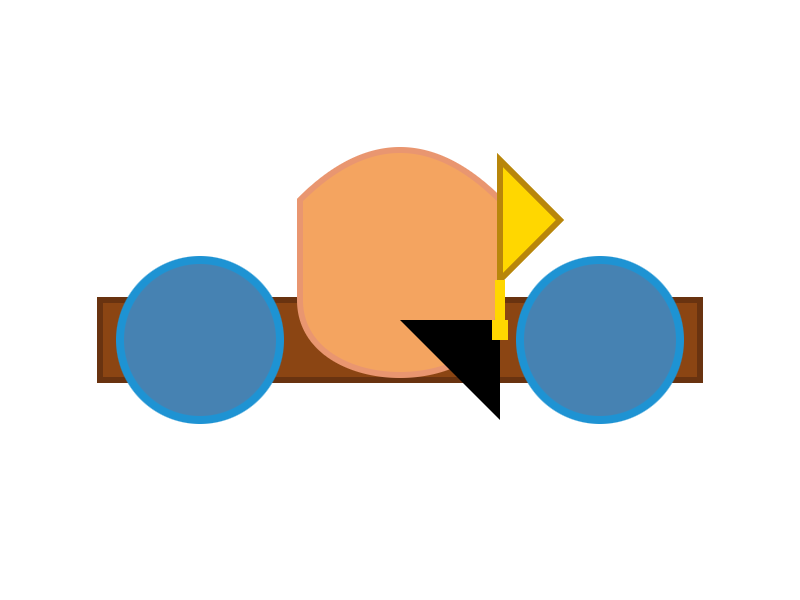
Pelicans for Gemma 4 E2B, E4B, 26B-A4B and 31B – the first three generated on my laptop via LM Studio, the 31B was broken on my laptop so I ran it via the Gemini API instead simonwillison.net/2026/Apr/2…