AI Dynamics

Global AI News Aggregator

About

TOOLS

  • Gemma 4 MLX Support: 125 Quantized Models Released for Mac Developers
    Gemma 4 MLX Support: 125 Quantized Models Released for Mac Developers

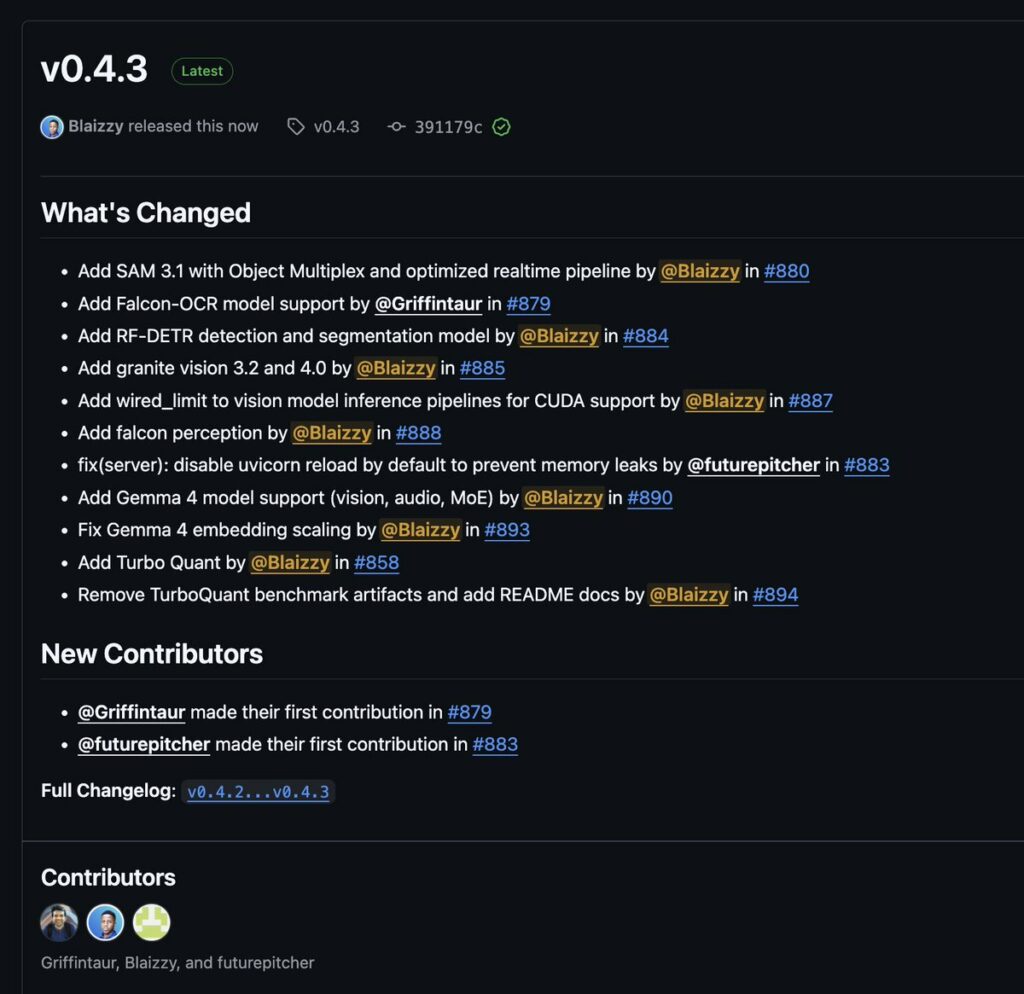
    This guy is BEYOND CRACKED. Gemma 4 already on MLX, bro has uploaded all models with quantization. 125 models uploaded in last few hours 🀯 New mlx-vlm repo also supports turbo-quant, and rf-detr too (among other things) If you are a mac dev, you better be jumping at this. Bookmark him, turn his notifications on, sponsor his work. Prince Canuma (@Prince_Canuma) mlx-vlm v0.4.3 is here πŸš€ Day-0 support: πŸ”₯ Gemma 4 (vision, audio, MoE) by @GoogleDeepMind πŸ¦… Falcon-OCR + Falcon Perception by @TIIuae πŸͺ¨ Granite Vision 4.0 by @IBMResearch New models: 🎯 SAM 3.1 with Object Multiplex by @facebook πŸ” RF-DETR detection & segmentation by @roboflow Infra: ⚑ TurboQuant (KV cache compression) πŸ–₯️ CUDA support for vision models (Sam and RF-DETR) Get started today: > uv pip install -U mlx-vlm Leave us a star ⭐️ github.com/Blaizzy/mlx-vlm β€” https://nitter.net/Prince_Canuma/status/2039815307821199709#m

    β†’ View original post on X β€” @huggingface, 2026-04-02 21:44 UTC

  • Google Gemma 4 Release Cancels Evening Plans
    Google Gemma 4 Release Cancels Evening Plans

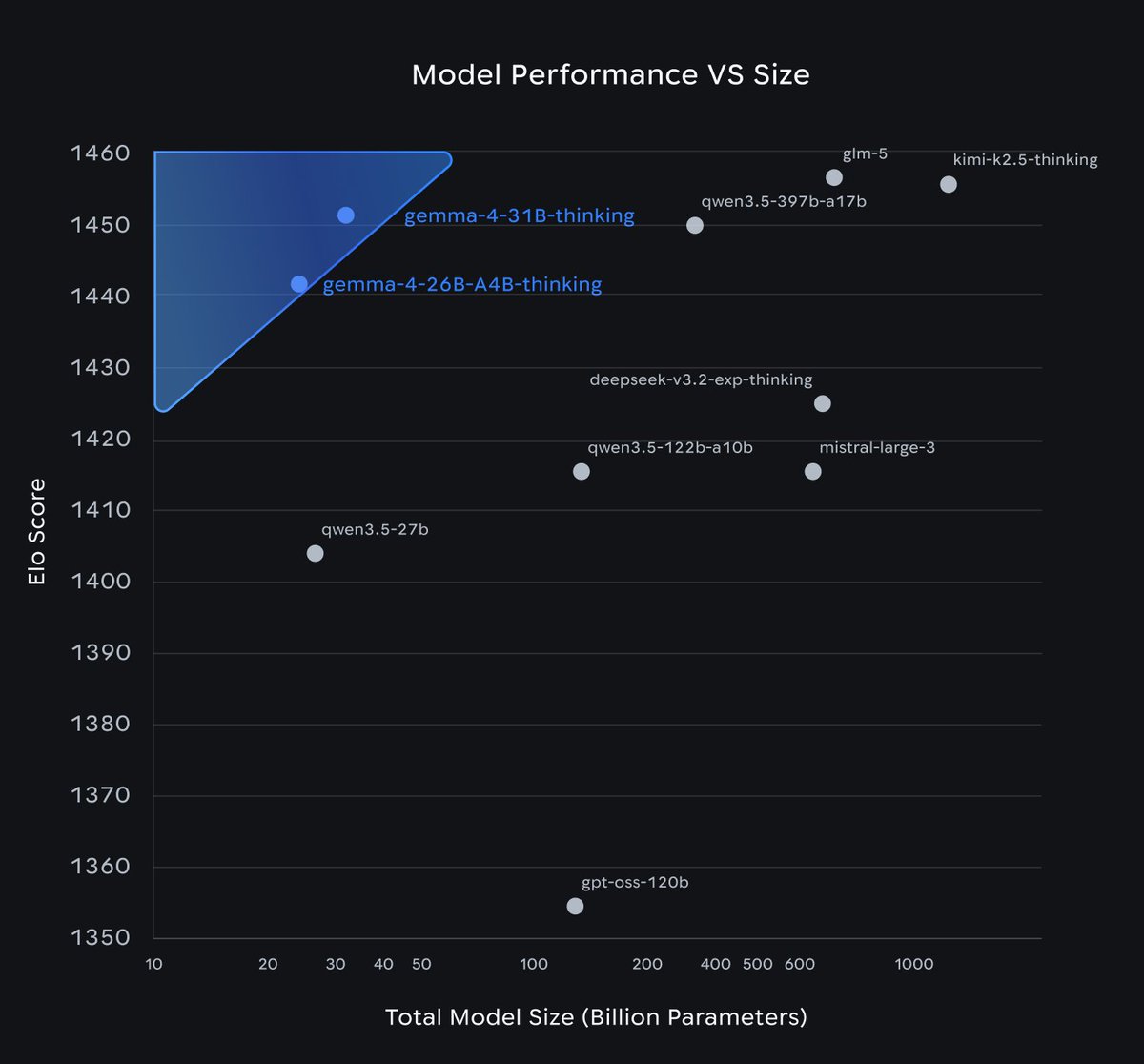
    Ok there goes my plans for this evening. Google Gemma (@googlegemma) Meet Gemma 4! Purpose-built for advanced reasoning and agentic workflows on the hardware you own, and released under an Apache 2.0 license. We listened to invaluable community feedback in developing these models. Here is what makes Gemma 4 our most capable open models yet: πŸ‘‡ β€” https://nitter.net/googlegemma/status/2039736504822763534#m

    β†’ View original post on X β€” @bobgourley, 2026-04-02 21:42 UTC

  • Pika Launches Real-Time Video Chat Feature

    thanks for supporting Pika's real time video chat!

    β†’ View original post on X β€” @pika_labs

  • LLM Discord Bot Compacts Conversations into Entity Dossiers

    I've been doing something similar with a Discord I'm in. The LLM reads chronologically and compacts by week, then compacts weeks to years, then years to full essays. It also keeps track of entities it encounters (people, projects, etc) and creates dossiers on them. All with

    β†’ View original post on X β€” @genekogan

  • MCP Server Development for AI Infrastructure

    Yeah, @blevlabs already had it build one MCP server for it. Don't know when I'll be able to get to this. But it is an interesting idea! On the list.

    β†’ View original post on X β€” @scobleizer

  • Trentclaw: Security Audit Tool for OpenClaw Gateway Setup

    clawhub install trentclaw audits your openclaw setup for gateway security, tool permissions, MCP servers, and chained attack paths. results grouped by severity with specific fixes. secrets never leave your machine. trent.ai/openclaw/

    β†’ View original post on X β€” @lawrennd, 2026-04-02 21:18 UTC

  • Poe Platform Now Supports OpenCode AI Coding Terminal

    Poe now supports @opencode An open-source AI coding terminal that pairs with all major models on Poe. One click login, instant access, no extra configuration. Start building now. https://
    poe.com/api/applicatio
    ns/OpenCode
    …

    β†’ View original post on X β€” @poe_platform

  • LLMs Excel at Curating and Searching Knowledge Bases

    I have also been obsessed with building LLM knowledge bases. Here is one example of the type of things you can do that Karpathy is alluding to: nitter.net/omarsar0/status/203396… LLMs are excellent at curating and searching (finding connections) once data is stored properly. Andrej Karpathy (@karpathy) LLM Knowledge Bases Something I'm finding very useful recently: using LLMs to build personal knowledge bases for various topics of research interest. In this way, a large fraction of my recent token throughput is going less into manipulating code, and more into manipulating knowledge (stored as markdown and images). The latest LLMs are quite good at it. So: Data ingest: I index source documents (articles, papers, repos, datasets, images, etc.) into a raw/ directory, then I use an LLM to incrementally "compile" a wiki, which is just a collection of .md files in a directory structure. The wiki includes summaries of all the data in raw/, backlinks, and then it categorizes data into concepts, writes articles for them, and links them all. To convert web articles into .md files I like to use the Obsidian Web Clipper extension, and then I also use a hotkey to download all the related images to local so that my LLM can easily reference them. IDE: I use Obsidian as the IDE "frontend" where I can view the raw data, the the compiled wiki, and the derived visualizations. Important to note that the LLM writes and maintains all of the data of the wiki, I rarely touch it directly. I've played with a few Obsidian plugins to render and view data in other ways (e.g. Marp for slides). Q&A: Where things get interesting is that once your wiki is big enough (e.g. mine on some recent research is ~100 articles and ~400K words), you can ask your LLM agent all kinds of complex questions against the wiki, and it will go off, research the answers, etc. I thought I had to reach for fancy RAG, but the LLM has been pretty good about auto-maintaining index files and brief summaries of all the documents and it reads all the important related data fairly easily at this ~small scale. Output: Instead of getting answers in text/terminal, I like to have it render markdown files for me, or slide shows (Marp format), or matplotlib images, all of which I then view again in Obsidian. You can imagine many other visual output formats depending on the query. Often, I end up "filing" the outputs back into the wiki to enhance it for further queries. So my own explorations and queries always "add up" in the knowledge base. Linting: I've run some LLM "health checks" over the wiki to e.g. find inconsistent data, impute missing data (with web searchers), find interesting connections for new article candidates, etc., to incrementally clean up the wiki and enhance its overall data integrity. The LLMs are quite good at suggesting further questions to ask and look into. Extra tools: I find myself developing additional tools to process the data, e.g. I vibe coded a small and naive search engine over the wiki, which I both use directly (in a web ui), but more often I want to hand it off to an LLM via CLI as a tool for larger queries. Further explorations: As the repo grows, the natural desire is to also think about synthetic data generation + finetuning to have your LLM "know" the data in its weights instead of just context windows. TLDR: raw data from a given number of sources is collected, then compiled by an LLM into a .md wiki, then operated on by various CLIs by the LLM to do Q&A and to incrementally enhance the wiki, and all of it viewable in Obsidian. You rarely ever write or edit the wiki manually, it's the domain of the LLM. I think there is room here for an incredible new product instead of a hacky collection of scripts. β€” https://nitter.net/karpathy/status/2039805659525644595#m

    β†’ View original post on X β€” @dair_ai, 2026-04-02 21:01 UTC

  • Developer Shares Workflow Using Replit Claude Code and Codex

    yeah, i love Replit for projects like this cuz i can open up the mobile app, prompt it, click publish and share the link all from a single app I also use Claude code and codex regularly for more complex stuff

    β†’ View original post on X β€” @yoheinakajima

  • Running LLMs Locally: LM Studio and Ollama Options

    Whoa! I'd missed that detail. Any idea how to run that locally? I'm not sure if LM Studio or Ollama can handle that yet

    β†’ View original post on X β€” @simonw