AI Dynamics

Global AI News Aggregator

About

TOOLS

  • Andrej Karpathy’s LLM Wiki: Persistent Memory vs Traditional RAG
    Andrej Karpathy’s LLM Wiki: Persistent Memory vs Traditional RAG

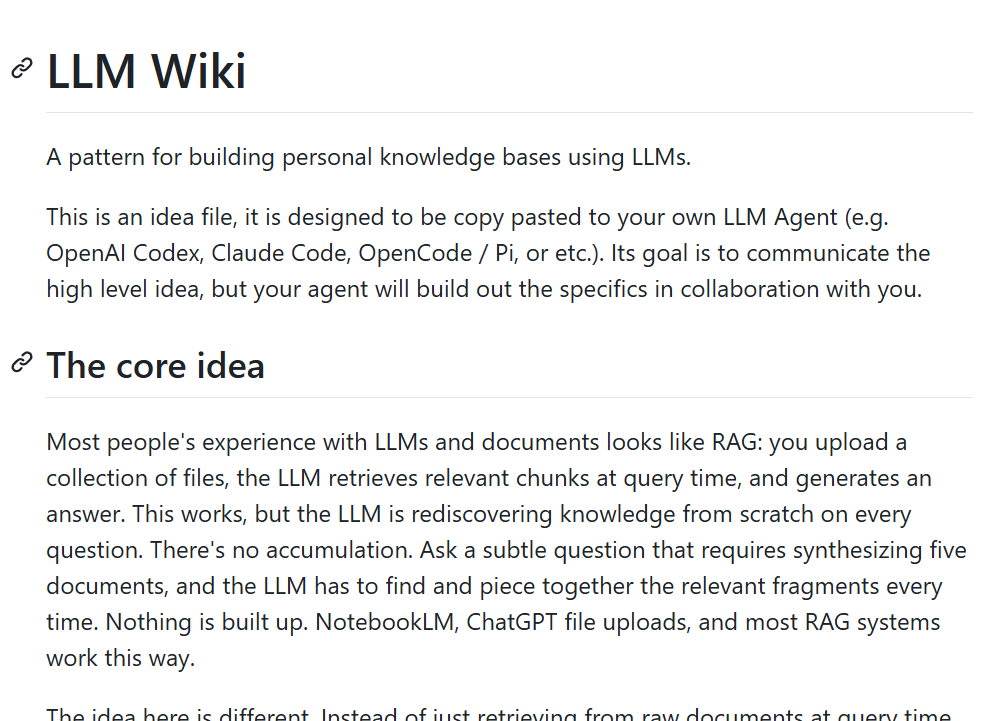
    🚨 Andrej Karpathy just dropped something that could replace a lot of RAG workflows. It's called LLM Wiki. The idea is simple: Most AI systems retrieve context from scratch every time you ask a question. LLM Wiki doesn't. It builds a persistent knowledge base that gets better every time you add a new source. So instead of: • search docs
    • pull fragments
    • answer
    • forget everything
    • repeat it does this: • ingest a source
    • extract the important ideas
    • update entity pages
    • revise topic summaries
    • connect related concepts
    • flag contradictions
    • keep compounding the knowledge over time That shift matters. RAG is great for retrieval. But a lot of people are really trying to build memory. Not just "find me the right chunk again."
    More like: "help me build an evolving model of this topic over time." That's what this is. Karpathy's examples are strong too: • personal knowledge
    • long-horizon research
    • books and topics
    • internal company knowledge
    • meeting transcripts
    • customer calls Basically, anything where the knowledge should accumulate, not reset every session. The best way to think about it: Obsidian is the IDE.
    The LLM is the programmer.
    The wiki is the codebase. You don't manually maintain the system. You feed it sources, ask questions, and the AI keeps the structure alive. That's a much bigger idea than "better RAG." 100% open source. [Translated from EN to English]

    → View original post on X — @scobleizer, 2026-04-06 15:06 UTC
  • Karpathy’s Second Brain Idea Just Killed RAG
    Karpathy’s Second Brain Idea Just Killed RAG

    Karpathy's Second Brain idea just killed RAG. LLMs can now turn papers, repos, and notes into a living wiki that keeps getting smarter. And people are already doing wild use cases with it. 10 examples: [Translated from EN to English]

    → View original post on X — @montreal_ai, 2026-04-06 15:03 UTC

  • Platform Launch: 72 Workflows Outpaces Typical Tool Offerings

    72 workflows on day one is not a small launch. Most tools ship with five and call it a platform.

    → View original post on X — @aihighlight

  • Morphic Workflows Eliminates Need for Complex AI Prompting

    Morphic just killed the "I don't know how to prompt" excuse for good. Select your assets, pick a workflow, and the output is already done before you finish your coffee. Jaynti Kanani (JD) (@jdkanani) Introducing Workflows on @morphic. You know what you want, you just don’t know how to prompt for it. That’s what Workflows solve. Storyboarding? Three clicks. UGC ads? No prompting. Color grade? In seconds. Try now: morphic.com/workflows Live with 72 workflows today. More coming soon. With Workflows, you can capture repeatable creative tasks and reuse them without starting from scratch. Just select your assets and options while running a workflow. Minimal prompts required. And no nodes, of course. There’s a workflow for everything: filmmaking, social media, animation, fashion, marketing, and some just to have fun. Tag someone who'd make something wild with this. Here are my 5 favorite workflows: — https://nitter.net/jdkanani/status/2041154028034490867#m

    → View original post on X — @aihighlight, 2026-04-06 14:59 UTC

  • Call out now part of pi’s documentation
    Call out now part of pi’s documentation

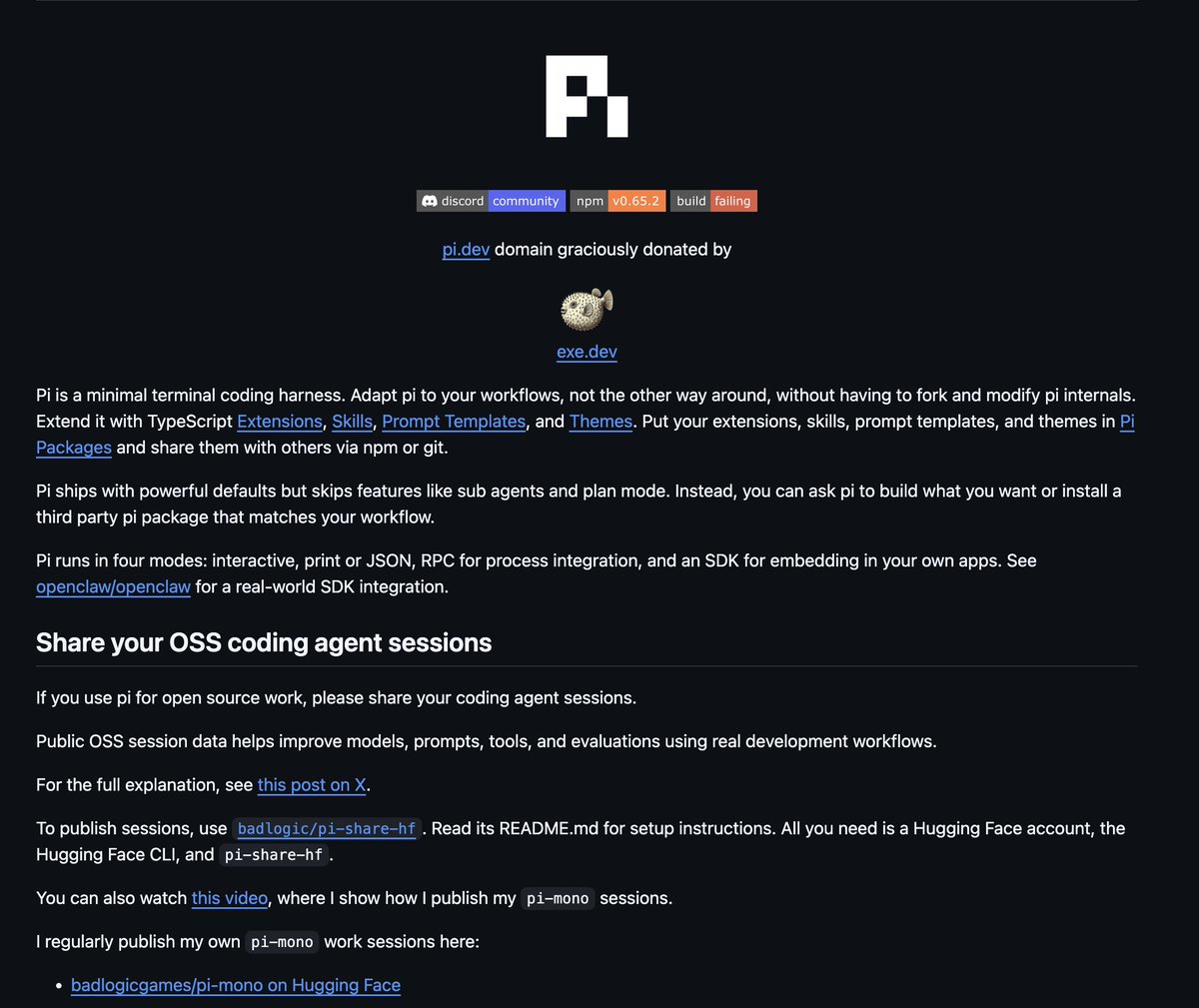
    Call out now also part of pi's docs. Just do it. Mario Zechner (@badlogicgames) People who like sharing agent traces. I've just published all my pi-mono coding agent sessions on @huggingface so you get to laugh at or pwn me! huggingface.co/datasets/badl… I suggest you do the same, see thread below. Let's make this a community effort. Here's pi-share-hf: github.com/badlogic/pi-share… If you are working on tools that help identify PII/sensitive data, get in touch. The better the classification is, the more willing people will be to share their traces. — https://nitter.net/badlogicgames/status/2041151967695634619#m

    → View original post on X — @clementdelangue, 2026-04-06 14:56 UTC

  • Morphic Workflows: Automated Video Creation from Single Image

    Holy sh*t. Dropping one image in and watching it automatically predict 9 scenes, upscale every frame, animate them, and stitch together a compiled video  🤯 @Morphic just dropped ‘Workflows’. You bring the image. It handles everything after.
 Following closely 👀 Jaynti Kanani (JD) (@jdkanani) Introducing Workflows on @morphic. You know what you want, you just don’t know how to prompt for it. That’s what Workflows solve. Storyboarding? Three clicks. UGC ads? No prompting. Color grade? In seconds. Try now: morphic.com/workflows Live with 72 workflows today. More coming soon. With Workflows, you can capture repeatable creative tasks and reuse them without starting from scratch. Just select your assets and options while running a workflow. Minimal prompts required. And no nodes, of course. There’s a workflow for everything: filmmaking, social media, animation, fashion, marketing, and some just to have fun. Tag someone who'd make something wild with this. Here are my 5 favorite workflows: — https://nitter.net/jdkanani/status/2041154028034490867#m

    → View original post on X — @datachaz, 2026-04-06 14:54 UTC

  • AI as AI Ops: Automate Your AI Workflows for Higher ROI
    AI as AI Ops: Automate Your AI Workflows for Higher ROI

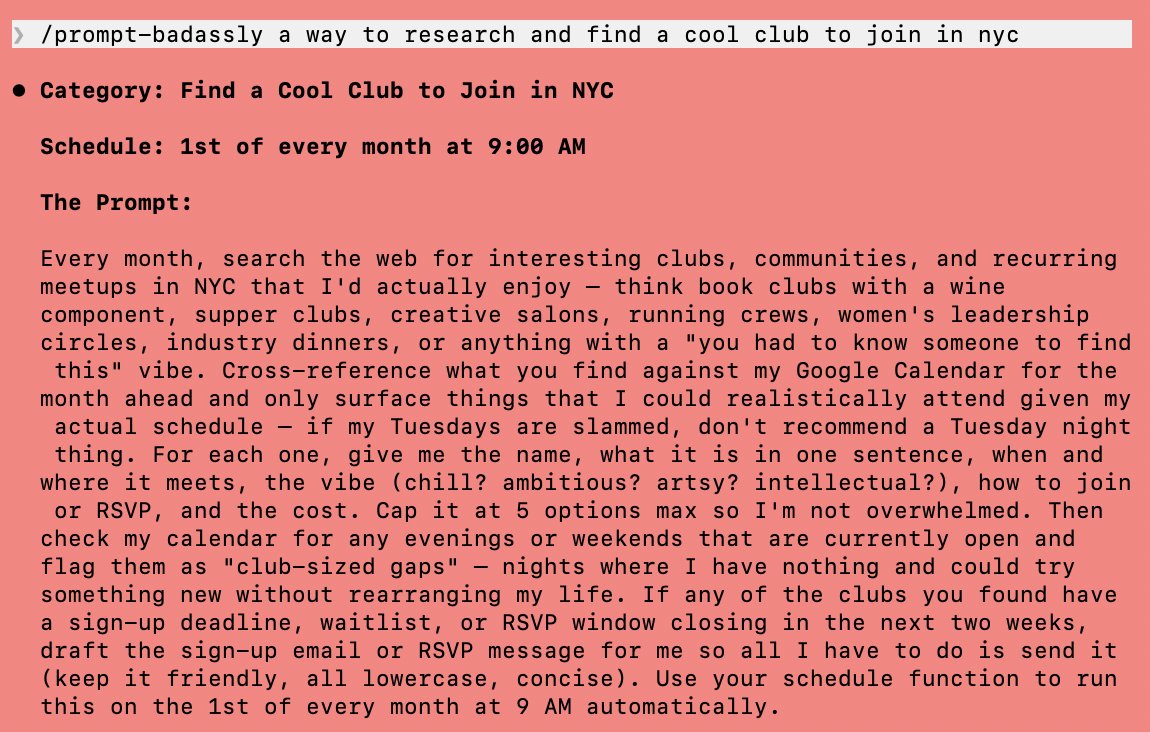
    AI is better than you at working with AI. It's better at generating prompts for AI, teaching skills to other AI agents, coordinating messaging between AIs. AI is an AI ops whisperer. Think like a PM: go through the journey you're taking right now with your AI workflows and find high ROI ways to use AI to help your AI efforts. Yes, you can prompt AI to create an app. But you can also… …and this is overkill and would waste a lot of tokens but I want to dramatize it because when costs plummet, we will see strange usage patterns… Prompt an AI with the idea, and then it creates a much better prompt (see images), and then it creates 4 different versions of that prompt, and then it spawns parallel agents to research the product space from 4 different points of view, and then they all meet in an agent team war room and battle it out, and then spec a product together while 5 other agents with 5 different goals in parallel spec it out themselves, and then 3 more agents review and critique the specs, then another reviews all previous work and summarizes, and another one tees up open questions, then 10 more with radically different personas meet to evolve the best idea and spawn 50 more versions, then you run a simulation by 10000 personas to vote for the product with the fastest time to market, highest delight, and strongest ROI potential. And then you create the app. What I'm saying is: find where you are the intermediary and shouldn't be, and find higher order ways to plug yourself in. Take yourself out of the loop before the loop takes you out.

    → View original post on X — @alliekmiller, 2026-04-06 14:38 UTC

  • OpenSeeker: AI-Native Search Beyond Keyword Matching

    OpenSeeker: Rethinking Search With AI-Native Reasoning In this episode of Artificial Intelligence: Papers and Concepts, we explore OpenSeeker, an emerging approach to building AI-native search systems that go beyond traditional keyword matching. Instead of retrieving links based purely on queries, OpenSeeker focuses on reasoning over information helping users get structured, context-aware answers rather than a list of results. We break down how modern search is evolving with large language models, why retrieval alone is no longer enough, and how systems like OpenSeeker combine retrieval with reasoning to deliver more accurate and useful outputs. If you’re interested in AI-powered search, retrieval-augmented generation, or the future of information discovery, this episode explains why OpenSeeker represents a shift toward more intelligent and answer-driven search experiences. Resources: Paper Link: arxiv.org/abs/2603.15594v1 Interested in Computer Vision and AI consulting and product development services? Email us at contact@bigvision.ai or visit us at bigvision.ai

    → View original post on X — @learnopencv, 2026-04-06 14:30 UTC

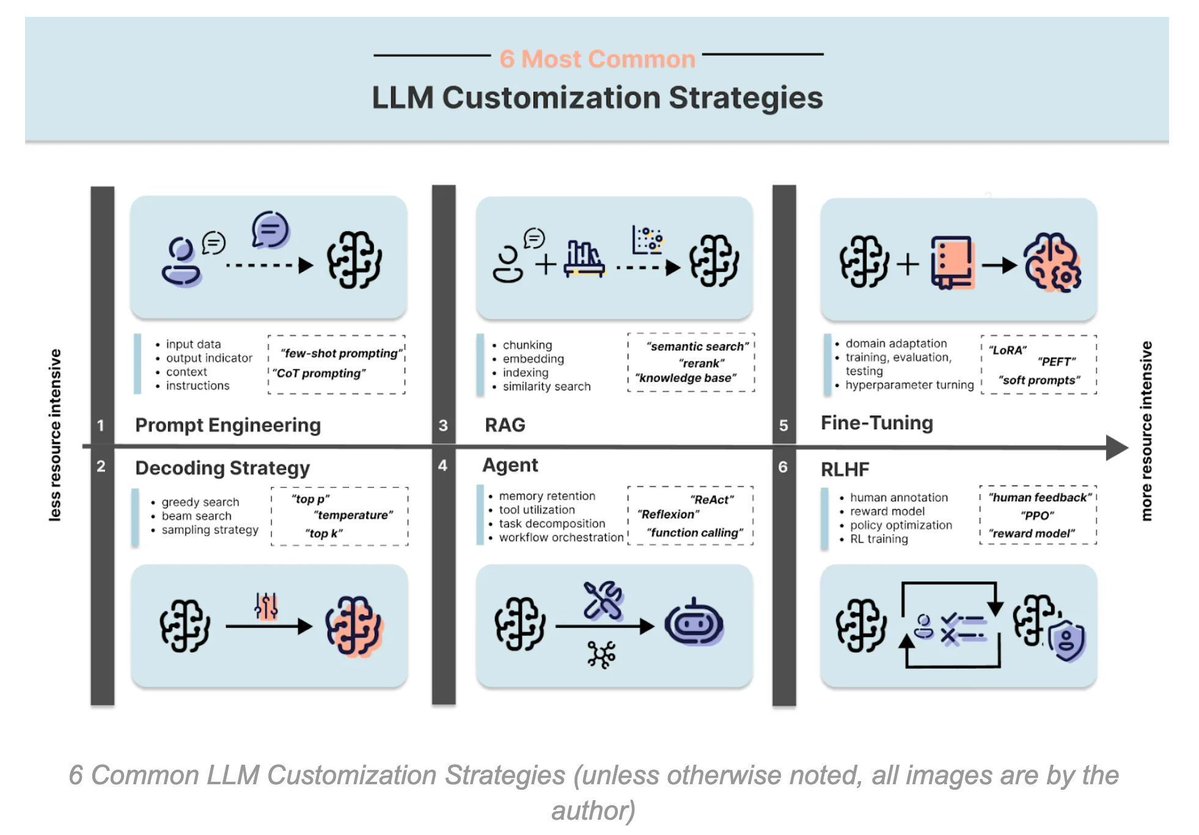
  • RAG, AI Agent, Fine-Tuning, and LLM Customization Strategy Explained
    RAG, AI Agent, Fine-Tuning, and LLM Customization Strategy Explained

    RAG, AI Agent, Fine-Tuning, LLM Customization Strategy Briefly Explained! #BigData #Analytics #DataScience #AI #MachineLearning #NLProc #LLM #IoT #IIoT #PyTorch #Python #RStats #TensorFlow #Java #JavaScript #ReactJS #GoLang #CloudComputing #Serverless #DataScientist #Linux #Programming #Coding #100DaysofCode geni.us/RAG-AI-Agent

    → View original post on X — @gp_pulipaka, 2026-04-06 14:26 UTC

  • Google Cloud Cookbook: Big Data Analytics and Machine Learning Guide
    Google Cloud Cookbook: Big Data Analytics and Machine Learning Guide

    Google Cloud Cookbook! #BigData #Analytics #DataScience #AI #MachineLearning #IoT #IIoT #PyTorch #Python #RStats #TensorFlow #Java #JavaScript #ReactJS #GoLang #CloudComputing #Serverless #DataScientist #Linux #Books #Programming #Coding #100DaysofCode geni.us/Google-Cloud-Cookboo…

    → View original post on X — @gp_pulipaka, 2026-04-06 14:26 UTC